
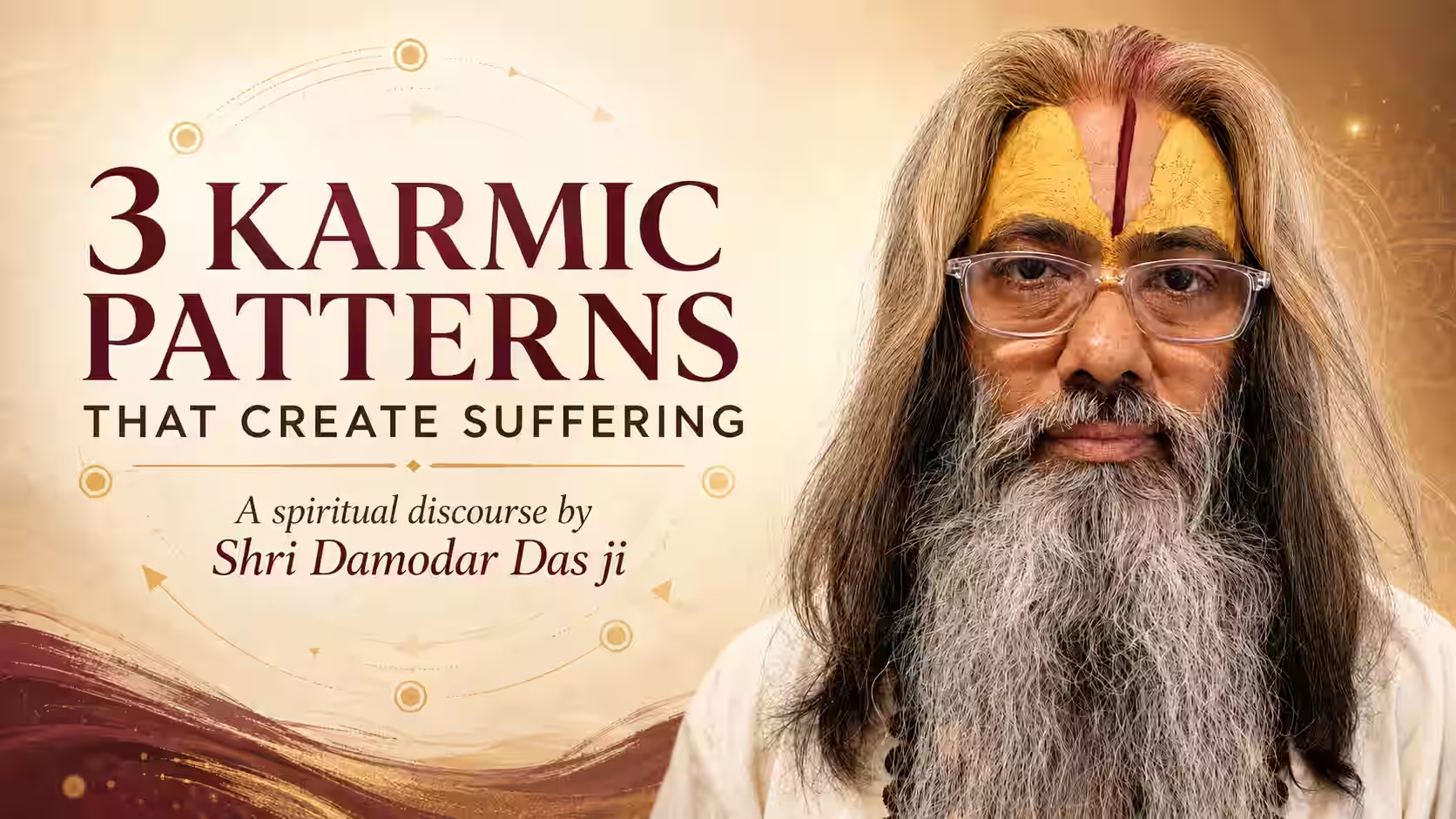
Difficulties often return in repeating patterns. This is because our mind is auto trained to look at outer circumstances through a very automated repeatable inner pattern
These patterns can appear through relationships, through other events and situations or through how we feel. Even though the situations seem different, the same thought, fear, the same expectation or the same reaction is usually underneath them.
Shri Damodar Das ji, in this spiritual discourse explains three prominent karmic patterns that quietly influence how we interpret life, relate to others, and create suffering within ourselves.
Before You Watch
Kindly listen with a quiet mind. You may comprehend these patterns not only in the behaviour of others, but also within your own responses to life.
We may recognize a karmic pattern when events or emotions continue to repeat over and over again in a person’s life. These repetitions soon become central themes of that individual’s inner journey.
Every karmic pattern carries a deeper message. When we are occupied with the immediate difficulty, we usually focus only on the pain or person involved. We may ask why the situation is happening, but we do not step back to understand what the situation is revealing about our own mind.
Hence the lesson remains unnoticed and the pattern continues.
This repetition is not necessarily a punishment. It can become a means through which life brings our attention to something that requires understanding. Through experience, struggle, sincere reflection, and appropriate guidance, the soul moves towards greater maturity.
The purpose of recognising a karmic pattern is therefore not to blame ourselves. It is to see more clearly.
In This Discourse
- The “Me and Mine” Pattern: seeing life through personal gain and loss
- The “Better Choice, Better Life” Pattern: believing that we can remain exempt from uncertainty
- The “I Know” Pattern: mistaking our perception for complete truth
1. The “Me and Mine” Pattern
Seeing Life Through Gain and Loss
The “Me and Mine” pattern is one of the strongest tendencies of the human mind. It exists, in some form, within almost everyone.
Before the mind understands an event in its proper perspective, it often asks:
“What do I gain from this?”
“What might I lose?”
Because of this habit, life becomes highly personal and subjective. Events are no longer seen simply as they are. They are first measured according to whether they bring us pleasure or pain, approval or rejection, advantage or disadvantage.
We find it difficult to remain a witness because we identify ourselves with every thought, person, emotion, and situation. This constant involvement keeps the mind tied to material life. It strengthens the feeling of “I” and “mine,” and in this way, the ego becomes more powerful and more visible.
When Another Person’s Success Feels Like Our Loss
Suppose a close friend receives an opportunity or achieves something that we had also hoped for.
Outwardly, we may congratulate the person. Inwardly, however, the mind may begin to compare:
“Why did this happen to them and not to me?”
“Am I falling behind?”
“What does their success say about my own life?”
At that moment, we are no longer simply witnessing another person’s happiness. We have begun to interpret their success through our own sense of gain and loss.
The friend’s achievement is an independent event. Yet the ego makes it personal. It seeks validation and begins to treat the other person’s success as evidence of our own inadequacy.
Nothing has actually been taken away from us. Nevertheless, the mind creates the experience of loss. Comparison leads to insecurity, and insecurity creates disappointment around an event that was never truly about us.
This is how the “Me and Mine” pattern produces suffering even when no real loss has occurred.
We see this happen a lot. It bothers us when someone else gets all the attention. It bothers us when a family member makes a decision without talking to us. It even bothers us when someone’s life is going the way we wanted ours to go. The thing that is happening on the outside is different every time. What does this thing mean to me? That is the question we always ask ourselves.The pattern of things is always the same, we just relive the same pattern, but in different forms related to the various aspects of life.
Pause and Reflect
Has something truly been taken away from me, or is my mind creating a false sense of personal loss?
This question does not ask us to suppress disappointment. It asks us to separate the actual event from the meaning the ego has added to it.
When this separation becomes possible, another person’s happiness no longer has to become our sorrow. We slowly learn to see life with greater equanimity.
2. The “Better Choice, Better Life” Pattern
The Illusion of Being the Exception
“Life is the best teacher”, they say. Yet we ignore life’s silent teachings.
Life does not send lessons only through our personal experiences. Nature also allows us to witness the struggles of other people so that we may learn without facing the same lesson in precisely the same form.
The mind, however, often separates our life from theirs. It tries to convince us that we are exceptions.
When someone goes through a time like a tragedy or a loss or an illness or money problems or a relationship that hurts we really do feel sorry for them. We feel sorry for people who are going through these things because they are very difficult to deal with. People who experience tragedy, loss, illness, financial difficulty or a painful relationship need our sympathy. Beneath that sympathy, however, the mind may quietly begin searching for reasons:
“They did not weigh the advantages and disadvantages.”
“They were careless.”
“They ignored the warning signs.”
“They were not sufficiently informed.”
These explanations may sometimes contain a degree of truth. But there can also be a hidden motive behind them.
By locating the fault entirely within the other person’s choices, we place ourselves in a safer and apparently superior position. We begin to believe that they suffer because they chose poorly, whereas we shall remain safe because we are more thoughtful, cautious, or wise.
The Promise of a Perfectly Controlled Life
We can get caught in a trap. Our mind tells us that the choices we make are really important and that the world will be different for us because of the choices we make. The world will react to our choices. Not always, in the way we think it will. This trap is the idea that our choices make us special and that the world will treat the choices we make in a way.
Planning and being careful are important. We should think things through. Be smart when we have to make big decisions.
Our mind can take this too far. It starts to think that if we plan everything right we can have a life that is totally under control. A life with no problems, no losses, no changes and no surprises.
We start to think that just because we have a picture in our mind of how we want things to be, life has to turn out that way.
Think about a friend who is going through a time in her marriage. We probably feel bad for her.Yet the mind may quietly decide that she chose the wrong partner or ignored signs that should have been obvious.
This conclusion gives the mind a feeling of security. It tells us that we are more observant and will choose more wisely. We then assume that our own relationship will remain safe.
But people do not deliberately choose suffering. No one selects a partner with the intention of experiencing pain later. At the time of choosing, there is usually an expectation of happiness, love, companionship, or security.
People change. Circumstances change. Emotions change. Life itself changes. Change is something that always happens. Nobody can avoid it.
This does not mean that every person will have problems in their marriage.
The lesson can come from being sick, having money problems, issues with your job or your kids, taking care of your family or something else in your life.
The way it happens can be different. The message is still the same: people can only make plans for long.
Things happen that the people do not expect and that can be really tough.
The people can only plan much and that is it.
We can be smart. Try to reduce some risks but we cannot make sure that our marriage will always be fine or that we will never be sick or that we will always have enough money or that nothing bad will ever happen to us.
Change and marriage and health and money are all things that can be uncertain. That is just the way it is.
From Judgment to Humility
The suffering of another person may have entered our awareness for a reason. It gives us an opportunity to learn compassion, humility, and gratitude.
If we use another person’s pain only to confirm our own superiority, we lose the lesson. If we allow it to soften our certainty, we become more capable of understanding both life and the person before us.
The lesson is not to become fearful or stop making thoughtful decisions. It is to plan sincerely while remembering that control is never complete. Wisdom prepares; ego demands guarantees.
Pause and Reflect
I wonder if I am really learning from what other people have been through. I reflect if I am just looking for things to criticize them so I can feel better about myself.
When I do not judge people or things I start to feel grateful for what I have. That feeling comes to me naturally.We begin to recognise that our present stability is not evidence of superiority. It is also a form of grace.
3. The “I Know” Pattern
Mistaking Perception for Truth
The “I Know” pattern arises from the mind’s belief that it understands completely.
We assume that what we see is the truth. But we rarely notice that our perception is already shaped by past experiences, memories and personal judgments.
Every ordinary person carries this tendency. Therefore, two people rarely meet each other entirely as they are. They meet through the filters of their own minds.
The image we form of another person is often partly self-created. It may contain something true, but it is not the complete reality of who that person is.
This pattern becomes one of the main causes of misunderstanding. When our belief in something becomes really strong we tend to stop listening to what other people think. When people do things that do not match our belief we then feel they are not being honest.
It is really hard for us to figure out why we do things or what we are fearful of. We can get really confused about our feelings and our own thoughts. So it is even harder to understand another person, like the people we meet or our friends.
When the Mind Creates a Story
Suppose a person asks a friend for financial help. The friend offers support sincerely and without any hidden intention.
Later, the person who received the help may begin to view the friend’s behaviour through a feeling of indebtedness. If the friend replies late to a message, the delay may be interpreted as avoidance. A change in tone may be interpreted as neglect, pride, or superiority.
The recipient may begin to feel burdened, inferior, or silently judged.
In reality, the friend may be facing difficulties at home. Because of emotional stress, the friend may have naturally withdrawn from social interaction. The silence may have nothing to do with the financial help.
Yet the mind connects both events and creates a story.
It may even judge the friend to ease the discomfort of feeling indebted. In this way, a sincere act of support becomes the seed of misunderstanding, because though the support was sincere,the mind added an interpretation to what it could not fully know.
This occurs frequently in relationships. A delayed response becomes rejection. Quietness becomes anger. Advice becomes control. Confidence becomes pride. A boundary becomes a lack of love.
The conclusion may feel completely true because it is in agreement with our emotional state. Emotional stimulation can be biased and cannot be mistaken for knowledge.
Perception Is Reality Coloured by the Mind
The “I Know” pattern shows us over and over that we can not really know someone by guessing.
To get to know someone we need to think about our own thoughts and feelings first.
The “I Know” pattern helps us see that we have to be aware of the things that influence our thoughts about people.
We can not just assume we know someone that’s not enough; the “I Know” pattern teaches us that.
We have to make an effort to understand the “I Know” pattern and how it affects the way we think about people like our friends and family.
The “I Know” pattern is important because it helps us to be more honest with ourselves and to really get to know the people around us.
What we perceive is not always reality itself. It is often reality coloured—and sometimes distorted—by the mind.
This is one of the patterns to spot because the mind doesn’t often challenge its own thoughts. It automatically looks for proof that backs up what it already thinks is true.
With Sadhana watching ourselves closely being open and honest when we talk and getting the right help this strong belief can slowly get weaker. We start to be more ready to hear others to ask questions and to accept that there are things we don’t know.
Pause and Reflect
What do I truly know, and what has my mind added to the situation?
This single question can prevent many misunderstandings. It creates a pause between perception and judgment, allowing humility and truth to enter.
How a Karmic Pattern Creates Repeated Suffering
A karmic pattern often moves through a simple inner sequence:
An event occurs
↓
The mind interprets the event through an old tendency
↓
A familiar emotional reaction arises
↓
We respond from the reaction rather than from clarity
↓
The resulting suffering strengthens the original pattern
The external circumstances may change, but the inner movement remains familiar.
Awareness introduces another possibility:
An event occurs
↓
The habitual interpretation becomes visible
↓
We pause before accepting it as truth
↓
A more balanced response becomes possible
↓
Understanding and maturity gradually develop
We may not immediately stop the first thought or emotion from appearing. But through self-observation, we can learn not to follow every thought unquestioningly.
Recognising the Pattern Within Yourself
Karmic patterns become clearer when we observe them without immediately defending or condemning ourselves.
When a situation disturbs you, gently consider:
- What exactly happened, before my interpretation began?
- What meaning did my mind immediately add to the event?
- Did I experience it as a personal gain or loss?
- Am I demanding certainty or complete control from life?
- Am I assuming that I fully understand another person’s intention?
- Have I felt this same emotion in apparently different situations?
- What might this repetition be asking me to understand?
Self-observation should not become self-condemnation. A pattern becoming visible is not a reason for shame. It may be a sign that consciousness is becoming ready to understand what previously remained hidden.
Recognition Is Only the Beginning
Recognising a pattern is just the start.
The pattern can show up in ways for different people. For one person the idea of “Me and Mine” might be really obvious in their relationships. For someone it might be more about getting recognition or having lots of possessions or being successful in their family or career.
The “Better Choice, Better Life” pattern can show up when we judge someone Marriage but it can also happen when we see someone getting sick or losing money or failing at their job or having family problems.
The “I Know” pattern can cause problems between friends or between spouses or within families or, at work.
That is why it is good to have an idea of what is going on but it is even more important to really look at ourselves.
Through practice, prayer, being humble paying attention to ourselves and getting good guidance we can start to see these patterns more clearly. Our mind learns to stop for a moment before we decide what is true. We do not judge much. We do not need to make everything about ourselves.
As time goes on we complain less. We are more grateful. We can be happy when things are not perfect.
May we be able to see what is going on in our mind and be humble enough to question it and strong enough to learn from everything that happens to us.
When a Difficulty Continues to Repeat
Sometimes it is difficult to recognise a pattern while we are living inside it. The immediate problem can occupy so much of our attention that its deeper root remains hidden.
Personal spiritual guidance can help a seeker examine the recurring difficulty, the response it repeatedly creates, and the lesson that may not yet have become clear.

Personalized Consultation
- Can ask questions for Personal Guidance
- Understand Nuances for Personal Growth
- Ask Limited Life-Changing Questions
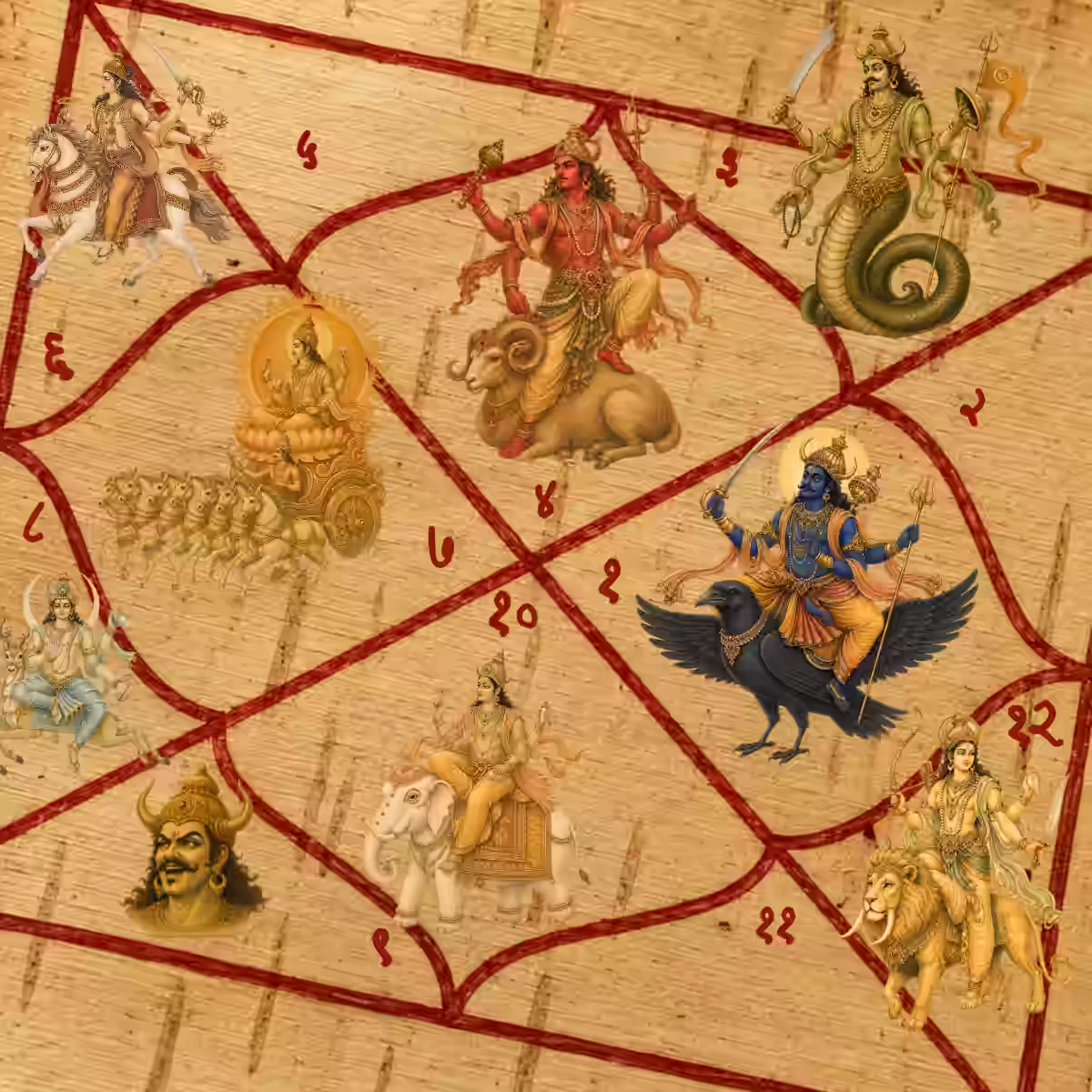
Karmic Reading Consultation
- A Brief on Your Personality
- Your Complete Chakra Profile
- Detailed answers to 5 Questions
- Yantra, Puja and Mala Remedy Recommendations
- Full Name
- Place of Birth
- Date of Birth (DD/MM/YYY)
- Time of Birth (24 HRS)
- 5 Questions that you are seeking Answers for
About Shri Damodar Das ji
Shri Damodar Das ji has more than 35 years of experience in Yantra preparation, Sadhana, and spiritual guidance. Through YantraChants.com, he shares traditional spiritual knowledge and guidance with seekers who wish to understand their life experiences more deeply and approach them with sincerity, Shraddha, and greater awareness.
Frequently Asked Questions
What is a karmic pattern?
A karmic pattern is a recurring inner tendency that influences how a person interprets and responds to different life situations. The external events may change, but the underlying thought, fear, attachment, or reaction remains similar.
Are karmic patterns a form of punishment?
They should not be approached simply as punishment. A recurring pattern can become an opportunity to recognise an attachment, assumption, or response that has not yet been fully understood.
Can the same karmic pattern appear in different areas of life?
Yes. A pattern may appear through relationships for one person and through career, money, health, recognition, or family for another. Its outward form can change while the inner tendency remains the same.
How can I recognise a karmic pattern in my life?
Observe situations that repeatedly produce a similar emotion or conclusion. Separate the facts of the event from the meaning your mind adds to it, and notice whether the same reaction has appeared in different circumstances.
Can Sadhana help weaken karmic patterns?
Sincere Sadhana can support self-observation, humility, steadiness, and greater awareness of the mind. Recognition develops gradually; it is not merely an intellectual exercise.
When can personal spiritual guidance be helpful?
Guidance may be helpful when a difficulty keeps returning and the person is unable to identify its deeper pattern while caught in the immediate circumstances.

Damodar Das Ji Maharaj

Rohini Devi Dasi