
Festivals are highly Symbolic
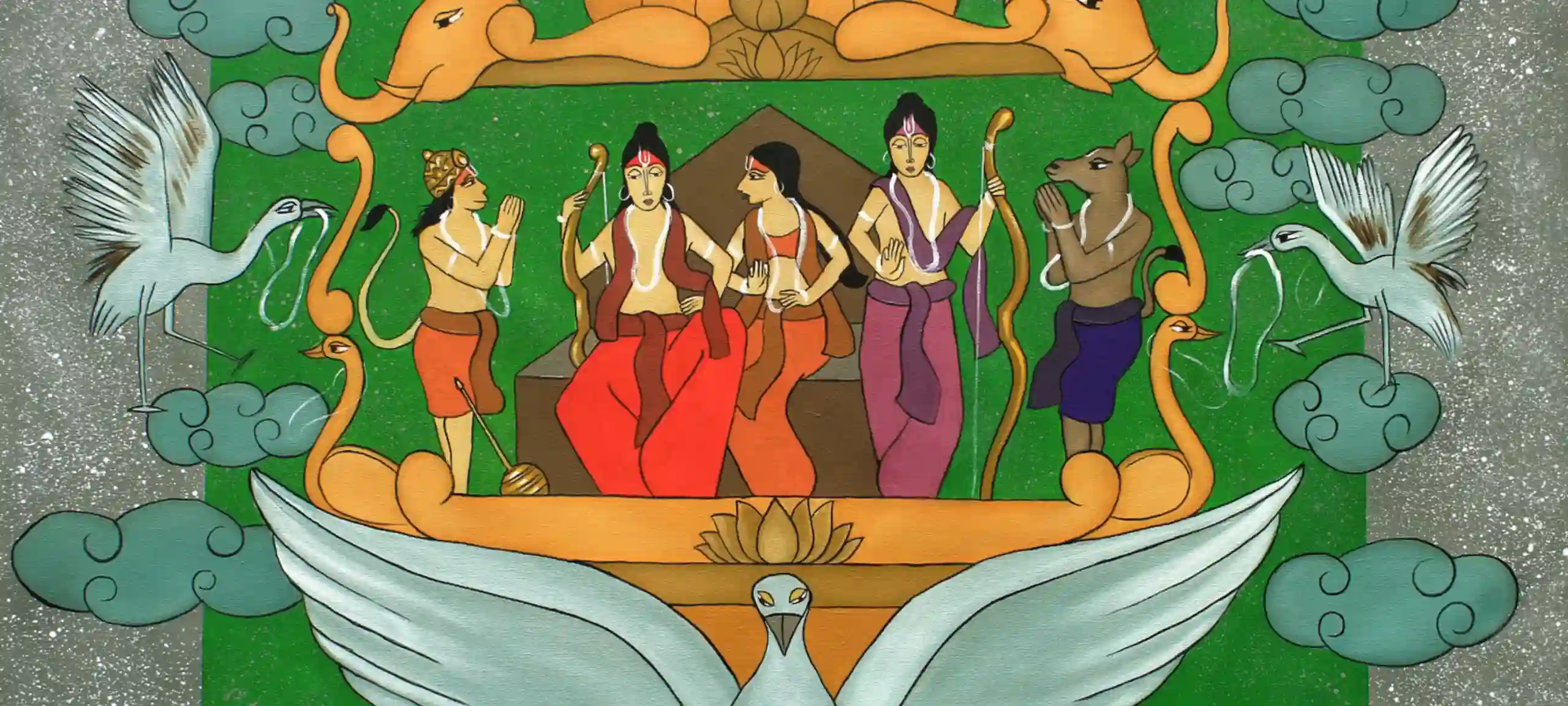
We celebrate Deepawali (Diwali) as the festival of lights, following the return of Lord Rama from Lanka. Often, we forget the significance of this great festival. Deepawali, although celebrated by lighting lamps, has inner connotations. Many times we celebrate festivals but discount the symbolism and the mood of such festivals.
When people search for Lord Rama diwali, they are often looking for more than a date or a story, they are seeking the inner reason why light conquers darkness. In the Diwali tradition rooted in Lord Rama’s return, the outer lamps reflect an inner awakening: the courage to hold on to truth, to act with integrity even when no one is watching, and to allow clarity to dispel confusion in our daily choices. Remembering this connection gently pulls us back to the heart of Diwali: lighting the mind with wisdom and the home with love.
We forget the intention and purpose of a festival and merely carry out the rituals associated with the festival. When this happens, we naturally drift away from the great morals that are behind the celebrations.
Navaratri Dussehra and Diwali
The festivals of Dussera and Deepawali (Diwali) occur during autumn (in India). Within a fortnight of the passing of Dussera, we celebrate Deepawali. 9 days prior to Dussera, we celebrate Navaratri, the 9-day fasting festival. Men and women fast during those 9 days, rejuvenating the entire body system.

On the 10th day of Navaratri, Dussera occurs and within a fortnight of Dussera, Deepawali arrives. Why am I talking about these 3 festivals as a prelude to the topic of Deepawali, we need to understand deeply.
Unless we understand Navaratri and Dussera, we cannot appreciate.
This is where the lord ram diwali narrative becomes a guiding thread: Navaratri refines intention, Dussehra declares victory over inner enemies, and Diwali crowns the journey by welcoming virtue back into the city of our heart, just as Ayodhya welcomed Rama. When we see all three as one continuous sadhana, our celebration feels coherent, purposeful, and personally transformative.
Our Current Life is not in line with Diwali
Deepawali represents the culmination of human endeavor, the final victory drum that celebrates “good over evil”. We have heard this “Good over evil” phrase over and over again but we do not quite understand it too well.
Why?
We see people buying out Truth and carrying out evil deeds without relent. We see the rich usurping the rights of the poor and we see so-called VIPs trampling over the sustenance of the common man. What good are we talking about? We should try to delve deeper into the festival of Deepawali to understand this. Only then can we draw some meaning into ourselves. Before exploring the Significance of Navaratri Festival let us discover more about the Sri Seeta Ram Yantram which is created at yantrachants.com as per our traditional Parampara processes.
What is the Sri Seeta Ram Yantra?
The Sri Seeta Ram Yantra is a sacred geometric companion to the paired Name “Sita–Ram,” uniting the auspicious tenderness of Sri Sita with the steadfast righteousness of Sri Rama. Where mantra refines the inner current through sound, rhythm, and breath, the yantra educates the eyes and prana through proportion, direction, and luminous symmetry.
Practitioners repeat “Sita Ram” while resting the gaze upon the central bindu; sight, sound, breath, and feeling begin to move together, and scattered attention gathers into one clear mood of devotion. Over steady days this pairing softens speech, steadies choices, and reorients family life toward truthful kindness.
In the attached diagram one sees the protective square with four gateways, the circular mala of mantra, a warm lotus, interlaced triangles, and the tranquil bindu carrying “Ram.” Each layer teaches: the square establishes boundaries so that love keeps dignity; the circle calms churn and lengthens breathing; the lotus opens the heart to gratitude and forgiveness; the crossing triangles balance receptive compassion with responsible action; the bindu calls the whole person home to stillness. Thus shape becomes prayer, and prayer becomes habit.
Gentle trāṭaka on the bindu for short cycles, alternated with relaxed eyes closed, prevents strain and draws the after-image within, where mantra continues by itself.
The yantra therefore functions as the “visible mantra.” People who learn visually or who struggle with mental drift find that shape anchors sound and japa anchors life. Sit quietly, light a diya, straighten the spine, take three long exhales, and begin.
If tears arise, let them rinse the eyes; if heat rises, soften the gaze; if sleepiness comes, chant aloud for one round and return to silence. Couples may alternate rounds so that home and hearts find a coherent rhythm. Students can keep a small print near the study desk as a reminder to be honest, industrious, and kind.
Because Sita–Ram represents love guided by law, the yantra especially supports committed marriage, patient communication, steady livelihood, clear decision making, and gentle authority with children or teams. It serves entrepreneurs who seek prosperity without compromising dharma, caregivers who must be firm yet compassionate, and elders who wish to keep a soft heart and a straight back. On Rama Navami, Sita Navami, or Ekadashi, increase japa modestly, offer simple sattvic food, share kirtan for a few minutes, and close with gratitude.
Over forty to ninety disciplined days, one usually notices less reactivity, cleaner routines, and a relieved sense that the right action is also the kind action. That recognition is the living fruit of Sita–Ram. Keep a short diary line after practice, noting mood, one helpful action, and one kindness promised. Such simple accountability seals the merit of japa and turns devotion into daily culture.
Benefits of the Sri Seeta Ram Yantram
Practitioners keep the Sri Seeta Ram Yantra for benefits that are both gentle and decisive, because it binds tenderness to truth. First, it nourishes harmony in marriage and family by cooling reactive speech and inviting respectful pauses. Gazing at the bindu while repeating the paired Name gives the tongue a new habit; words arrive slower, sharpness dissolves, and listening grows. Misunderstandings reduce as the mind verifies intention before replying.
When couples sit together for small rounds, tone shifts from point-scoring to problem-solving, and forgiveness becomes easy. Second, the yantra strengthens patience and will-power without turning the heart hard. The square teaches boundaries, the circle teaches steadiness, and the star teaches balanced courage; together they create disciplined kindness suited for long projects, parenting, caregiving, and leadership.

Third, the yantra refines decision making. By aligning breath and gaze, it regulates the navel and heart centers, clearing anxiety, clarifying motives, and letting the next right step appear without inner noise. People who felt flooded by options begin to move one task at a time and finish what they start.
Financially, the yantra supports clean prosperity. Under Sita’s śrī and Rama’s maryādā, appetites become moderate, waste reduces, and budgets acquire an ethical backbone. Households report fewer impulsive purchases and steadier saving, not from fear but shared purpose.
For business owners, the yantra becomes a small governance reminder near the desk: deliver on promises, price fairly, value teams, and prefer reputation over short wins. When such choices accumulate, wealth arrives with respect rather than worry. Students benefit through increased concentration and responsibility; the yantra’s center is a gentle mirror that returns wandering minds to the page without inner scolding. Teachers and counsellors use it to model calm attention before difficult conversations.
Emotionally, regular practice produces a reliable softness. Grief and anger still arise, yet they are held within patience, and the need to retaliate weakens. Family members often comment that the practitioner has become both firmer and kinder, a blend that invites trust. This blend improves teamwork at offices; presence grows more than volume, and others feel safe to admit mistakes early. Spiritually, the yantra matures bhakti by giving the mind a home.

During kirtan or silent japa, the memory of the bindu reappears spontaneously; the chest warms, eyes moisten, and prayer continues even while cooking, studying, or commuting. Festivals such as Rama Navami, Sita Navami, and Vivaha Panchami become richer because the heart already knows reverence. The yantra supports vrata observances and Ekadashi restraint, making simplicity feel dignified, not deprived.
Health wise, the gentle trāṭaka used here can complement breath practices by slowing the mind and normalizing sighing patterns that trigger neck and shoulder tension. It is not a medical therapy, yet by cultivating rhythmic attention it reduces nervous agitation that magnifies discomforts. Sleep improves for many because evening japa replaces late-night scrolling; mornings feel cleaner when the altar is visited before messages.
Young people find that discipline adopted for bhakti spills into study, diet, and friendships; elders find that gratitude replaces complaint. In community life, the yantra encourages service: one hour each week for tutoring, kitchen seva, or neighborhood cleanliness becomes natural, and practice gains strength by touching society.
Above all, the benefit is integration. Sita’s compassion does not dilute Rama’s law, and Rama’s law does not stiffen Sita’s compassion. Together they shape a person who can say a clear yes and a clean no. Such people carry a stable atmosphere that protects children, steadies teams, and heals homes. When the yantra is honored daily, even briefly, the altar becomes a small Ramarajya where truth is courteous, prosperity is shared, and devotion enjoys excellent manners.
Sri Seeta Ram Yantram Structure
Study the attached Sri Seeta Ram Yantra and move from the outside inward, because each ring educates a different layer of habit. Begin with the bhupura, the square enclosure with four projecting gateways. It is the house of dharma: boundaries, courtesy, and consent.
Passing through a gate is symbolic of leaving pettiness and entering worship; devotees sometimes touch the forehead in each cardinal direction to remember humility. The square’s even arms imprint steadiness upon the body and are excellent for people who overextend themselves or dissolve boundaries in the name of kindness.

Inside the square lies a circular mantra-mala. Here the repeated Name “Ram” or “Sita Ram” forms a protective current. Reading the ring clockwise while breathing slowly quiets rumination and gathers attention in the chest. It is helpful to synchronize every two or four heartbeats with the silent Name; the circle then becomes a living rosary and the mind stops begging for novelty.
The next field is the lotus. The attached version shows a gentle twelve-petal arrangement, whose rhythm suits household life: patience, truthfulness, fidelity, empathy, forgiveness, generosity, contentment, industriousness, prudence, gratitude, restraint, and service.
Petals remind us that devotion opens by degrees; if a day feels heavy, gaze at one petal only and breathe until warmth returns. Some practitioners mentally place loved ones on specific petals, praying that each quality sweeten family speech.
Within the lotus are interlaced triangles and nested polygons that resolve toward the center. The upward triangle carries courage, clarity, and right action; the downward triangle carries tenderness, nourishment, and receptive wisdom.
Interlaced, they portray Sita and Rama guiding one another so that strength never becomes harshness and love never becomes indulgence. Lines meeting at crisp angles teach decision making; when the eye traces a line without wobble, the tongue later speaks without wobble. The small inner polygons are stepping stones for attention; as you walk them with the gaze, breath slows on its own.
At the heart rests the bindu, a red stillness bearing “Ram.” It is the meeting of sight, sound, and prana; linger here briefly, then let the after-image float inside the forehead while mantra continues. The bindu is not a dot to conquer but a home to return to.
Ending the session by resting awareness here plants a simple memory that repeats during the day, on the bus, while cooking, or while signing a document, so that action remains courteous and exact. This architecture, taken together, is a map of dignified love: Sita’s grace and Rama’s law expressed as square, circle, lotus, star, and point.
The swastika markers in the corners affirm auspicious beginnings and rightward movement, encouraging practitioners to start small, continue daily, and close with gratitude for the chance to practice.
Geometrical Significance of Sri Seeta Ram Yantra
Geometry in the Sri Seeta Ram Yantra is the language of training. Each form modulates prana and attention so that love gains discipline and discipline keeps tenderness. The outer square is a body lesson: sit evenly, breathe evenly, honor boundaries. It presses the restless mind into four calm corners, which is why people who overpromise or undersay no benefit quickly from simply looking at the square before beginning japa. Because a square prefers proportion, it gradually teaches time management and orderly speech.
The circle converts effort into flow. As the eyes trace it, breath lengthens, shoulders release, and rumination loses fuel. Circles unify dispersed concerns into one field, so households practicing together often find schedules syncing without fights. A circular mantra-mala adds a soft magnetic pull that keeps attention devotional; your mouth remembers to return to “Sita Ram” when thoughts wander.
The lotus is an energy governor. Petals open the heart without flooding it. Think of each petal as a valve that lets feeling rise in a measured way; gratitude appears, yet you remain capable of practical decisions. Because petals repeat, they train consistency: better small daily offerings than rare grand displays. Placing a specific virtue on a petal rewires habits by association.

The interlaced triangles synchronize ida and pingala, vision and execution. Upward movement supports courage, downward movement supports receptivity. Interlaced, they prevent collapse into passivity or aggression, encouraging a confident gentleness suited for marriage, parenting, and leadership.
Edges and vertices act like tuning forks; when the gaze meets a clean vertex, speech later finds a clean conclusion. Nested polygons draw attention inward by discrete steps so the nervous system does not feel forced.
Finally, the bindu condenses the field into one compassionate point. Trāṭaka here kindles a warm thread between chest and brow, calming the navel and brightening discrimination. Because the bindu is small, it forbids mental chatter; one either attends or drifts, and the correction is obvious. A few cycles of gazing and soft closing of the eyes create an inner after-image, proving that the geometry has entered memory.
This impression travels into daily life: during conflict, the remembered point appears, breathing steadies, the right sentence comes, and harm is avoided. In this way geometry becomes ethics, and bhakti becomes culture. Over weeks the body learns fairness from the square, calm from the circle, warmth from the lotus, balance from the star, and sincerity from the point.
Mantras to Activate the Sri Seeta Ram Yantra
Activation begins with purity, intention, and right measure. Take water for achamana, light a small ghee diya, and state a single sankalpa in simple words. Then perform brief trāṭaka on the bindu and begin japa. Choose one bīja per sitting so the mind learns a single note.
Three Sri Seeta Ram Bīja Mantras
- ॐ रां , Om Rām. Builds courage, discipline, truthful speech, and clear decisions under Rama’s maryādā.
- ॐ ह्रीं , Om Hrīṁ. Opens the heart to compassion, forgiveness, and clean sensitivity associated with Sita’s dayā.
- ॐ श्रीं , Om Śrīṁ. Invokes auspicious prosperity, household harmony, and graceful success without greed.
Rotate these across weeks or keep one as your root note for forty days. If practicing as a couple, begin with Rām for steadiness, add Hrīṁ for tenderness, and occasionally include Śrīṁ for shared abundance. Keep counts modest, 11, 27, 54, or 108, and favor consistency over ambition. Close by touching the ground and offering gratitude to parents, teachers, and all beings.
Two Gāyatrī Mantras
Sri Rāma Gāyatrī:Om Dāśarathāya vidmahe Sītā-vallabhāya dhīmahi, tanno Rāmaḥ pracodayāt. Use when seeking dhārmic clarity, leadership courage, or integrity in work.
Sri Sītā Gāyatrī:Om Janakanandinyai vidmahe Bhūmijāyai dhīmahi, tanno Sītā prachodayāt. Use when cultivating gentleness, household peace, generosity, and protection of dignity.
Chant a short round of bīja first, then a few malas of your chosen Gāyatrī, or reverse the order on festival days. On Ekādaśī, reduce food and increase kindness; a calm body receives mantra more deeply.
About Guru Deeksha
A self-realized Guru aligns method, pace, and protection. Deeksha prevents overreach, sets right counts, and places your effort inside living lineage, which multiplies results and reduces friction. If deeksha is not yet available, begin humbly, keep sattva in food and speech, and ask for guidance when possible.

Remember: the yantra is a companion to diligent action, apologize when wrong, fulfill promises on time, and let bhakti perfume every task. For delicate situations, marriage healing, career courage, or study steadiness, observe a forty-day vow at the same hour daily. Keep a small diary line after each sitting; noticing progress reinforces sincerity and builds cheerful consistency.
Preparation of Sri Seeta Ram Yantra at yantrachants.com
At YantraChants, preparation begins with reverence for materials and for the recipient’s journey. We favor Bhojpatra, Himalayan birch, because it holds line and breath with unusual stability and keeps a quiet, ancient fragrance. After altar purification and a short kirtan, the artisan notes the devotee’s name for sankalpa and sits in a clean, sattvic space with steady light. A pomegranate-twig stylus is trimmed; natural inks are mixed from vermilion, kesar-ashtagandha, and lamp-black, with a gentle binder so strokes remain crisp yet alive.
Geometry is measured patiently. The bhupura is laid first to establish boundaries; gateways are proportioned so that the field invites yet protects. The mantra-mala ring follows, lettered in a soft clockwise movement. Lotus petals are sketched and refined; triangles, polygons, and bindu are drawn only after a brief round of Rām japa to quiet the hand. This sequence prevents cleverness from outrunning devotion and keeps the figure devotional rather than decorative.
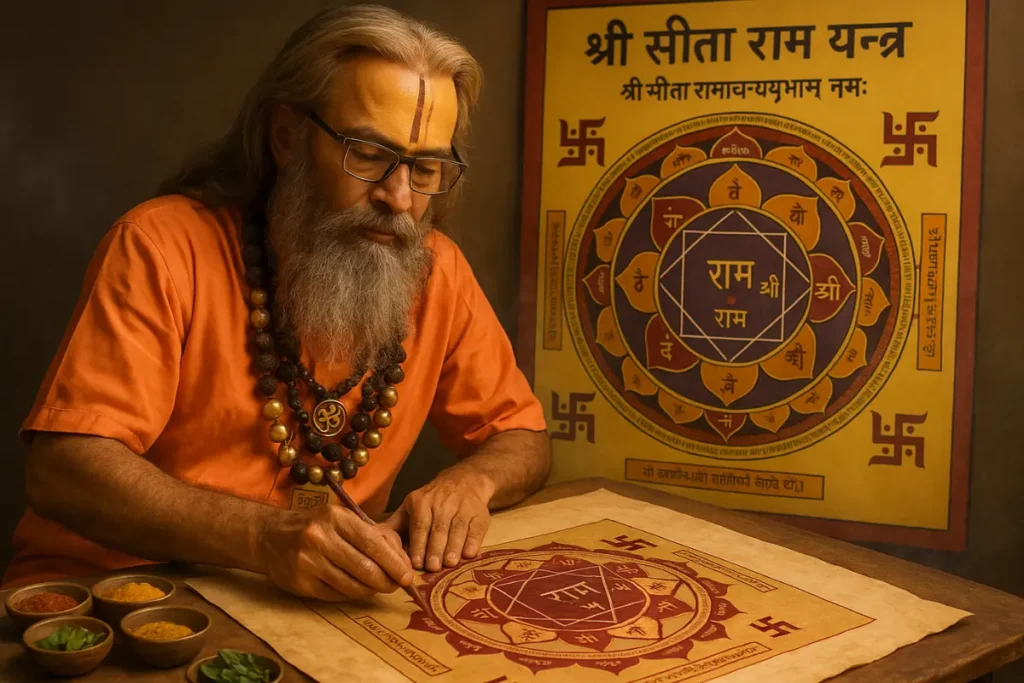
Once lines settle, nyāsa is performed: seed mantras are lightly touched upon the major points while the breath is counted. Then the yantra receives prāṇa-pratiṣṭhā through upacāras, water, a drop of pañcāmṛta, incense, flame, flower, and a few grains, according to our Guru-paramparā. During this time, the artisan maintains mauna except for necessary mantra and lets the mind rest inside the bindu. A final layer of protective japa is offered for the recipient’s welfare and for their household’s harmony.
The yantra then rests overnight on the altar beneath a light cloth while the mantra continues softly. At dawn, after darśana and gratitude, it is wrapped in clean fabric and placed within a protective envelope with simple guidance for placement, care, and daily practice. If a pocket version or kavach is requested, the geometric core is reduced carefully so proportions remain faithful; it is then laminated lightly to withstand travel without dulling the charge.
All along, the guiding principle is safety, simplicity, and sincerity. We avoid sensational promises and instead emphasize steady sādhana: small daily japa, weekly kindness, and patient honesty in relationships and work. Devotees are encouraged to begin on Thursday, Friday, or Ekādaśī, keep a short diary line after each sitting, and meet the Guru in person or online when available. In this way, the finished yantra arrives not as a product but as a sādhana companion, already warmed by prayer and ready to support the next faithful step.
Our homepage explains this Bhojpatra process in plain language so families understand how materials, measurement, and mantra cooperate. It also clarifies care: keep the yantra dry, avoid casual handling, never place on the floor, and retire respectfully if damaged. We remind patrons that blessings ripen through practice; geometry guides, mantra fuels, and your conduct completes the circuit. This is our promise.
Importance of a Self-Realized Guru
A Self-realized Guru makes the difference between inspiration and transformation. Books can teach shape and sequence, yet living guidance tunes proportion, posture, breath, and ethical application. Deeksha is not merely permission; it is alignment. Under a realized teacher, the yantra stops being a pretty diagram and becomes a training ground where speech, time, and relationships are corrected kindly.
A Guru helps you choose a right vow for your season of life: a count you can keep, a time you will honor, and a motive that cleans the heart. They protect you from spiritual greed, doing too much, too soon, and from dullness, doing too little, with excuses. When obstacles arise, a simple instruction lands precisely: change the bīja, shorten the sitting, add a minute of kīrtan, apologize to someone, eat lighter on Ekādaśī, walk in the sun. This kind of exact advice saves months of wandering.
The Guru also connects you to lineage memory. Through paramparā, forgotten refinements revive: how to combine bindu-trāṭaka with heart-awareness, how to pace breath without strain, how to end practice so the fruit carries into the kitchen, office, and street.
Because the teacher embodies Sri Sītā’s compassion and Sri Rāma’s discipline, you absorb both qualities through association, often faster than by study alone. Where the yantra sets geometry, the Guru sets example.

Finally, a realized Guru keeps the practice human. They see your specific story, work stress, family temperament, regrets, and tailor the sādhana so it heals rather than overwhelms. They celebrate small truth telling, small kindness, and small improvements as serious victories. In their presence, you remember why devotion matters: to become trustworthy, useful, and quietly joyful.
With such guidance, the Sri Seeta Ram Yantra becomes active not only on the altar but in behavior, promises are kept, anger cools faster, and love grows a spine. If you do not yet have a Guru, begin humbly and pray for one, offering a small kindness weekly as your request. When a trustworthy teacher appears, keep company, ask few questions, listen deeply, and implement fully. Such obedience is not blind; it is intelligent trust that converts inspiration into dependable character over months and years.
Rare Observations on Sri Seeta Ram
Many notice a soft warmth in the heart during trāṭaka, spontaneous humming of “Sita–Ram” while doing chores, and an urge to apologize quickly. During Rama Navami, Sita Navami, Vivaha Panchami, and Ekādaśī the yantra feels especially responsive, extend practice slightly, keep food sattvic, and add brief kirtan. As a gentle remedy for conflicts, sit together, do 11 Rām japa gazing at the bindu, then 11 Hrīṁ with eyes closed, ending with a minute of “Sita–Ram” aloud.
Devotional Significance of Sri Seeta Ram
Sita–Ram is love guided by law: tenderness that does not collapse, truth that does not bruise. Practicing before this yantra turns houses into small classrooms for courtesy, reliability, and service, bhakti expressed as everyday excellence.
FAQs of Sri Seeta Ram Yantra
Q1. What is the Sri Seeta Ram Yantram and how does it work with the Sri Seeta Ram Mantra?
A: The Sri Seeta Ram Yantram is a sacred geometric support that focuses your mind and devotion on Sri Seeta Ram. Regular japa of Sri Seeta Ram Mantra attunes your awareness to the yantra’s geometry, helping stabilize attention and bhāva.
Q2. How do I place the Sri Seeta Ram Yantram at home for best results?
A: Keep it on a clean, dedicated altar facing East or North-East (Ishanya). Sit facing East during practice, light a diya/incense, and keep the surface tidy and uncluttered.
Q3. Which day is best to begin, and what is the minimum daily practice?
A: Begin on Thursday or Friday (and Ekadashi for vratas). Start with a short pūjā (diya, incense), then 11–108 repetitions of 3 Sri Seeta Ram Beeja Mantras (with sankalpa aligned to Protection, Wealth/Prosperity, Education/Knowledge, Career/Success, Devotion/Bhakti, Marriage/Relationships, Spiritual Growth). Consistency matters more than volume; choose a time you can keep daily.
Q4. Do I need Guru Deeksha for the Sri Seeta Ram Yantram?
A: Deeksha deepens effect and safety by aligning you with a living paramparā. However, sincere daily devotion with purity and respect is always beneficial; seek guidance when possible.
Q5. Who can keep the Sri Seeta Ram Yantram? Any restrictions?
A: The yantra is kept by those who approach with shraddhā (respect) and sattva (cleanliness). Follow your family/paramparā norms; when unsure, keep it simple and dignified.
Q6. How long does it take to see results?
A: Timelines vary by karma and steadiness of practice. Give yourself a 40–90 day disciplined sādhana window, then review gently without anxiety.
Q7. Can I keep multiple yantras together with the Sri Seeta Ram Yantram?
A: Yes, if intentions harmonize. Avoid contradictory goals on the same altar, maintain spacing, and keep the altar visually calm.
Q8. How do I cleanse and re-energize the Sri Seeta Ram Yantram regularly?
A: Gently dust/wipe, offer a diya/dhūpa, and do periodic japa counts (11/27/108) of the three bījas. Monthly vrata days or the deity’s tithis are ideal for a slightly longer practice.
Q9. Where should I place it in an office/shop, or can I carry a kavach version?
A: Place it near your work desk/cash box in a dignified spot. A pocket yantra/kavach can be carried respectfully when appropriate.
Q10. What should I do if the yantra fades, cracks, or is accidentally disrespected?
A: Retire it respectfully, wrap in a clean cloth and bury/immerse per local custom, then install a properly prepared yantra.
Q11. Can I offer tulsi and observe Ekadashi with this practice?
A: Yes, tulsi is sacred to Viṣṇu/Kṛṣṇa. Ekadashi vrata with simple sāttvik offerings amplifies bhakti and steadiness.
Q12. How do I set a sankalpa without anxiety?
A: State your intention softly at the start, then release it into practice. Let steadiness, gratitude, and right action carry the intention.
Custom FAQ on Sri Seeta Ram Yantram
Q13. Which bīja should a beginner start with?
A: Begin with Rām for 21–40 days to build steadiness; add Hrīṁ for warmth and Śrīṁ for graceful prosperity.
Q14. Can couples use it to repair arguments?
A: Sit together, 11 Rām gazing at the bindu, 11 Hrīṁ with eyes closed, then one minute of “Sita–Ram” aloud; keep voices gentle afterward.
Q15. Is morning or evening better?
A: Choose the time you can keep daily. Mornings set tone; evenings dissolve the day’s residue.
Q16. May I travel with a pocket yantra?
A: Yes, carry in a clean pouch; avoid mixing with money or placing on the floor.
Q17. What offerings are ideal?
A: Tulsi, clean water, a small fruit, and a ghee diya, offer sincerity first; grandeur is optional.
Q18. I get watery eyes during trāṭaka, what to do?
A: Use short cycles: gaze 20–30 seconds, close gently 10–15 seconds sensing the after-image; blink naturally.
Q19. Can children participate?
A: Yes, keep it playful and short; teach soft speech, gratitude, and one small act of help daily.
Q20. How do I know practice is working?
A: Speech grows kinder, promises are kept, decisions feel clean, and home ambience turns calmly industrious, these are reliable signs.
Significance of Navaratri
Devi Parashakti (Mother Durga) undertook severe penance for 9 days, before slaying Raktabeeja, Shumba, and Nishumba. Mother Durga represents infinite power and she does not have to undertake any penance in order to slay demons.
But why did she undertake tapas anyway? She wanted to set an example to man, that, in order to undertake a daunting task, one has to stay single-minded and focused. Unless we sacrifice ourselves for a higher cause, we cannot enrich our souls, by giving ourselves into our lower tendencies.

Raktabeeja, Shumba, and Nishumba exist within our bodies. Raktabeeja is interesting. With every drop of his blood, new demons with the same evil characteristics are reproduced. We try to fix one evil within ourselves. But without inner discipline, many other evil tendencies pop out of us.
Such is our distorted human nature. We are a storehouse of evil tendencies that provoke us to become haters and criminals in smaller or bigger ways.
Sadhana And Intention: The Main Key
Unless sadhana becomes our objective, our single-pointed objective, we can never succeed. Unless we direct our intention towards our own highest good as well as for the good of the world, we can never attempt any sadhana.
We should understand that intention and sadhana form the basis of sacrifice. Sacrifice alone qualifies as the pre-requisite for complete victory over our lower tendencies.
Devi Parashakti established the rudiments of sadhana during those 9 days of Navaratri (9 nights). Navaratri thus represents sincerity of purpose and pursuing Truth in the form of sadhana.
Goal of Sadhana
Sadhana and intention combine to result in inner purification. Inner purification symbolizes peace and prosperity of the highest kind. Material wealth just represents a tiny portion of overall prosperity. This, one must realize.
Diwali acquires its full meaning only after this inner purification, which is why traditions recall that on Diwali day, Lord Rama returned to Ayodhya after the great battle, symbolizing that the light we invite comes after discipline and discernment. When our efforts are sincere, the mind becomes a worthy place for joy to dwell, and the lights we kindle outside mirror a steady lamp within.

Lord Rama and Navaratri
Sri Rama took up 9 days of fasting during Navaratri in the month of Ashwin. Ashwin month falls between the period of September 23 and October 22, following the Gregorian calendar. Only following the process of intense sadhana for 9 days, he entered into war with the demon king Ravana. Sri Rama represents the highest human ideals. When a man of total inner integrity takes up sadhana, he becomes impregnable.
This does not mean that he can transcend difficulties in a jiffy. He still has to put up a formidable fight with external nature and the Mind (Maya). However, his sadhana supports and guides him.
Significance of Dussehra
Sri Rama, the Lord in human form, defeated Ravana and slew him on the Dussehra day. This day follows the 9 days of Navaratri.

When one carries out sadhana in the spirit of destroying one’s inner enemies, he finds success. He shall then easily slay the six vices and the 4 limitations of the human senses. The six vices are Lust, Anger, Greed, Self-Pride, Bodily Attachment, and Envy.
Dussehra and the 10 heads of evil
The 4 defects of the senses are the tendency to cheat, the tendency to exaggerate, the tendency to commit mistakes and errors, and the tendency to lie. These 10 vices represent the 10 heads of Ravana. Dussehra represents the slaying of this 10 headed demon. Dussehra represents the end of evil.
This is precisely why Lord Rama’s return on Diwali day is celebrated so soon after Dussehra. Once the ten heads of falsehood are cut away, the path is cleared for the return of clarity, humility, and compassion. The festival sequence reminds us that ethical victory must precede celebration; only then do lamps hold meaning, and only then does joy become steady rather than fleeting.

But yet, the highest remains to be attained. Two goals represent the end of all human effort. They are the end of the evil (sorrow) and attainment of bliss (Self-Realization). Dussehra (slaying the 10 headed monster within) ends sorrow and represents the attainment of one goal.
Diwali represents Self-Realization
Diwali or Deepawali symbolizes Self-Realization or the attainment of eternal peace and rest. Only with the rooting out of sorrow shall there be a scope of attaining permanent or eternal happiness.
When we remember that on Diwali day Lord Rama returned to Ayodhya, we honor not merely a historical moment but a living psychology: the exiled virtues in our own heart come home after we exhaust the rule of cravings and fear. Lighting each lamp becomes a vow to keep wisdom enthroned within, so that peace is not an accident of circumstance but the natural fragrance of a disciplined life.
Ayodhya stands for our existence, a city that has banished the fountainhead of bliss, Sri Rama. Ayodhya gropes in the dark because the light of Sri Rama is missing.
Gloom oversees the city in the absence of Sri Rama. Sri Bharath had sacrificed the throne and simply played the role of a nation caretaker. He lived the life of a thorough mendicant and deputed for Sri Rama. His eyes await the Lord.
Dussera has just been celebrated, and Sri Rama is about to return to Ayodhya.
The Return of Lord Rama
As the Supreme Being Sri Rama makes his way to Ayodhya after slaying Ravana, the city of Ayodhya lights up. Every house adorns itself with the dazzling lights of millions of mud-lamps awaiting their dear Lord.
Families who cherish the lord ram diwali tradition often narrate this moment to children while lighting the first lamp, linking a timeless story to a personal promise: to speak truthfully, to act fairly, and to choose compassion when anger would be easier. In this way, Diwali becomes a living practice, not a single night of lights.
The heart is full of love. When the Lord arrives at Ayodhya; that marks the auspicious moment of Deepawali, the festival of lights.

When sorrows end, when vices are removed, you do not have to do anything after that. You just wait in anticipation of the Lord. He shall come, The Lord has to come. He has no option.
Opening up of Spiritual Vision
When our vices are rooted out, when we stop believing the misinformation of the senses, our vision opens up. We can see the Lord arriving in our hearts with the spiritual vision that sadhana and Grace have granted us.
At this point, Lord Rama and Diwali is no longer only about lamps in the streets of Ayodhya, it is about a lamp in the cave of the heart. The more we align our choices with dharma, the brighter that inner flame becomes, guiding decisions, calming the mind, and making the presence of the Lord unmistakable in everyday life.
Only then can true celebration happen. Before that, everything else is just groping in utter darkness.
Damodar Das Ji Maharaj