

Introduction
If your mind does not rest even when life is calm, the problem may not be your circumstances, it may be your Moon.
In Jyotish, Chandra governs how reality feels inside you. When Chandra is disturbed, peace feels effortful. When Chandra is stable, life becomes easier to digest. This guide explains why emotional instability cannot be forced into silence, and how a Living Chandra Yantra becomes a stabilizing field for the mind itself.
If you feel sudden fear-surges or “energy dips” alongside mental restlessness, keep a protective anchor close: Om Hum Hanumate Namah: 7 Miracles & Yantra Vidhi shows how Hanuman-tattva steadies courage when the mind feels easily shaken.
An Introduction to Chandra Yantra: The Storm Within and the Search for Inner Safety
Are you exhausted by a mind that keeps replaying worries, even when nothing is outwardly wrong?
In Jyotish, the Moon (Chandra) is not just a celestial body. It is the Graha that governs your Manas, your mind, emotional impressions, memory patterns, and your sense of inner safety.
When this lunar field is disturbed, the result is often:
- anxiety loops
- emotional exhaustion
- insomnia or “mind-on” sleep
- devotional dryness
- feeling unsafe even in safe conditions
This is why many people struggle to find peace even when life looks “fine” from the outside.
This guide explains why sheer willpower often fails to calm the mind, and how an authentic, lineage-consecrated Chandra Yantra can act as a permanent cooling support for emotional balance.
Sri Chandra: The Planet of Mind and Inner Safety
While Surya (Sun) represents identity, purpose, and radiance, Chandra represents your inner climate.
Chandra governs:
- how you receive reality
- how you interpret emotional experiences
- how memory imprints affect the present
- how safe or threatened life feels from within
- how easily the nervous system settles into rest
In simple terms: The Moon determines whether life feels nourishing or heavy.
Quick Reference Table: Chandra and the Inner Life
| Aspect | Chandra’s Role |
|---|---|
| Manas (Mind) | Emotional interpretation |
| Samskaras | Memory imprinting |
| Mother Principle | Nurturing patterns |
| Inner Safety | Ability to rest and trust |
| Sleep Cycle | Nervous system cooling |
For seekers whose restlessness is actually a “clarity problem” (too many thoughts, not enough inner guidance), this companion reading fits perfectly: Why Sri Dakshinamurthy is the Ultimate Source of Wisdom, because Guru-tattva cools the mind by removing confusion, not by adding more noise.
“The Moon does not change reality, it changes how reality is experienced.”
-The YantraChants.com Karma Reading Experience
The Mirror Nature of the Mind
Chandra does not produce light. It reflects it.
This is powerful spiritual symbolism.
A stable Moon reflects truth clearly.
A disturbed Moon reflects fear, projection, and confusion.
A stable Moon reflects truth clearly. A disturbed Moon reflects fear, projection, and confusion.
–A YantraChants.com Understanding
Because the Moon governs receptivity, it also absorbs the emotional atmosphere of places and people. This is why sensitive people often feel drained, not because they are weak, but because their lunar receptivity is unprotected.
When we fail to protect our receptive nature, our inner sanctuary can become a dumping ground for the world’s chaos.
If your anxiety is tied to over-control, over-planning, or emotional tightness, then surrender-based remembrance can soften the inner climate: Om Namo Narayanaya: Meaning, Power & Sri Vishnu Yantra explains why Narayana-japa + Yantra supports steadiness without aggression.
Some minds get disturbed because they absorb “too much of others.” If that describes you, study the safety-centered approach in Ucchistha Ganapati: 7 Secrets You Must Know, it clarifies why certain forces should be approached through Yantra discipline (not casual mantra), especially for sensitive householders.
Why Willpower Cannot Fix Moon Problems
Many seekers try to fix emotional instability using discipline.
But discipline is solar energy.
Moon problems are lunar in nature.
So the common approach becomes:
- force the mind
- suppress emotion
- “think positive” harder
- push through exhaustion
This rarely works.
You cannot discipline the Moon. You can only soothe it.
“The mind settles through nourishment, never through force.”
-Shri Damodar Dasji Maharaj
Just as you cannot calm a rippling lake by striking it, you cannot quiet the mind through aggression. You need a cooling, stabilizing influence.
Sun vs Moon: Understanding the Difference
| Feature | Surya (Sun) | Chandra (Moon) |
|---|---|---|
| Domain | Ego, soul, discipline | Mind, emotions, memory |
| Function | Projects outward | Receives and absorbs |
| Healing Method | Action, structure, willpower | Soothing, cooling, containment |
| Imbalance Result | Burnout, rigidity | Anxiety loops, insomnia, distrust |
Quick Jump Links for This Practice
If you’re returning to this page for daily use, these jump links make it easy to reach the right section in seconds.
Message CHANDRA YANTRA KIT to get the right Yantra + Mala suggestion.
The Chandra Yantra: A Cooling Field for the Mind
A Yantra is not decoration.
It is an energetic instrument (Upakaranam) designed to tune consciousness.
For lunar healing, the Yantra must not be treated as a printed symbol alone. To actually cool and stabilize the mind, it needs the correct medium, geometry, and activation.
This is where YantraChants.com’s Vidya-Siddhi Framework and Trust Stack become essential.
A Chandra Yantra can support the mind only when it is prepared with organic integrity and lineage activation.
“A Yantra without consecration is just a drawing. Activation transforms geometry into presence.”
-Shri Damodar Dasji Maharaj
The YantraChants.com Trust Stack: What Makes a Yantra “Living”
The Trust Stack Table
| Pillar | Why It Matters |
|---|---|
| Authentic Bhojpatra | Supports pranic retention |
| Hand-Drawn Geometry | Carries Sankalpa (spiritual intent) |
| Traditional Stylus/Ink | Preserves energetic conductivity |
| Prana-Pratishtha | Activates living spiritual presence |
| Lineage Guidance | Ensures authenticity and safety |
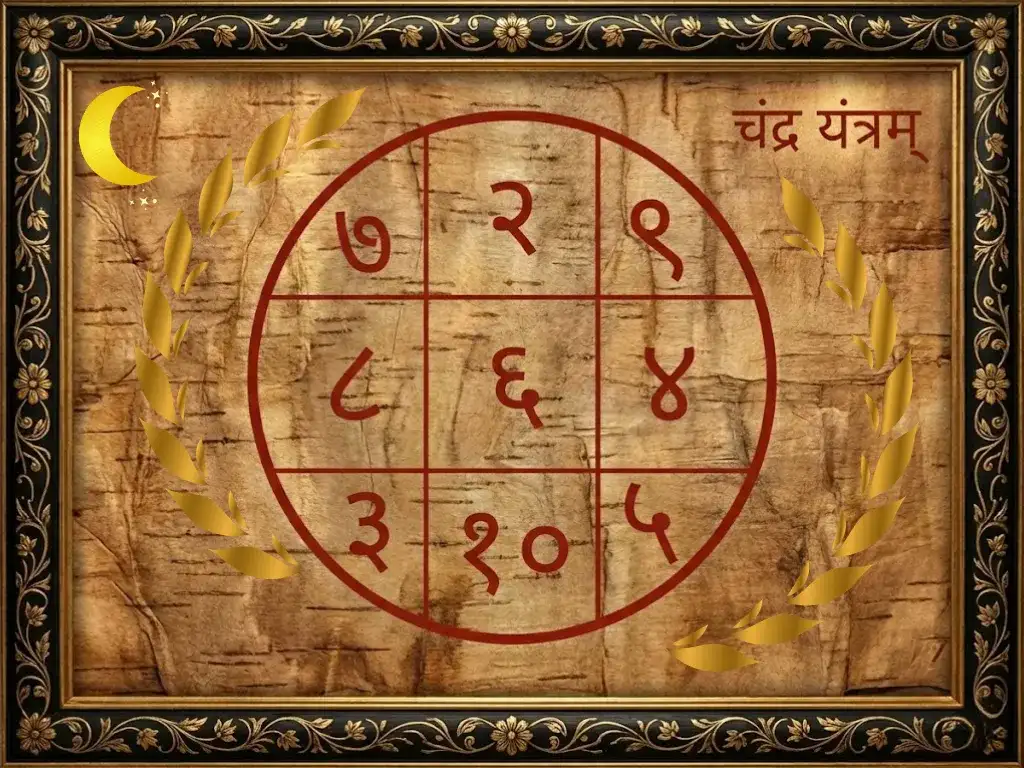
The Medium: Authentic Himalayan Bhojpatra
The Moon is traditionally linked with fluids, nourishment, and vegetation. Synthetic materials do not hold this energetic quality well.
Authentic Himalayan Bhojpatra (Birch Bark) acts like a living energetic battery and can retain the Prana of consecration much more effectively than printed substitutes.
The Geometry: Hand-Drawn Precision
A proper Chandra Yantra is not only symbolic, it is geometric medicine.
The traditional 3×3 magic square totaling 18 reflects lunar principles (including the tithi cycle). Hand-drawn geometry matters because a living line carries Sankalpa.
At YantraChants, this is aligned with traditional hand-drawing discipline (including pomegranate-twig lineage usage where applicable).
The Activation: Prana Pratishtha (The Ramanandi Lineage Consecration)
Consecration is what transforms a pattern into a presence.
Under the Sri Ramanandi Sampradaya tradition and guided by Sri Damodar Dasji Maharaj, the Yantra undergoes mantra-based activation (Prana-Pratishtha), making it a Living Yantra rather than a decorative object.
This is the difference between:
- something you look at
- vs
- something that begins to work on your field
Also note: when your Moon is unstable, the daily rhythm matters as much as the remedy. A simple sunrise water-offering practice can rebuild inner timing and nervous-system discipline, see Surya Arghya Vidhi: 41-Day Solar Success Guide as a gentle “outer structure” to support your lunar healing.
Self-Check: Is Your Moon Asking for Stabilization?
If you want a quick diagnostic before choosing tools, take this short self-check. It helps you identify whether your pattern is mainly anxiety loops, sleep-readiness issues, emotional overload, or “inner unsafety.”
Loading…
—
—
The YantraChants.com Trust Stack Disclaimer: This is spiritual support content, not a medical diagnosis. Severe distress should also be addressed with qualified medical/mental health care.
Benefits of a Living Chandra Yantra
- Stops the Spirals : slows repetitive thought momentum
- Improves Emotional Digestion : helps process impressions more gently
- Restores Sleep Readiness : cools the mental field before rest
- Softens the Heart : supports Bhakti and devotional receptivity
- Builds Inner Safety : reduces emotional overreaction over time
- Stabilizes Relationships : less projection, more calm response
- Supports Japa Practice : gives the mind a steady visual anchor
How to Use the Chandra Yantra (Simple Daily Practice)
If you are just beginning, keep it simple.
Basic Daily Use
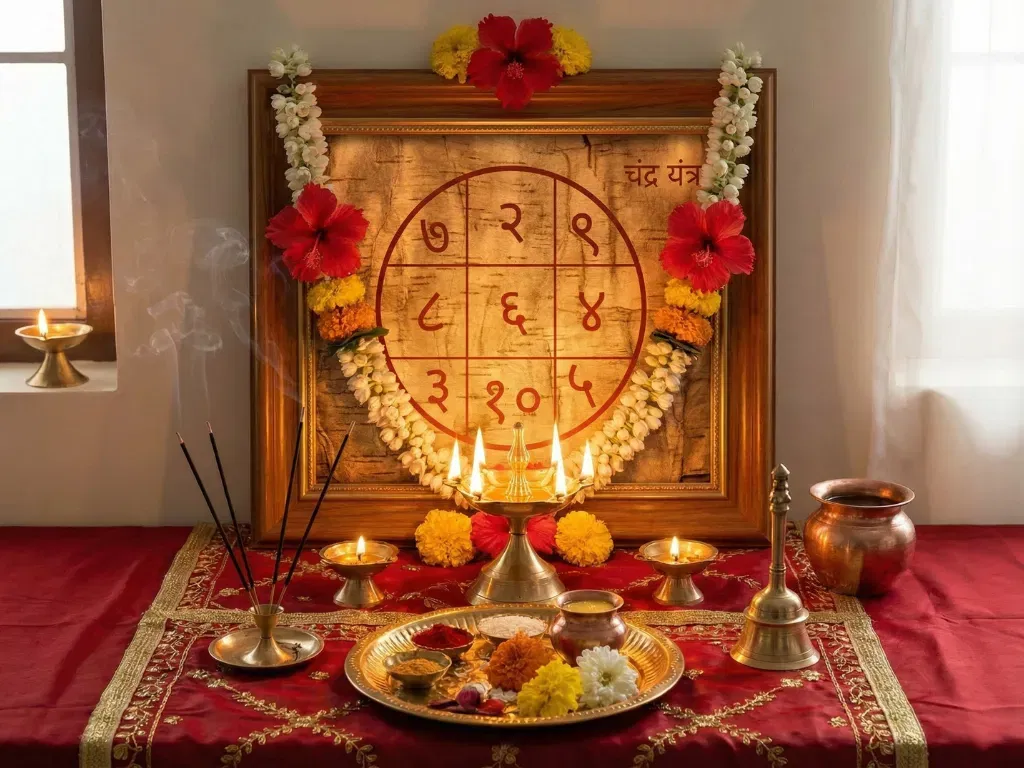
- Place the Chandra Yantra on an East or North-East wall/altar
- Keep the area clean and visually calm
- Offer a white flower on Mondays (optional but beautiful)
- Light a diya gently
- Sit for a few minutes and chant softly:
- Om Som Somaya Namah (Alternately, Sri Chandrashekaraya Namo Namah, for all those not initiated into Beeja Mantras)
- Let your gaze rest softly on the Yantra center
No force. No tension. Lunar practices work through softness and repetition.
How to Stabilize the Mind with a Chandra Yantra (10-Step Method)
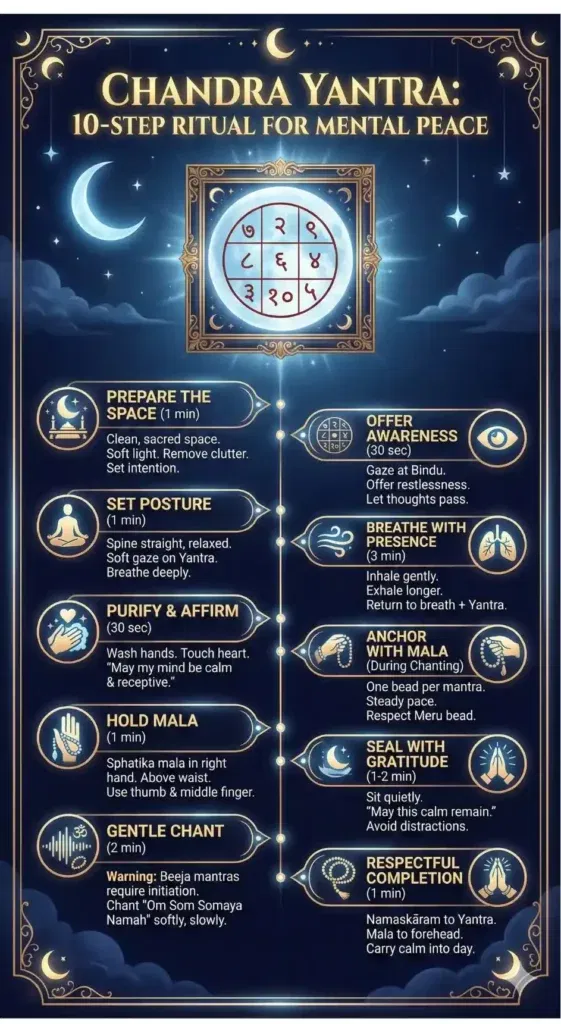
Step 1: Prepare the Space — 1 minute
- Place the Chandra Yantra on a clean altar or East/North-East wall at eye level.
- Remove clutter nearby; the Moon responds strongly to atmosphere.
- Prefer soft lighting over harsh white lights.
- Sit on a dedicated āsana (mat/cloth) to signal sacred time.
Step 2: Face the Yantra and Set Your Posture — 1 minute
- Sit with a straight but relaxed spine.
- Keep shoulders soft.
- Rest the hands gently.
- Let the eyes soften on the Yantra without staring.
Step 3: Wash the Hands, Touch the Heart — 30 seconds
- Wash or wipe hands.
- Lightly touch the center of the chest.
- Take 3 slow breaths.
- Inwardly affirm: “May my mind become calm and receptive.”
Step 4: Hold the Sphatika Mala Correctly — 1 minute
- Hold a Sphatika (crystal) mala in the right hand.
- Keep it relaxed, not stretched.
- Maintain it above waist level.
- Move beads using thumb and middle finger (avoid the index finger).
Step 5: Gentle Opening Chant — 2 minutes
YantraChants.com Trust Stack Warning: This Mantra (Om Somaya Namah) should only be chanted by persons who have undergone Beeja Mantra initiation of some kind by an authorized Guru. Chanting Beeja Mantras or Mantras containing Om is not recommended for causal chanting, as a standard spiritual practice.
YantraChants.com Trust Stack Advice: One may Chant “Sri Chandrashekaraya Namo Namah”, if not initiated into Beeja mantras. This Mantra is safe for all to chant as it invokes Lord Shiva’s cooling Moon Effect on the Mind. One can use a Neem mala or Sphatika Mala.
- Begin softly with: Om Som Somaya Namah
- Chant slowly, not loudly.
- Let the sound settle into the breath.
- Lunar practices favor softness over intensity.
Step 6: Offer Awareness to the Yantra Center — 30 seconds
- Gaze softly at the Bindu (the Yantra’s invisible center point).
- Offer your restlessness inwardly.
- Do not analyze your thoughts, just place them down.
Step 7: Slow Breathing with Presence — 3 minutes
- Inhale gently through the nose.
- Exhale slightly longer than the inhale.
- Let thoughts pass without engagement.
- Keep returning to breath and the Yantra together.
Step 8: Use the Mala as a Stability Anchor — During Chanting
- Move one bead per mantra.
- Maintain a steady pace.
- At the Meru bead, reverse direction respectfully (do not cross).
- Let the bead rhythm calm the mind naturally.
Step 9: Closing Gratitude and Emotional Seal — 1–2 minutes
- Sit quietly after chanting.
- Offer a simple inward prayer: “May this calm remain within me.”
- Avoid immediately checking your phone or rushing away.
Step 10: Respectful Completion — 1 minute
- Offer a gentle namaskāram to the Yantra.
- Touch the mala lightly to the forehead.
- Carry one calm intention into the day (e.g., patience, softness, receptivity).
Frequently Asked Questions (FAQs) on Chandra Yantra, Chandra Graha, and Chandra Mantra
Q1. What is Chandra in Jyotish, and why is it considered so important?
A. In Jyotish, Chandra (Moon) is not merely a physical satellite but a Graha that governs the Manas (mind), emotions, memory patterns, receptivity, and inner safety. As per YantraChants.com Vicāra-Tattva-Ādhāra, Chandra is central because it shapes how a person experiences life internally, whether reality feels nourishing, stable, and devotional, or restless, fearful, and mentally noisy.
Q2. What does Chandra govern in a person’s life according to spiritual and Jyotish understanding?
A. Chandra governs the emotional mind, sensitivity, memory impressions (Samskaras), nurturing tendencies, relationship with the mother principle, restfulness, and the ability to feel inwardly safe. As per YantraChants.com Vicāra-Tattva-Ādhāra, it also influences how well one “digests” emotional experiences instead of getting trapped in recurring anxiety or mood loops.
Q3. What is the difference between Surya and Chandra in inner life practice?
A. Surya (Sun) is linked with identity, soul-expression, direction, and willpower, while Chandra is linked with emotional climate, receptivity, and mental steadiness. As per th YantraChants.com Vicāra-Tattva-Ādhāra, many people try to solve Moon-related disturbances with Sun-style force, but Chandra responds better to cooling, soothing, stabilizing practices rather than pressure or mental aggression.
Q4. Why is Chandra called the “mirror of the mind”?
A. Chandra reflects rather than produces light, which symbolically represents the mind’s reflective nature. A stable Moon reflects truth and experience clearly, while a disturbed Moon reflects fear, projection, emotional distortion, and confusion. This is why Chandra remedies are often aimed at calming reflection, not increasing force.
Q5. Can weak or disturbed Chandra cause anxiety and overthinking?
A. Yes. Disturbed Chandra energy often shows up as repetitive worry loops, emotional reactivity, insecurity, over-absorption of others’ energy, poor sleep, and a sense of inner instability. The issue is not lack of intelligence but a mind-field that is overheated or unsettled and needs cooling support.
Q6. Why doesn’t “willpower” alone fix Chandra-related mental restlessness?
A. Because Chandra is not a force that responds well to suppression. As per YantraChants.com Vicāra-Tattva-Ādhāra, the Moon principle is soothed, not conquered. Just as ripples in water settle through stillness, not impact, the mind calms through cooling routines, devotional steadiness, mantra, sacred space, and sattvic support rather than self-violence or forced positivity.
For those who want a Shakti-supported emotional sanctuary, the devotional depth of Devi-stotra can be profoundly nourishing: Lalitha Sahasranama: 8 Secrets of Devi’s Grace complements Moon remedies by restoring softness, bhava, and inner safety.
And if what you call “restlessness” is actually an obstacle-loop (starting things but not finishing), Ganapati-tattva is often the missing stabilizer, this guide is a strong companion: Ganapathy Mantra: 11 Incredible Benefits of the Siddhi Vinayaka Yantra.
Conclusion: Reclaim Emotional Stability with a Living Chandra Yantra
A strong Moon does not mean becoming emotionless.
It means developing the ability to digest emotion and return to center.
When the mind becomes cool, devotion deepens naturally. Relationships soften. Sleep improves. Reactions become less sharp. Your inner life becomes more livable.
The YantraChants Chandra Yantra, prepared through authentic Bhojpatra, traditional hand-drawn geometry, and lineage-based activation, is designed to support exactly this kind of emotional and spiritual stabilization.
Make the Calm Stay: Your Moon-Soothing Journal
A Living Yantra stabilizes the field, but your daily awareness seals the change. Use this Mindfulness Journal to lock a 7/21/41-day cycle and record what shifts in sleep, reactivity, and devotional softness.
Mindfulness Awareness Plan
Choose your cycle length (7 / 21 / 41 days), pick disciplines, lock them for the full cycle, and journal daily to see exactly where you slip - and what strengthens you.
If you would like help choosing the right Chandra Yantra or pairing it with a Sphatika Mala for your practice:
WhatsApp: +91 74172 38880
Suggested message: “Namaste ji, I want guidance for Chandra Yantra and Sphatika Mala for mind stability.”
Finally, for protection during unstable phases (fear, negativity, sudden instability), keep this close as a supporting reference: Varaha Yantra & Mantra: The Divine Anchor for Protection and, for Sri Vidya seekers, the Sri Chakra protection discipline in Khadgamala Stotram: Meaning & Sri Chakra Protection.

Vani Devi Dasi

Rohini Devi Dasi