
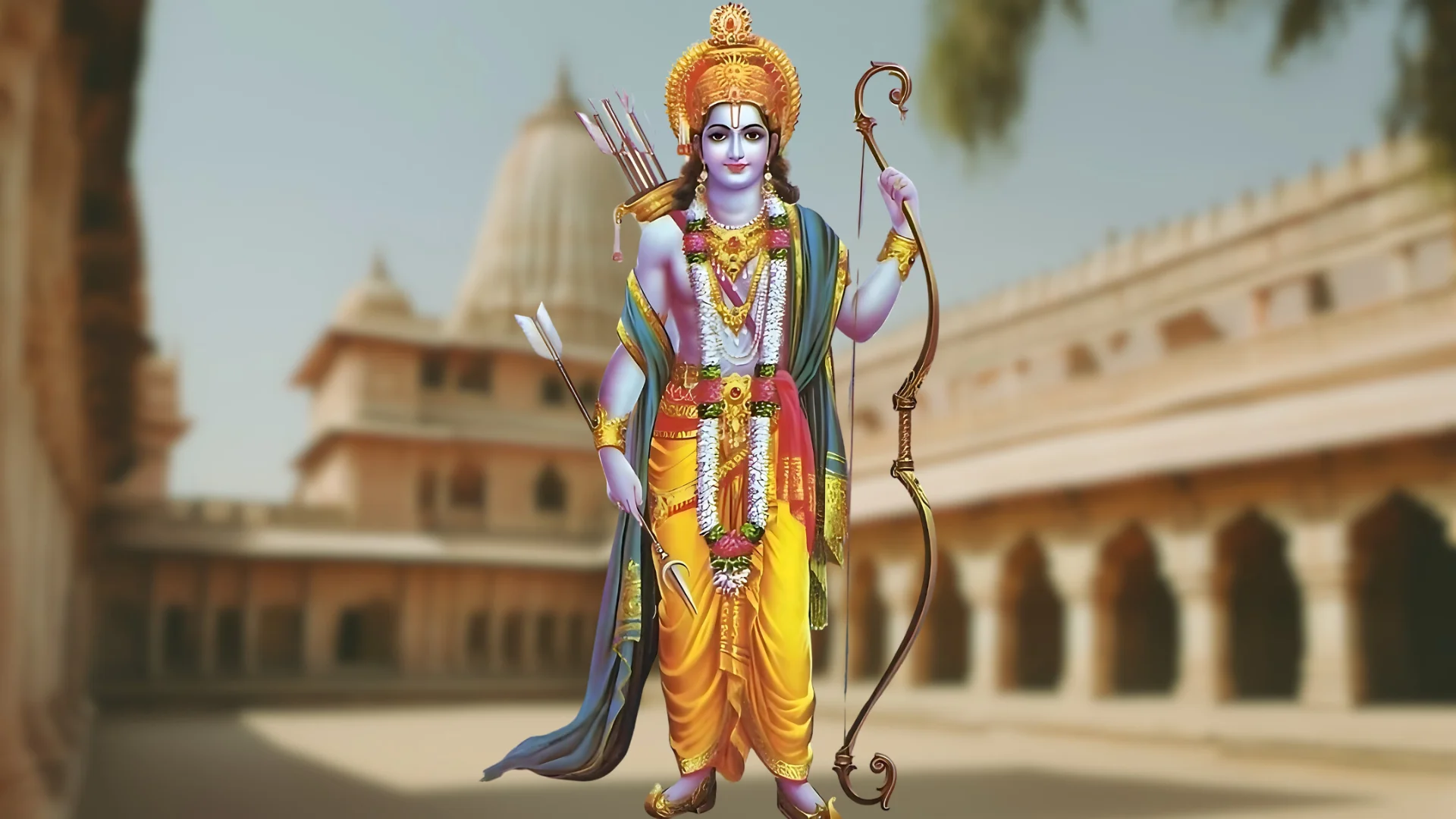
Fundamentals of the Rama Moola Mantra
Ram Ramaya Namah is called the Ram Moola Mantra. Many teachers have not given specific rules to chant this powerful Beeja mantra and proclaim that everybody is qualified to chant this mantra.

Based on my personal 35 plus years of mantra sadhana Grace and Blessings, Gurudeva instructs one cannot chant this mantra without prior qualification, all by oneself. Lord Raghavendra is the governing deity of the mantra, and Ram is the Beeja. This mantra is the Taraka Brahma mantra. It works like the Brahmastra.
The Sri Rama Moola Mantra, also known as Om Ram Ramaya Namaha, is one of the oldest, most sacred mantras recorded in the Upanishads. It is believed to condense the entire spiritual energy of Lord Rama into a single seed vibration. Devotees who engage in Ram Sadhana experience inner calm, discipline, and radiant strength. In traditional lineages, the Rama Moola Mantra is revered as the most powerful mantra of Lord Rama, channeling the grace of both Vishnu and Shakti through a single sound current.
Origins of the Rama Moola Mantra
But, one should chant this mantra only once one’s mind has become completely pure, and the Guru has qualified the sadhaka and given him/her Deeksha, to do Samaj Seva and work for the higher good of humankind, as part of his/her eternal higher sadhana process.

Lord Raghavendra revealed this mantra for the very first time to his consort, Sita Devi. Srimati Sita Devi who adores Lord Hanuman as her child, initiated him into this mantra. This is one of the most powerful Beeja mantras I have come across and in terms of Power and efficacy, since I have also taken initiation into it many years ago. Another Nama mantra which is equally effective is the Seeta Ram Hanuman mantra, which I keep chanting.
This Rama Moola mantra finds mention in the Rama Tapaniyo Upanishad. Lord Brahma, Sage Vashishtha, Parashara muni, Vyasa and Shukracharya received this through Guru Parampara System. Finally, Shukracharya initiated Jagadguru Ramananda Acharya into this mantra who is the incarnation of Lord Rama Himself.
The chant Om Ram Ramaya Namaha acts as a protective vibration around the sādhaka. Its benefits include mental stability, removal of karmic debt, and a renewed sense of faith in divine justice. In ancient tantric texts, this is classified among the Moola Mantras that purify the soul through sound. Practitioners often report a subtle warm light in their heart region during chanting, a sign of Lord Rama’s presence as the Tāraka Brahma.
The meaning of Om Ram Ramaya Namaha is simple yet profound: “I bow to Lord Rama, the embodiment of joy, virtue, and truth.” Om represents the primordial sound of creation; Ram is the Beej that burns negativity like fire; Ramaya symbolizes surrender to the divine order; and Namaha signifies the ego’s complete offering. Thus the phrase invokes the balance of spirit and matter, sun and moon, devotion and detachment.
Differences between Sri Rama and Sri Krishna
The Mantra Om Ram Ramaya Namaha means
I bow to Lord Rama who brings happiness, peace and fulfillment Essentially, the name Rama itself is called the Taaraka mantra. Just like Sri Rama’s character, His name is straightforward. Lord Rama stands straight looking into the devotee’s eye.
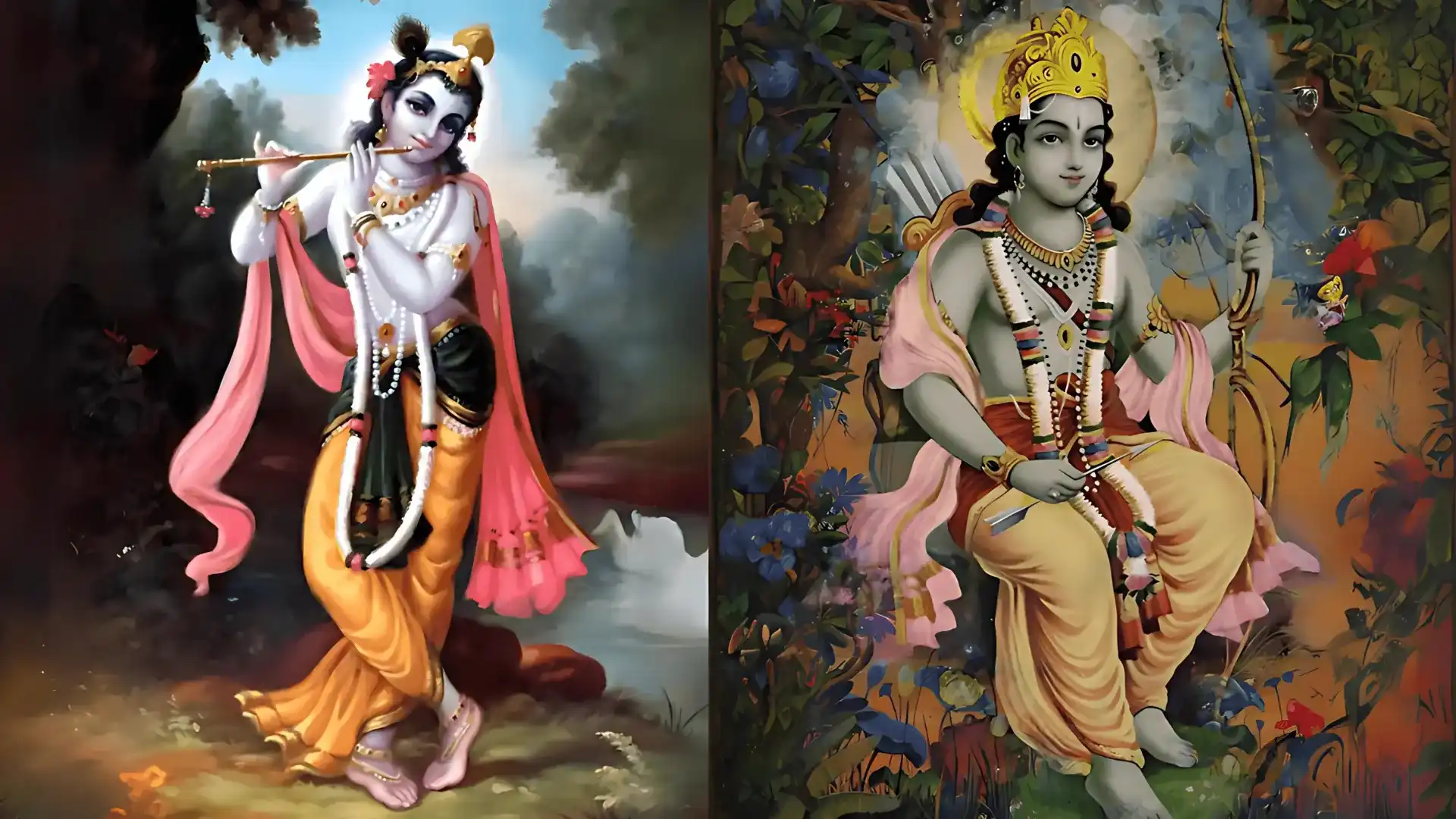
Lord Krishna stands in three bent posture known as Tribhanga. His name is also difficult to pronounce because of the Ri mantra in His Nama, and he looks at his devotee with a side glance. Lord Krishna’s character thus has multiple hues; however, Lord Rama is as straight as a stick.
Because of this directness and purity, the Rama Moola Mantra is regarded as the most powerful mantra of Lord Rama. Unlike other complex tantric invocations, this one requires no elaborate rituals, only faith, discipline, and guidance from a Guru. It carries the vibration of righteousness (Dharma) and acts as a spiritual weapon against inner negativity. The recitation of this single sound syllable Ram is described in the Rama Rahasya Upanishad as equal to reciting a thousand names of Vishnu.
Benefits of the Rama Mantra
So it is very easy to please Him. But, Lord Rama also looks at the Dharma aspect. If you are following your Dharma, Lord Rama is pleased. Lakshmi devi waits to enter your doorstep.
The mantra fulfills unfinished tasks and grants Karya-Siddhi if chanted by a soul, who has lost all the sense of mine-ness and working for higher good, having given up working for himself. An addict can get rid of his addictions.

It helps you attain the four aims of life, which are Dharma, Artha, Kama and Moksha. You get answers to your doubts internally even without having to express it. Chanting this mantra also invites the grace of mother Sita, and Lord Hanuman. Just like, when we cuddle a baby,its mother gets happy, Lord Hanuman becomes pleased when we praise Lord Rama and the same goes with Mother Sita. This mantra increases the Teja or brilliance in our body.
The Moola Mantra benefits extend far beyond material success. Devotees who regularly chant experience a purified mind, improved health, and deep inner faith. It is said that Om Ram Ramaya Namaha acts as a subtle detox for the nervous system, releasing anger, jealousy, and fear. With time, the mantra develops a protective aura around the devotee, often referred to as Ram Kavach in some spiritual traditions.
Those who practice the Ram Mool Mantra as a daily discipline report a marked increase in concentration and contentment. In ancient Ayodhya traditions, it was believed that this mantra alone could protect entire households from misfortune. The sound “Ra” activates the solar plexus, while “Ma” soothes the mind, creating a balance between effort and surrender. Hence, Rama is called the bridge between discipline and divine love.
Every Ram Sadhana is unique because the energy of Lord Rama works silently through devotion and duty. The devotee is tested in truthfulness, service, and detachment. When performed with steadfastness, Ram Sadhana unfolds as a journey from individual ego to universal consciousness. One begins to embody the qualities of Rama, integrity, strength, compassion, and fearlessness, not as concepts but as living forces within.
According to spiritual texts, the Om Ram Ramaya Namah Mantra benefits include the awakening of the solar nerve centers, which enhances mental alertness and inner vision. It also acts as a shield against dark thoughts and unseen energies. Healers use the vibration of this mantra to stabilize their own energy before helping others, for it draws on the pure fire of Rama’s truth.
As a Beej Mantra, Ram is both seed and flame. The syllable itself represents the core of the fire element (Agni), which destroys negativity and purifies the inner body. In tantric yoga, chanting the Beeja Mantra Ram on each chakra is believed to burn away past karmas and ignite the divine light within. Therefore, in the context of Rama Moola Mantra, the word “Ram” is not merely a name, it is a vibration of transformation.
The Sri Rama Moola Mantra is thus a bridge between form and formless, between devotion and realization. It teaches that the divine exists not only in temples but within the rhythm of the heart. When recited with faith and discipline, it brings both worldly success and spiritual completion. This is why the Upanishads call it the “Taraka Mantra of Rama”, the chant that ferries the soul across the ocean of birth and death.
Among the many sacred formulas known to humanity, few match the Om Ram Ramaya Namah benefits in sheer simplicity and power. This mantra transcends religious boundaries, helping even those with no formal training to find peace within themselves. Its vibration harmonizes the five elements in the body and awakens the fire of truth in the soul.
When you repeat Ram Ramaya Namaha, you connect to an ancient lineage of sages and Rishis who have used this sound for thousands of years to invoke protection, clarity, and divine love. The Ram Ramaya Namaha Mantra benefits include karmic healing and blessings that flow across generations. Families who recite it daily find greater unity, prosperity, and a sense of sanctity in their homes.
In the Vedic framework, the Moola Rama Mantra represents the spiritual core of Lord Rama worship. It is the essence from which other mantras arise. Advanced sādhakas use it to invoke the energy of Dharma Vijaya, the victory of righteousness over illusion. Just as the root supports the tree, the Moola Rama Mantra supports all forms of Rama devotion and Vishnu worship. Before we deleve deep into the Conditions for chanting the Moola Mantra let us discuss the rare Sri Rama Mantra Yantra
Sri Rama Mantra Yantra, The Sacred Geometry of Bhakti and Inner Purity
What is the Sri Rama Mantra Yantra Equivalent Yantra?
The Sri Rama Mantra Yantra is a sacred geometric embodiment of the divine vibration contained in the Sri Rama Moola Mantra , Om Ram Ramāya Namah (ॐ राम रामाय नमः). It represents the subtle field where Lord Sri Rama’s consciousness becomes accessible to the devotee through bhāva (heart devotion) rather than ritual formality.
Each line, angle, and bindu (central point) of the Yantra carries the resonance of “Hreem Rām Hreem” and “Sowṁ”, the bija sounds that awaken sattva and compassion within the mind. The intersecting triangles signify the descent of divine will (Śrī Rāma Tattva) into the human heart and the ascent of the devotee’s love toward the Divine. Thus, the Yantra is both an altar and a mirror , it reflects the devotee’s own purified consciousness.
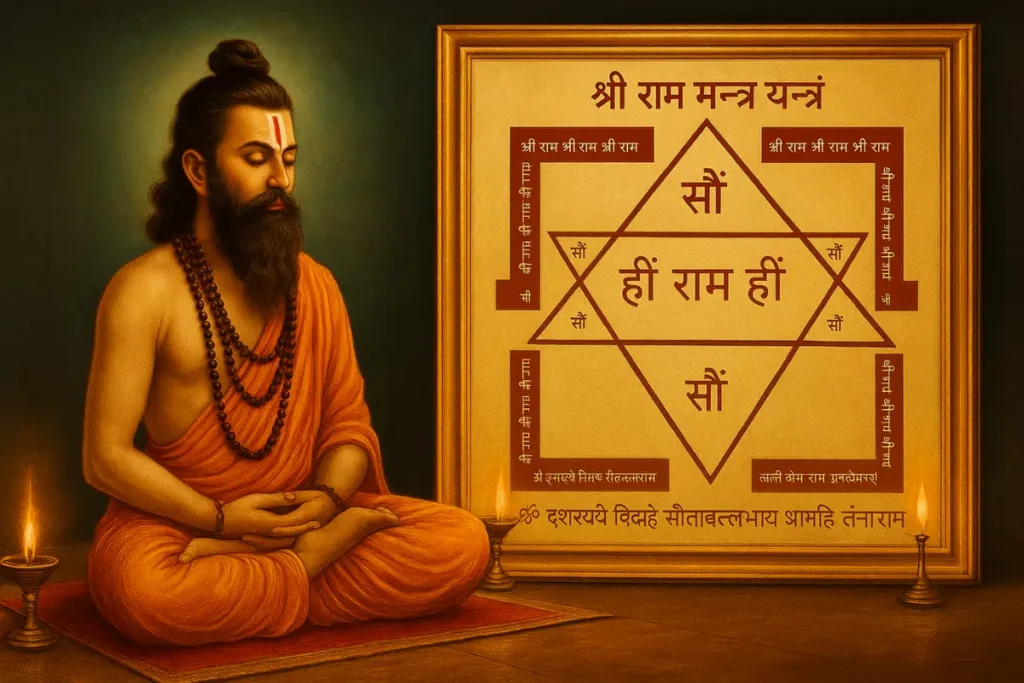
Meditating upon this Yantra is not merely symbolic; it reorganizes inner energy patterns, harmonizing the manas (mind), buddhi (intellect), and chitta (feeling) so that the Rama Nama may take root effortlessly. Wherever it is placed , home, temple, or workplace , the Sri Rama Mantra Yantra transforms ordinary space into a field of calm, righteousness, and inward devotion.
Benefits of the Sri Rama Mantra Yantra
The Sri Rama Mantra Yantra brings peace, stability, and devotion that transcends the turbulence of the modern mind. Its vibration awakens the innate dharma shakti within the practitioner, supporting both spiritual and practical life.
When one meditates upon it while chanting Om Ram Ramāya Namah, the mind experiences spontaneous concentration (ekāgratā). Anxiety and restlessness subside, replaced by compassion, discipline, and equanimity , virtues embodied by Lord Sri Rama Himself. This equilibrium directly aids relationships, decision-making, and emotional health.
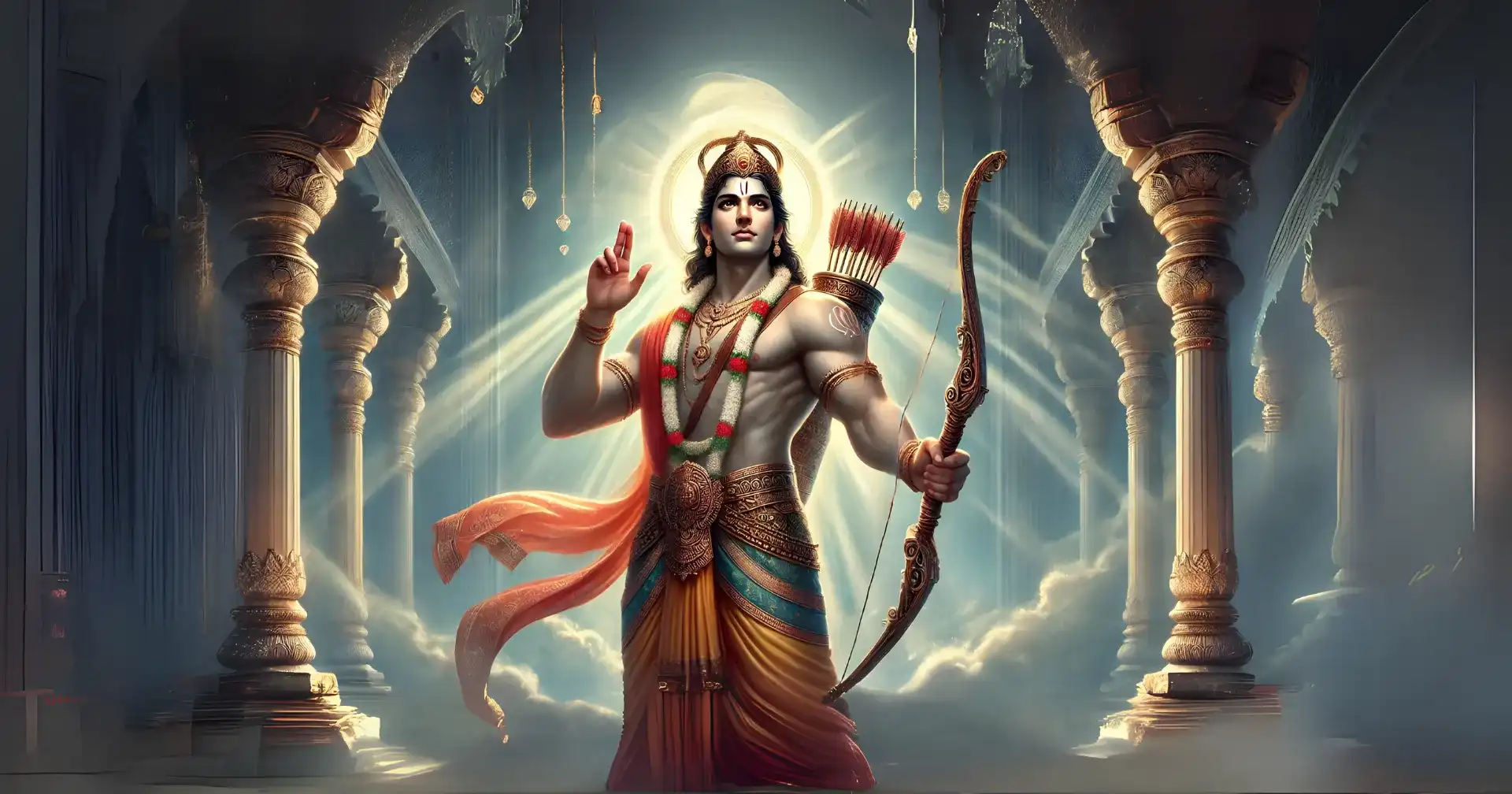
Spiritually, the Yantra serves as a bridge between external worship and internal realization. It helps devotees feel the living presence of Sri Rama in their daily life , not as an image of the past, but as the eternal consciousness of righteousness (Maryāda Puruṣottama). With steady practice, one feels guided from within, finding clarity and courage even amidst trials. Ultimately, the Yantra refines the heart, turning ordinary remembrance into deep, living Bhakti.
Structure of the Sri Rama Mantra Yantra
The Sri Rama Mantra Yantra image shows the classic design used in the Vaishnava tradition. At its center lies the sacred bindu containing “हीं राम हीं (Hreem Rām Hreem)”. This bindu is enclosed by two interlocking triangles forming the six-pointed Śaṭkoṇa, symbolizing the harmony of divine will and human surrender.
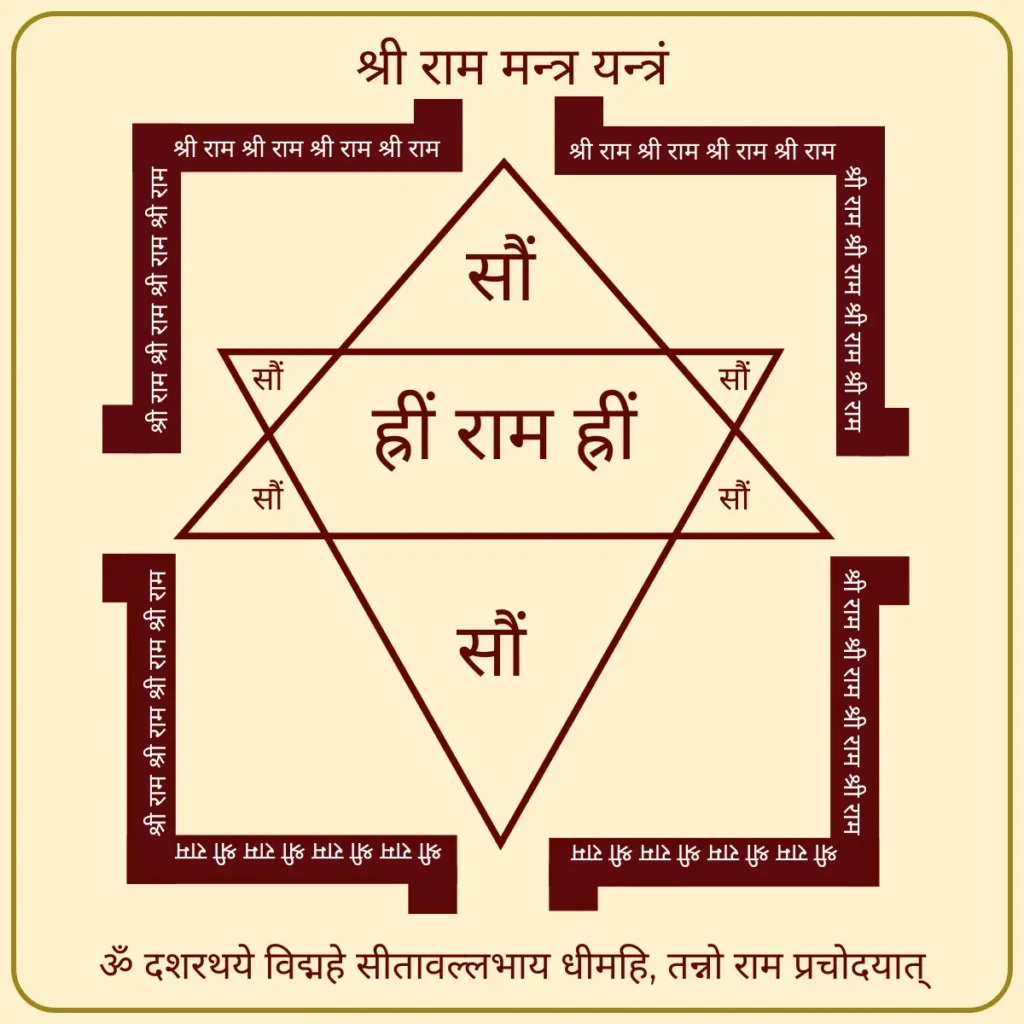
Within and around these triangles appear five repetitions of the seed syllable “सौं (Sowṁ)”, representing the fivefold flow of prāṇa through the heart. Surrounding the central geometry are four bhūpuras (square gateways) inscribed with Śrī Rām Śrī Rām Śrī Rām Śrī Rām, denoting His omnipresence in the four directions. Outside this is the periphery mantra:
“ॐ Daśarathāya Vidhmahe Sītāvallabhāya Dhīmahi Tanno Rāma Prachodayāt” , the Rāma Gayatrī, acting as the Yantra’s subtle aura.
Each geometric layer corresponds to the progression from name (nāma) → form (rūpa) → essence (tattva). The devotee’s awareness moves inward through these rings during meditation until resting at the bindu, where the heart recognizes its unity with Śrī Rāma Caitanya.
Geometrical Significance and Chakra Connection
The Sri Rama Mantra Yantra directly resonates with the Anāhata Chakra (Heart Center), the seat of Bhakti and emotional purity. The upward triangle represents aspiration , the devotee’s rising love; the downward triangle symbolizes grace descending from the Divine. Where they meet, the Śaṭkoṇa becomes the symbol of union between Ātman and Paramātman.
When one gazes steadily at the bindu while softly reciting Om Ram Ramāya Namah, the heart’s rhythm slows, breath becomes even, and subtle vibrations are felt in the chest. This experience purifies emotional residues, replacing fear and sorrow with courage and surrender , hallmarks of Sri Rama Bhakti.
Through consistent practice, awareness expands upward from the heart toward the Viśuddha Chakra (truth-expression) and downward toward the Maṇipūra Chakra (will-power). Thus, the Yantra becomes a living circuit of energy connecting feeling, speech, and action in divine harmony , the very essence of dharma.
Mantras to Activate the Sri Rama Mantra Yantra
Beeja Mantras
- Om Hreem Rām Hreem Namah
- Om Sowṁ Rām Sowṁ Namah
- Om Ram Ramāya Namah , the Moola Mantra, foundation of all Rama sādhanā
Gayatri Mantras
- Om Daśarathāya Vidhmahe Sītāvallabhāya Dhīmahi Tanno Rāma Prachodayāt
- Om Rāmachandrāya Vidhmahe Rāghavāya Dhīmahi Tanno Rāma Prachodayāt
These mantras are first purified through Guru Deeksha, wherein the Guru transfers subtle life-force into the disciple’s mantra. Without this empowerment, repetition remains mechanical; with it, the mantra becomes luminous, alive, and protective.
During activation, the practitioner lights a lamp, places the Yantra facing east, and chants each beeja 108 times. The Gayatri is recited thrice to seal the vibration. A calm, pure mind is essential; therefore, silence and cleanliness of the surrounding space are considered part of the ritual.
Preparation of the Sri Rama Mantra Yantra at YantraChants.com
At YantraChants.com, every Sri Rama Mantra Yantra is handcrafted on Bhojpatra , a traditional Himalayan bark used in ancient temples. The geometry is inscribed using a pomegranate-wood stylus dipped in natural red vermilion (raktachandana leha) and sanctified water. Each line is drawn under mantra recitation, ensuring the flow of sound merges with the geometry.
The process follows the living Guru Paramparā of Śrī Rāma Bhakti Tradition. Before dispatch, the Yantra undergoes prāṇa-pratiṣṭhā (energization), ghee-lamp ārati, and 108 recitations of the Moola Mantra by the Guru’s disciples. This is not mechanical manufacturing , it is conscious transmission.
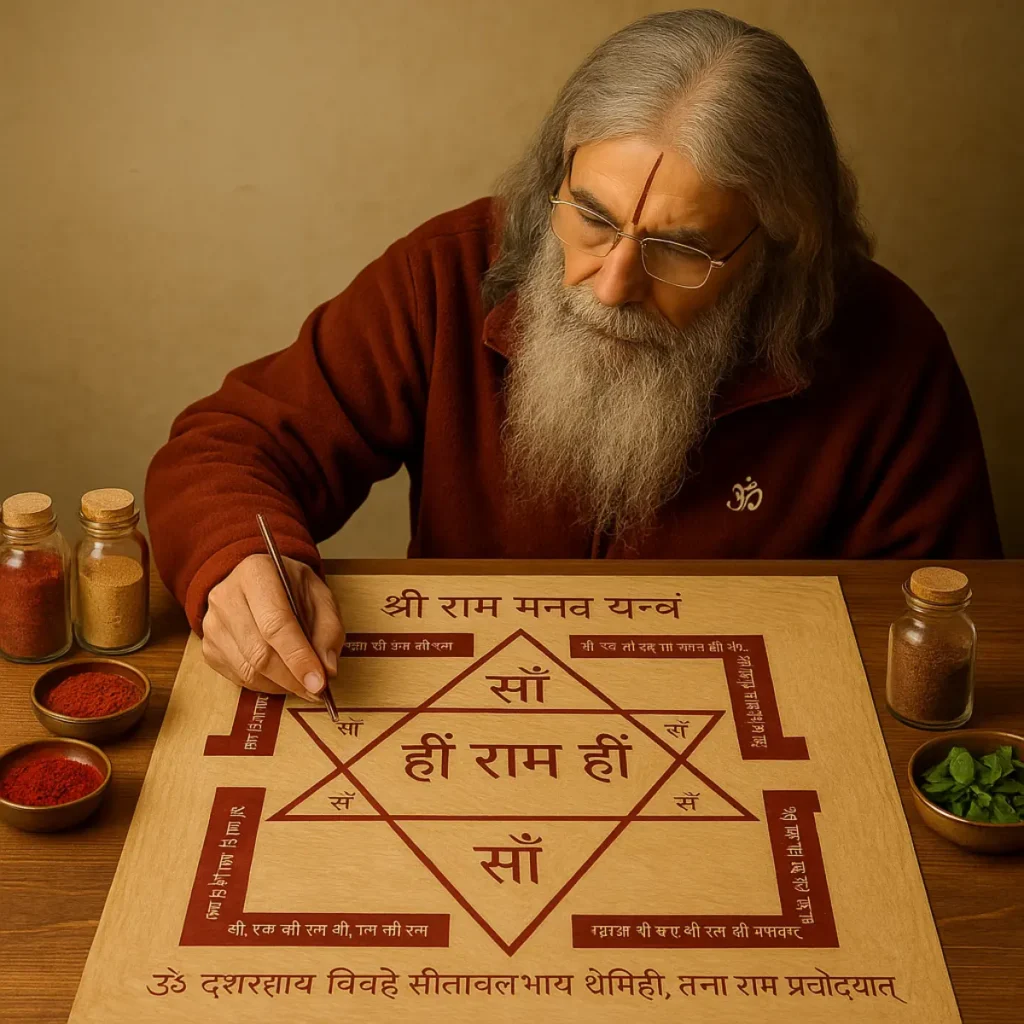
When received by a devotee, the Yantra carries a pre-established spiritual charge, ready to awaken upon first sight. Unlike printed replicas, these Bhojpatra Yantras have a living aura that resonates with the practitioner’s intention and becomes a subtle companion on the path of Bhakti and peace.
Importance of a Self-Realized Guru
The Sri Rama Mantra Yantra becomes truly active only through the touch and intention of a Self-Realized Guru. The Guru is the medium through which Lord Sri Rama’s grace flows into the seeker’s heart. While the Yantra represents divine energy, the Guru ensures it aligns with the devotee’s karmic pattern and readiness.

A realized master knows when and how to impart the Moola Mantra, the breathing rhythm, and visualization method that will safely awaken the heart. Under such guidance, the Yantra no longer remains an external diagram; it transforms into an inner landscape , a luminous lotus unfolding at the Anāhata Chakra.
The Guru’s role is therefore not ornamental but essential. Just as Lord Hanuman received strength through remembrance of Sri Rama, the disciple receives realization through the Guru’s remembrance of the Divine in him.
Rare Observations in Using the Sri Rama Mantra Yantra
Devotees often report a sense of gentle warmth in the chest, heightened intuition, or subtle fragrance of sandalwood during meditation. Such experiences indicate purification of the heart rather than mystical display. During Rāma Navamī, Hanuman Jayanti, or Navaratri, meditating with this Yantra magnifies inner absorption and deepens compassion.
The Yantra can also serve as a remedy during emotional imbalance or mental fatigue. Simply gazing at the bindu while softly repeating “Rām” synchronizes the mind and breath. Some devotees keep a small pocket version to hold during travel or sleep; it acts as an anchor of remembrance and security.
Above all, the most precious sign of success is a quiet joy , the inner assurance that Lord Sri Rama walks with you even in silence.
Devotional Significance of Sri Rama
Lord Sri Rama , the embodiment of Maryādā, virtue, and serenity , represents the perfected human who lives as divine. Meditating on His Yantra reminds us that righteousness need not be rigid; it is love disciplined by wisdom. Through Bhakti to Sri Rama, the ego softens, humility flowers, and forgiveness becomes natural.
Unlike occult practices that seek power, Rama Bhakti seeks purity. The practitioner does not chase miracles but inner mastery. By daily gazing at the Yantra, lighting a lamp, and chanting His Moola Mantra, one slowly begins to live with simplicity, duty, and compassion , the true fruits of Rāma-Tattva.
Integrated Process for Sri Rama Mantra Yantra Meditation
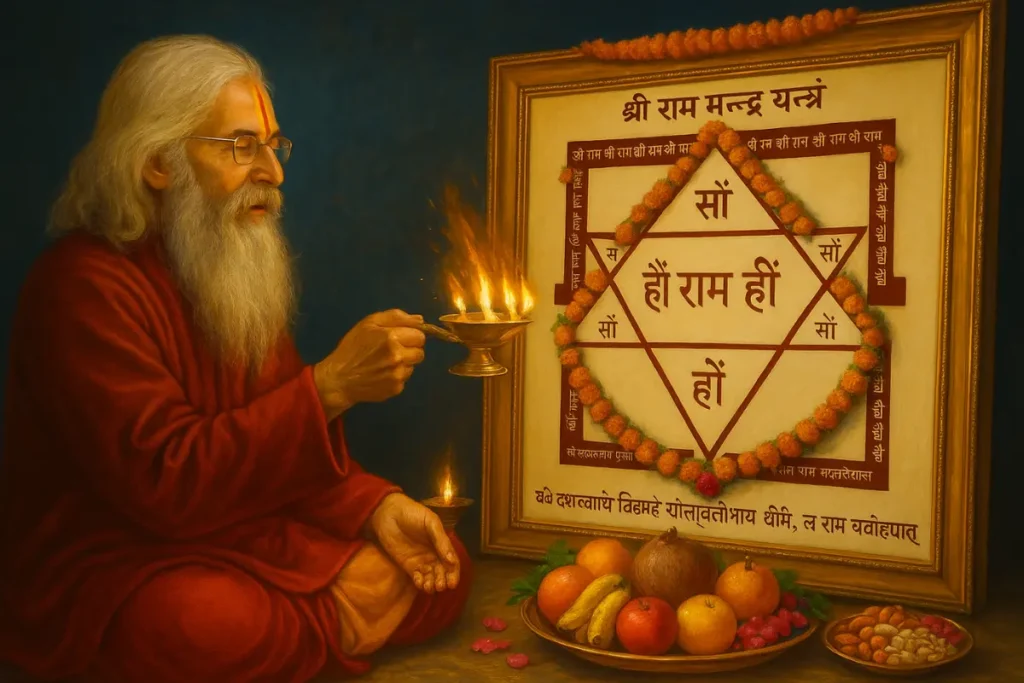
- Seat yourself facing east. Place the Yantra at heart level.
- Light a diya and offer a flower or tulsi leaf.
- Gaze softly at the central bindu for a few breaths until thoughts settle.
- Chant the Moola Mantra , Om Ram Ramāya Namah 108 times, letting sound and breath merge.
- Visualize golden light expanding from the Yantra into your chest, resting in the Heart Chakra.
- End with silent gratitude, feeling the presence of Lord Sri Rama within.
Regular practice awakens the Anāhata Chakra, seat of divine love. Here Bhakti begins , the vibration of “Rām” becomes the pulse of consciousness itself. Over time, this steady habit elevates awareness, strengthens will, and brings unshakable peace.
FAQs on Sri Rama Mantra Yantra and Practice
Q1. What is the Sri Rama Mantra Yantra and how does it complement the scriptural text?
A. It is a geometric expression of Lord Sri Rama’s mantra energy. While the scriptures give verbal knowledge, the Yantra transmits silent experience, helping the devotee internalize teachings through the heart.
Q2. How should I place the Yantra at home or office?
A. Keep it on a clean altar facing east or northeast at eye level. Ensure the surroundings are peaceful and free from clutter to preserve the sanctity of vibration.
Q3. Which direction should I face during practice?
A. Facing east invokes solar vitality and aligns with Sri Rama’s radiant aspect. North is acceptable when east is unavailable.
Q4. Which day and time are ideal to begin practice?
A. Start on a Thursday or Sunday, especially during sunrise (Brahma muhūrta). Discipline matters more than astrology; sincerity sanctifies the moment.
Q5. What offerings are appropriate?
A. A small diya, clean water, fragrant flowers, and tulsi leaves are sufficient. Bhakti, not quantity, pleases Lord Sri Rama.
Q6. How many daily repetitions of the Beeja Mantras are recommended?
A. Chant any of the three beejas 108 times daily or as per comfort, maintaining steadiness rather than speed.
Q7. How do I set a sankalpa that aligns devotion with life?
A. State inwardly, “May this practice purify my heart and guide all actions toward dharma and compassion.”
Q8. Can I split practice into short sessions?
A. Yes. Morning and evening sittings maintain continuity and deepen absorption.
Q9. How to cleanse or re-energize the Yantra?
A. Wipe gently with pure water or rosewater on full-moon days while chanting Om Ram Ramāya Namah 21 times.
Q10. What if altar space is small?
A. Keep only essentials: the Yantra, a lamp, and a flower. Simplicity concentrates energy.
Q11. How to combine text recitation with Yantra japa?
A. Recite the selected verse of Rāma Gayatrī before japa to invoke grace, then continue mantra repetition with gaze on the bindu.
Q12. Should I recite before or after Beeja Mantras?
A. Begin with the Gayatri, proceed to the Beeja (but only after a Paramparic Sri Guru initiation, not before), and end in silence , symbolizing invocation, manifestation, and dissolution.
Q13. What are signs that the synergy is working?
A. Inner calm, improved relationships, and effortless remembrance of the Name show the Yantra is resonating.
Q14. How to select a daily verse?
A. Choose any line from Rāma Charita Mānasa (for all) or Sri Rāma Gayatrī (for the Initiated only) that evokes love; repetition turns it into meditation.
Q15. How to handle pronunciation concerns?
A. Devotion outweighs accent. Chant slowly, letting vibration be felt rather than forced.
Q16. Do I need Guru Deeksha for advanced results?
A. Yes. Guru Deeksha aligns mantra energy with your subtle body, ensuring balanced awakening.
Q17. Are there restrictions on who can keep the Yantra?
A. None. Anyone with pure intent and respect may keep it; righteousness, not background, determines eligibility.
Q18. Is fasting required?
A. Optional. Light, sattvik food supports clarity; forced austerity is unnecessary.
Q19. What if I miss a day?
A. Resume calmly the next day. Consistency is cumulative; guilt dissipates energy.
Q20. How to retire a damaged Yantra?
A. Wrap it in natural cloth and immerse in a river or beneath a sacred tree with gratitude.
Q21. How to maintain a calm sankalpa without attachment?
A. Offer results mentally to Lord Sri Rama, seeing each act as service rather than achievement.
Q22. How long to notice changes?
A. Within 40 days many feel emotional balance and clearer perception. Growth then unfolds gradually.
Q23. How to review progress?
A. Observe increased patience, kindness, and self-discipline , these are signs of deeper Rama consciousness.
Additional Popular FAQs (Internet + Bhakti-based)
Q24. Can chanting the Rama Moola Mantra control the mind?
A. Yes. The repetition of Rām harmonizes breath and thought, gradually silencing mental turbulence.
Q25. How is Sri Rama Bhakti linked to humility?
A. His life teaches service over pride. Regular remembrance of His name dissolves ego and nurtures compassion.
Q26. Does the Yantra influence habits and discipline?
A. The geometric symmetry subtly entrains the mind toward order and focus, improving daily habits naturally.
Q27. Can the Yantra help in anxiety or overthinking?
A. Yes. Gaze softly at the bindu while repeating “Rām”, it pacifies mental restlessness by balancing Anāhata vibrations.
Q28. What is the link between Rama Nama and the Heart Chakra?
A. The syllable “Rām” vibrates directly through the chest, purifying emotional patterns and awakening unconditional love.
Q29. How does Sri Rama consciousness differ from other deities?
A. It expresses harmony of human duty and divine perfection , an example of divinity lived through humanity.
Q30. Can non-Hindus use this Yantra?
A. Absolutely. The vibration of Rām transcends boundaries; it is universal sound for peace and compassion.
Q31. Is the Sri Rama Yantra different from Hanuman Yantra?
A. Yes. The Rama Yantra radiates calm discipline, while Hanuman Yantra channels strength and courage; both complement each other.
Q32. What are ideal times for chanting?
A. Sunrise, sunset, or before sleep , when mind is quiet and receptive.
Q33. Why does chanting bring tears sometimes?
A. It is emotional purification; the heart releases old pain, allowing Bhakti to flow.
Q34. Can I keep the Yantra under my pillow?
A. Yes, if kept in a clean cloth. It stabilizes subtle energy during sleep and enhances dream clarity.
Q35. What if others touch my Yantra?
A. Purify by lighting a diya and chanting Om Ram Ramāya Namah thrice; intention resets sanctity.
Q36. Does focusing on the star shape have specific effects?
A. Yes. It synchronizes the left and right brain, balancing reason and emotion , the core of Rama consciousness.
Q37. Can I listen to Rama chants instead of reciting?
A. Listening with attention is beneficial, but active chanting internalizes energy more deeply.
Q38. Is there a connection between Rama Bhakti and mental health?
A. Profoundly. Rama Bhakti cultivates emotional regulation, faith, and resilience , all vital for balanced psychology.
Why cannot Everyone chant the Moola Mantra Without Restrictions
If an unqualified person chants this mantra, his body temperature can increase and may get high fever, because of energy blocks in his system because of negative emotions. So one can never undertake the sadhana of this mantra without the direct instructions of a perfect Guru.
But when a qualified person chants this mantra, it exhibits the flair of richness and ease. The consciousness of a person with totally purified consciousness gains tremendously when he takes the mantra from a qualified Guru.
Many seekers often wonder about the Om Ram Ramaya Namah meaning. The mantra carries a balance of cosmic order and inner alignment. The sound “Ram” ignites divine courage, while “Ramaya” means surrendering oneself to the essence of the Divine. “Namah” represents humility, the dissolving of personal will in God’s will. Thus, chanting it without preparation is like trying to hold fire with bare hands; only when purified by devotion can one safely channel its energy.
Those who have received proper Deeksha often witness what can only be called Mool Mantra miracles, sudden inner peace, dreams of divine guidance, protection from unseen dangers, or even healing of chronic ailments. These are not coincidences but signs of the mantra’s consciousness aligning the devotee’s life with Dharma. Just as fire burns impurities, the Moola Rama mantra burns karmic debris, creating clarity and divine protection.
The Moola Rama vibration is said to exist eternally in Ayodhya’s spiritual field. When chanted, it attunes the practitioner to Rama’s eternal consciousness, gentle yet firm, luminous yet grounded. Sages of the Uttaradi Mutt tradition call this resonance “Rama Shakti,” the spiritual current that flows from the heart of Vishnu through the syllable “Ra.”
Complete Selflessness through the Moola Mantra
His consciousness attains newer heights which adds to his persona and reach. Such a person attains complete selflessness which increases his energy body by leaps and bounds. The Mantra keeps diseases away provided you maintain a healthy lifestyle.
However, the chanting should be continuous- wherever you are, your tongue should repeat His name, not just limited to the Sadhana time, of course this applies only to people initiated into the mantra. The mantra is short and simple and does not involve twisting of the tongue.
The Ram Mantra is a direct invocation of divine simplicity. It does not demand elaborate rituals, only the purity of heart. Chanting Om Ramaya Namah even while walking, cooking, or working keeps one’s consciousness aligned with Dharma. It transforms mundane life into continuous prayer.
The ancient seers called it the Rama Manthra of Liberation, or Tāraka Mantra, because it ferries the soul across the ocean of illusion. This sound vibration awakens devotion (bhakti) in the heart and awareness (jñāna) in the mind. Every repetition of “Ram” brings the chanter closer to self-realization, as the mind dissolves into the rhythm of divine sound.
Breakdown of the Moola Mantra
In Yoga, Ra represents the solar energy generating heat in the body. It flows through the Pingala Nadi on the right side of our spinal cord. Remember to keep yourself hydrated during Rama mantra sadhana.

Ra thus represents masculine energy. To maintain a balance, Ma represents the lunar energy. It flows into the Ida Nadi on the left side of the spinal cord. It is feminine. The wife usually sits to the left of her husband. Thus Ida finds its place on the left side of our spinal cord while Pingala on the right side.
The relationship between Ra and Ma also forms the subtle science known as Ram Tantra, the yoga of sound, breath, and devotion. Here, the practitioner learns how the mantra aligns pranic energy in the body’s subtle channels, balancing Shiva and Shakti. The Ram Tantra tradition views the Rama Moola Mantra as both spiritual practice and energetic healing technique.
In certain tantric texts, this is referred to as the Ram Tantrik Mantra, symbolizing both solar and lunar unity. It opens the doorway to subtle consciousness and can ignite the Kundalini when practiced under a realized Guru. However, it must never be attempted casually, as the energy can be intense and transformative.
Process of Chanting Sri Rama’s Mantra
Now I shall tell you how to chant the mantra-
You can chant this mantra at your home, Hanuman temple or Shiva temple, after due initiation. Select the nearest auspicious day in the calendar, such as Rama Navami, Navaratri, Ekadashi or Diwali to begin your sadhana.
One should use either Lotus Bead, Chandan or Sandalwood Beads or Tusli Beads for chanting. A person committed to service of fellow men, can get his work done, by chanting regularly on Chandan Bead Mala. For attaining all the knowledge of the universe, the ideal candidate should use Tulsi beads.
For all other purposes, the initiated candidate should use Lotus Beads. Shiva Bhaktas can use Rudraksha Mala, if they are not married or following Brahmacharya.
By Shiva Bhaktas I mean those who are initiated by Shaivite gurus and have undergone the due purification process. As I said earlier, the mantra requires initiation and the guidance of a guru.
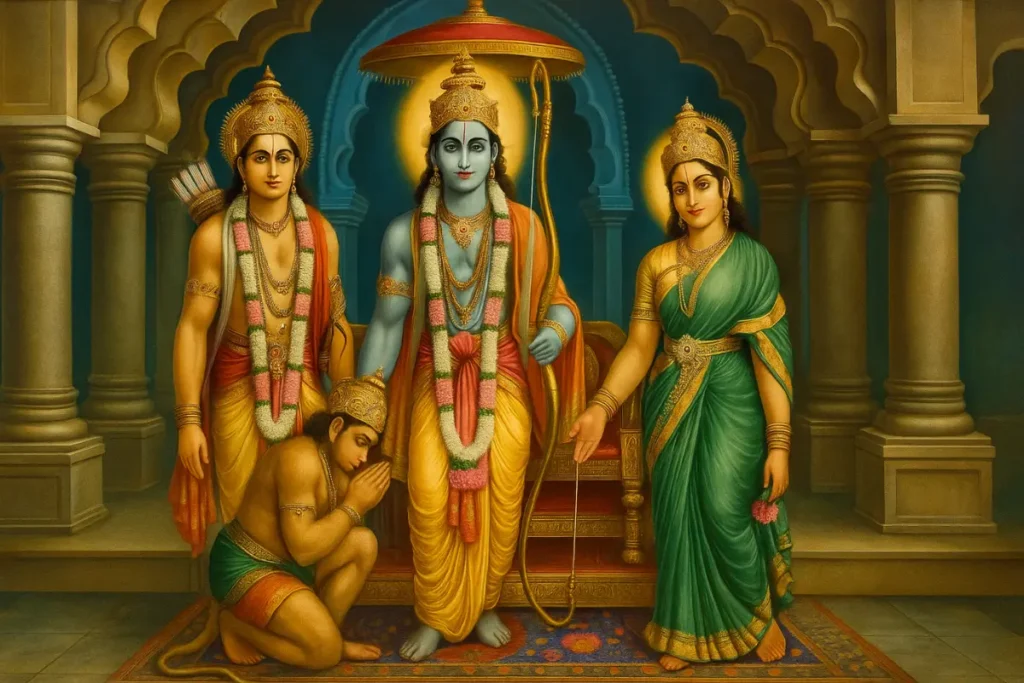
Keep an idol of Lord Rama or a photo of the Rama Darbar in front of you. There are no dress colour restrictions; however saffron colour is most suitable. Light a pure ghee lamp for the Lord and offer dry fruits as Archana. Do not forget to add a Tulsi leaf on it, with drops of water. Before starting your sadhana, think of your guru, Lord Ganesha and Lord Hanuman.
Then only shall your sadhana fructify.
Thereafter take a sankalpa telling the lord the purpose of your sadhana. Chant five rounds of the mala (i.e -108 x 5 chants) for six months without missing a single day. Obstacles will come to test you, but you have to remain steadfast. This is the only way.
You shall see genuine changes only after the stipulated time period. There are some lifestyle restrictions as well.
Since Lord Rama is an incarnation of Lord Vishnu, he does any help or support devotees consuming non-veg and onion garlic or involved with any form of Gambling. I want to clarify that in the modern context investing in shares is also a type of gambling. So the devotee has to mold himself to the liking of his Ishta Devata.
Also, no smoking, alcohol and addictive substances. Maintain this self-restraint for 6 months at least, after receiving initiation. One can only have an association with one’s wife for producing god-conscious progeny and not for sense enjoyment.
This should be the approach of any grihastha chanting any Sattvic Mantra such as the Rama Moola Mantra.
Advanced practitioners call this discipline the Ram Siddhi Mantra practice, for it ensures both worldly achievement and spiritual mastery. When performed sincerely, the mantra acts as an internal purifier, washing away subconscious fears and attachments. Each repetition is a declaration of surrender, “O Lord Rama, take charge of my mind and guide me on the path of truth.”
In Vaishnava traditions, the Om Ram Ramaya Namaha is often regarded as a Ram Mahamantra, equal in potency to the Hare Rama Mahamantra. The Mahamantra represents the soul’s call to merge with the divine presence of Lord Rama, who is known as the embodiment of Dharma, compassion, and truth.
Every Lord Rama Mantra echoes the vibration of faith and protection. Whether it is the Taraka Mantra, the Rama Gayatri, or the Rama Moola Mantra, all of them carry the same fire of righteousness. The secret lies not in the sound alone but in the heart that utters it.
The Rama Taraka Mantram has been described in the Agni Purana as the boat that ferries souls across the ocean of life and death. Chanting this mantra daily, especially during sunrise or sunset, brings harmony to the mind and strength to the heart.
When the devotee softly repeats Ramaya Namah, the mind begins to glow like the morning sun. “Ramaya” refers to the divine consciousness that pervades all beings. Thus, every chant is not just a prayer but a remembrance that Rama lives within.
Among thousands of sacred utterances, Om Ram Ramaya Namaha is one of the most powerful Rama mantras known for awakening self-discipline and moral clarity. Its steady rhythm guides the restless mind toward peace and gives strength to live a dharmic life amid worldly challenges.
When you receive Ram Mantra Diksha from a realized Guru, it’s not merely a transmission of sound but of Shakti, divine energy. The Guru ignites the flame of Rama’s consciousness in the disciple’s heart, enabling the mantra to bear fruit. Without initiation, the words remain sound; with it, they become divine fire.
There are many Rama Mantras, yet the Rama Moola Mantra stands as the root of all. It harmonizes the energies of devotion, protection, and liberation. Chanting this daily purifies the aura and ensures that no harmful energy can penetrate the devotee’s spiritual field.
Scriptures describe that the Guru of Lord Rama was Sage Vashistha, the great seer who initiated Him into divine knowledge. Through Vashistha, even the Supreme Being demonstrated the importance of learning under the guidance of a Guru. Hence, all Rama-related sadhanas emphasize Guru-śiṣya paramparā, the unbroken lineage of wisdom.
Truly, there is no greater example of divine perfection than Best Rama, who exemplified duty, compassion, and honor. His name alone carries vibrations of purity strong enough to transform consciousness. To chant His mantra is to align one’s heart with cosmic law.
Many devotees conclude their puja with Om Sri Sita Om Sri Rama, invoking both divine feminine and masculine energies. This chant harmonizes the grace of Sita with the courage of Rama, ensuring that the sadhaka lives with both compassion and strength.
Final Reflections
The chanting of Om Ram Ramaya Namaha is not a mere repetition, it is a living relationship with Lord Rama Himself. Every breath becomes a bridge between the human and the divine, between the seeker and the sought.
A Mantra for Ram is not only a tool for prayer but a key to awakening consciousness. When uttered with sincerity, the sound of “Ram” penetrates the layers of the mind, revealing peace where there was conflict and light where there was confusion.
Ultimately, Om Ram Ramaya Namaha remains the powerful mantra of Lord Rama that leads the soul toward liberation. It teaches humility, courage, and surrender, the pillars upon which true spiritual life stands.