
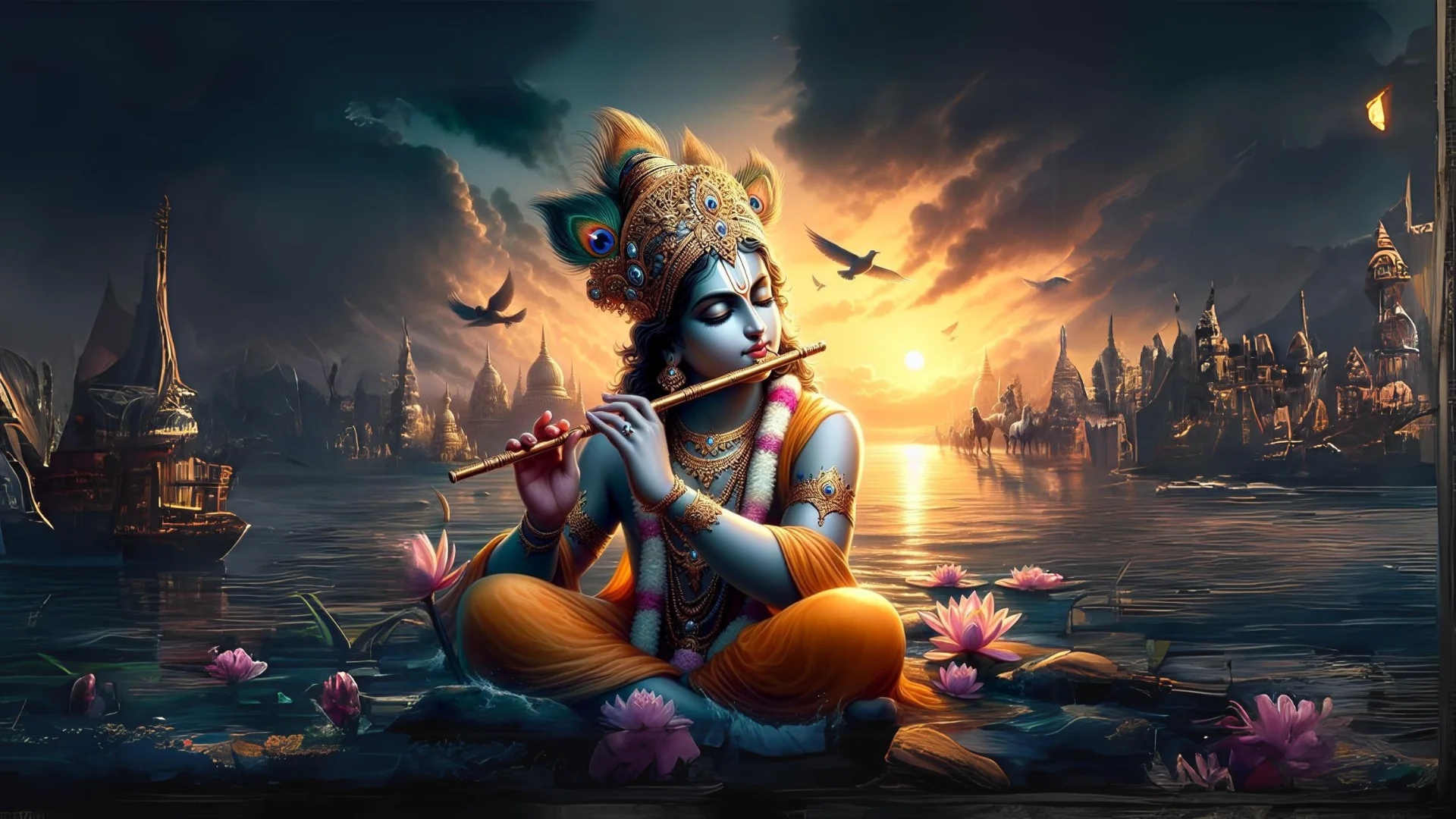
Om Kleem Krishnaya Namah is a powerful Beeja Krishna mantra. It evokes divinity, surrender (Sharanagati), emotional harmony, and bhakti. When one practices sadhana with an energized Krishna Yantra, it will help ground the Kleem beeja. With this, attraction transforms into devotion. One may develop steadiness in relationships. Overall one develops overall sweetness in one’s aura. Emostional Stress shall become a forgettable experience of the past.
A Rooted, Lineage-Practiced Approach
Some mantras awaken effort.
Some awaken surrender.
Om Kleem Krishnaya Namah belongs to the second kind.
This mantra has long been practiced in quiet, disciplined ways by Krishna-bhaktas living near the foothills of Govardhan, where remembrance of the Lord is woven not into performance, but into daily rhythm. In such settings, the mantra is not treated as a tool for results, but as a companion for inner softening and steadiness.
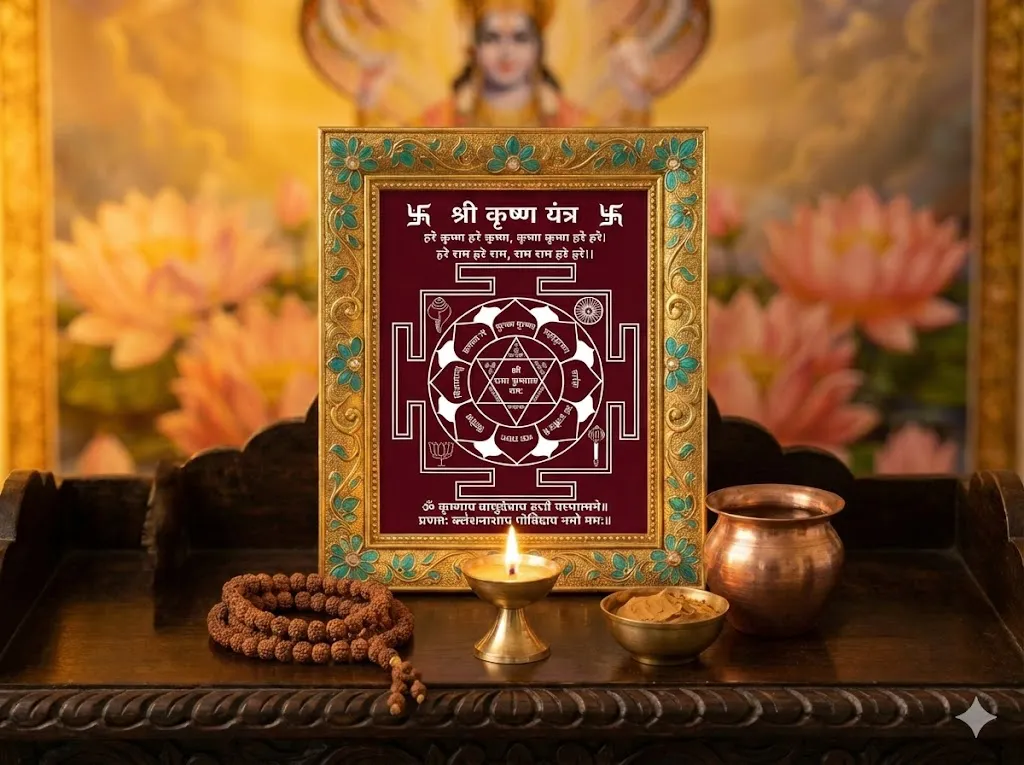
When supported by a properly energized Krishna Yantra, this mantra becomes a stabilizing bridge between bhakti (devotion) and jnāna (inner clarity), allowing spiritual depth and material life to harmonize naturally, without strain.
What Does Om Kleem Krishnaya Namah Really Mean?
This mantra is not a single sound, it is a layered alignment refined through lived repetition.
| Component | Inner Meaning | Subtle Effect |
|---|---|---|
| Om | Cosmic consciousness | Settles the mind into stillness |
| Kleem | Divine attraction (Ākarṣaṇa Śakti) | Softens emotional rigidity |
| Krishnaya | The all-attractive Lord | Aligns desire with love |
| Namah | Surrender | Dissolves ego friction |
This mantra does not force outcomes. It refines intention so life reorganizes itself with less resistance.
“When attraction is purified, it no longer binds, it liberates.”
The Kleem Beeja — Observed Through Practice, Not Theory
In the Shri Giriraj Govardhan-rooted family sādhana traditions, the Kleem Beeja is approached with restraint, not urgency.
Rather than loud repetition or public display, it is often:
- Chanted mentally
- Anchored to a yantra
- Integrated into fixed daily timings
Observed Inner Effects (When Practiced Correctly)
- Activation of the Anāhata (Heart) Chakra
- Gradual emotional healing without suppression
- Reduction of restlessness and longing
- Attraction toward harmony, not control
YantraChants.com Trust Stack Experience-Based Safety Marker
Beeja mantras amplify inner states. This is why traditional households rarely practiced Kleem in isolation. Nāma, yantra, and bhāva were always kept together to prevent emotional imbalance.
One must only perform Beeja Mantras under Guru Care and guidance for one’s own welfare.
Sri Krishna Yantra — Mantra Śarīra in Sacred Geometry
The Krishna Yantra is not symbolic art.
It is mantra embodied as form.
“The Sri Krishna Yantra is a living mandala, the visual resonance of the Lord’s flute-song.”
— Damodar Das Ji Maharaj
Why Yantra Support Matters (Observed Over Generations)
| Without Yantra | With Energized Yantra |
|---|---|
| Mental repetition only | Stabilized resonance |
| Effort-based practice | Grace-supported unfolding |
| Inconsistent experience | Sustained inner shift |
In traditional family rituals near Govardhan, the yantra served as the anchor, ensuring the mantra circulated rather than dispersed.

Sacred Architecture of the Krishna Yantra
| Yantra Layer | Spiritual Function |
|---|---|
| Bhūpura | Energetic containment & protection |
| Aṣṭa-dala Padma | Heart purification & devotional openness |
| Ṣaṭkoṇa | Union of Purusha (Krishna) & Prakriti (Radha) |
| Bindu | Seat of Krishna-tattva (stillness & presence) |
This geometry ensures that attraction matures into presence, not craving.

How Mantra & Yantra Work Together (Observed Reality)
“Sound awakens form. Form stabilizes sound.”
When Om Kleem Krishnaya Namah is chanted before the Krishna Yantra:
- The mantra anchors into space
- The heart softens without emotional flooding
- Devotion matures into steadiness
Commonly Observed Effects
- Improved emotional balance in relationships
- Reduced anxiety and inner friction
- A gentle emergence of prema-bhakti
7. Comparative Insight: Choosing the Right Spiritual Support
| Feature | Krishna Yantra | Surya Yantra | Hanuman Yantra |
|---|---|---|---|
| Core Energy | Madhurya (Love) | Tejas (Vitality) | Vīrya (Strength) |
| Best For | Relationships & harmony | Career & authority | Courage & protection |
| Recommended Mala | Tulsi | Red Sandalwood | Rudraksha |
Frequently Asked Questions (FAQs) on Sri Krishna Yantra and Kleem Beeja
Q1. What is the meaning of Om Kleem Krishnaya Namah?
A. It is a surrender-based invocation to Lord Sri Krishna, where “Om” connects to the cosmic source, “Kleem” carries attraction and heart-magnetism energy, “Krishnaya” is direct address to Lord Sri Krishna, and “Namah” expresses bowing and offering of oneself in devotion.
Q2. Is Om Kleem Krishnaya Namah a Nama Mantra or a Beeja Mantra?
A. It contains both. “Krishnaya Namah” is a direct devotional address (Nama-based surrender), while “Kleem” is a beeja seed-syllable. Because beeja elements are involved, this mantra should be approached with discipline and ideally under Guru guidance.
Q3. Why is “Kleem” called the backbone of this Krishna mantra?
A. “Kleem” is traditionally linked with attraction energy (akarshana shakti) and is often associated with heart-centered magnetism. In Krishna-oriented worship, it is understood as a seed that intensifies emotional connection, sweetness, and inner pull toward remembrance.
Q4. Is “Kleem” connected to Mother Kali Devi too?
A. Yes, many traditions interpret “Kleem” as a seed sound that may appear in both Krishna-related and Kali Devi-related streams, but the bhava (devotional intention), method, and lineage instruction decide the direction and safety of practice.
Q5. What is the difference between “Kleem” and “Kling”?
A. Some tantric lineages use “Kling” as a more energized or specialized sound-form associated with similar attraction currents. However, its usage, pronunciation, and suitability should not be assumed, lineage and Guru instruction matter.
Q6. What does “Kling Krishna Kling” mean in tantric traditions?
A. It is generally explained as invoking a concentrated attraction-force around Krishna consciousness, often framed as harmonizing inner polarities and refining emotional magnetism. Because it is a strong tantric usage, it is traditionally practiced only with proper instruction.
Q7. Can I chant these beeja-based mantras without a Guru?
A. It is safer and more traditional to take guidance. Beeja mantras are not merely words; they are treated as charged sound-keys. If you do not have initiation, keep your practice simpler, focus more on Lord Sri Krishna’s Names and devotion-based remembrance.
Q8. Why does this blog warn about risks in mantra chanting?
A. Because intense mantra practices can affect the mind, emotions, discipline, and lifestyle rhythms. A Guru provides correct measure, grounding, and correction, helping the sadhaka avoid imbalance and keep devotion steady.
Q9. What is the Krishna Yantra, and how is it different from a normal spiritual image?
A. A yantra is not only symbolic art. It is sacred geometry used as a concentration field for deity remembrance. The Krishna Yantra is described as a yantric form that supports bhakti, heart-softening, and steady inner focus when used respectfully in sadhana.
Q10. What does it mean when the Krishna Yantra is called a “spanda-yantra”?
A. “Spanda” refers to subtle vibration. The idea is that when mantra (sound) and yantra (form) are practiced together, a living rhythm of remembrance arises in the mind and heart, making practice more inward and steady.
Q11. What is the spiritual meaning of the bhupura (outer square) in the Krishna Yantra?
A. The outer square is described as a protective boundary that stabilizes attention and contains the sadhana space. Symbolically it is the threshold between outer life and inner devotional entry.
Q12. What do the lotus petals represent in the Krishna Yantra?
A. The lotus represents heart-purity and unfolding devotion. In Krishna-related symbolism, the lotus can also represent devotional qualities, softness, surrender, sweetness, and inner refinement.
Q13. What is the meaning of the two interlocking triangles (shatkona) in the Krishna Yantra?
A. They are commonly explained as the meeting of consciousness and creative power, Purusha and Prakriti, suggesting inner balance, harmony, and integration of mind and heart in spiritual discipline.
Q14. What does the bindu (center point) represent in Krishna Yantra meditation?
A. The bindu is the point of stillness, where attention becomes single and quiet. In devotion, it is treated as the heart-seat of remembrance, where the sadhaka rests the mind in Lord Sri Krishna.
Q15. How should I sit in front of the Krishna Yantra during practice?
A. Sit comfortably with a straight spine, place the yantra at eye level, and keep the gaze calm. The goal is not intense staring, but steady, affectionate attention, like darshan.
Q16. Why is Tulsi Mala recommended for Krishna meditation?
A. Tulsi is deeply revered in Vaishnava traditions. A Tulsi Mala supports humility, devotion, and steadiness in japa. It also helps the mind track the practice with simplicity and reverence.
Q17. Can I chant Om Kleem Krishnaya Namah silently?
A. Yes. Many practitioners prefer mental or low-volume chanting, especially with beeja elements, because subtle repetition supports inward absorption and reduces agitation or performance-like chanting.
Q18. How many times should I chant this mantra daily?
A. Choose a stable number you can maintain, like 27, 54, or 108, without strain. Consistency, sincerity, and steadiness are more important than high counts done with pressure.
Q19. What is Purashcharana, and why is it mentioned in the blog?
A. Purashcharana is a disciplined form of mantra practice usually done with vows of consistency, fixed timing, and supportive disciplines. It is traditionally guided, and its purpose is to deepen steadiness and remove inner obstacles to practice.
Q20. Why does the blog mention Govardhan and family ritual methods?
A. It adds lived devotional context, showing that practice is not theoretical. Govardhan is revered in Krishna-lila, and traditional household methods (lamp, chandan, bhoga, fixed timing) express grounded, lineage-style bhakti.
Q21. Does the Krishna Yantra “work faster” than japa alone?
A. It is better to frame it as support rather than speed. The yantra can help some people focus, stabilize the mind, and deepen remembrance, but inner transformation depends on sincerity, discipline, and grace, not mechanical speed.
Q22. What are safe alternatives if I feel unsure about beeja mantra practice?
A. You can focus on Nama-based devotion such as “Sri Krishna,” “Govinda,” or “Hare Krishna” style remembrance, and use the yantra for darshan and meditation. This keeps the practice gentle and heart-centered.
Q23. What is the most important attitude to keep while doing Krishna Yantra sadhana?
A. Keep the attitude of śaraṇāgati, humble surrender. Let the practice be an offering, not a demand. When devotion stays clean, the mind becomes calmer, the heart becomes softer, and remembrance becomes more natural.
How To Meditate on Lord Sri Krishna Using the Krishna Yantra and Tulsi Mala (Daily Practice)
8-Step Krishna Yantra Meditation Practice (15–18 minutes)
Step 1: Prepare the Sacred Space — 2 minutes
- Sit in a clean, quiet place where you will not be disturbed.
- Place the Krishna Yantra at eye level, preferably facing east or north.
- Light a simple ghee lamp or diya to invite sattvic clarity.
Take Away:
A stable outer space helps the mind settle into devotion rather than effort.
Step 2: Ground Yourself with Breath — 1 minute
- Sit comfortably with the spine upright.
- Take 5 slow, natural breaths, letting the exhale soften the chest.
- Allow attention to rest gently in the heart region.
Take Away:
Krishna sādhanā begins from softness, not force.
Step 3: Darśana of the Krishna Yantra — 2 minutes
- Gaze calmly at the center (bindu) of the Krishna Yantra.
- Do not analyze the geometry, simply receive it.
- Let the eyes relax, as if seeing with affection.
Take Away:
Yantra darśana trains the mind to recognize sacred presence without imagination.
Step 4: Tulsi Mala Invocation — 1 minute
- Hold the Tulsi Mala gently in your right hand.
- Mentally offer the mala at the feet of Lord Krishna.
- Take a silent resolve (sankalpa) to chant with sincerity, not expectation.
Take Away:
Tulsi connects the practice to humility and bhakti rather than outcome.
Step 5: Mantra Japa with Yantra Awareness — 5 minutes
- Chant softly or mentally: Om Kleem Krishnaya Namah.
- Complete one round (or a steady count such as 27 or 54).
- Let the sound arise from the heart while awareness remains on the yantra.
Take Away:
When sound (mantra) and form (yantra) unite, effort dissolves into remembrance.
Step 6: Silent Absorption (Bhāva Sthiti) — 2 minutes
- Stop chanting and remain seated before the yantra.
- Observe any gentle feeling of sweetness, stillness, or clarity.
- Do not chase experiences, simply stay present.
Take Away:
Silence allows Krishna consciousness to settle naturally.
Step 7: Inner Offering — 2 minutes
- Mentally offer your actions, relationships, and duties to Lord Krishna.
- Acknowledge both strengths and limitations without judgment.
- Rest briefly in the feeling of surrender (śaraṇāgati).
Take Away:
Offering life itself is the heart of Krishna bhakti.
Step 8: Closing Gratitude — 1–2 minutes
- Join your palms before the yantra.
- Express simple gratitude for guidance and protection.
- Conclude with the intention to carry remembrance into daily life.
Take Away:
Gratitude seals the practice and integrates it into lived experience.
Practice Note
This meditation is not about control or results. Its purpose is to cultivate steadiness, sweetness of heart, and alignment with Lord Sri Krishna’s consciousness. Regularity matters more than duration.
Conclusion: Grace Received, Not Demanded
True Krishna sādhana is not about acquiring power, it is about becoming gentle enough to receive grace.
When mantra, yantra, and bhāva align, life begins to reorganize itself naturally, bringing clarity, emotional balance, and devotional depth.
To support sincere seekers, YantraChants.com offers traditionally energized Krishna Yantras, Tulsi Malas, Sphatika Malas, and Meru-based yantric supports, prepared with lineage-based discipline and care.
WhatsApp Consultation: +91 74172 38880
(For guidance on Krishna Yantra, malas, and safe mantra alignment)

Viraja Devi Dasi

Rohini Devi Dasi