
Introduction
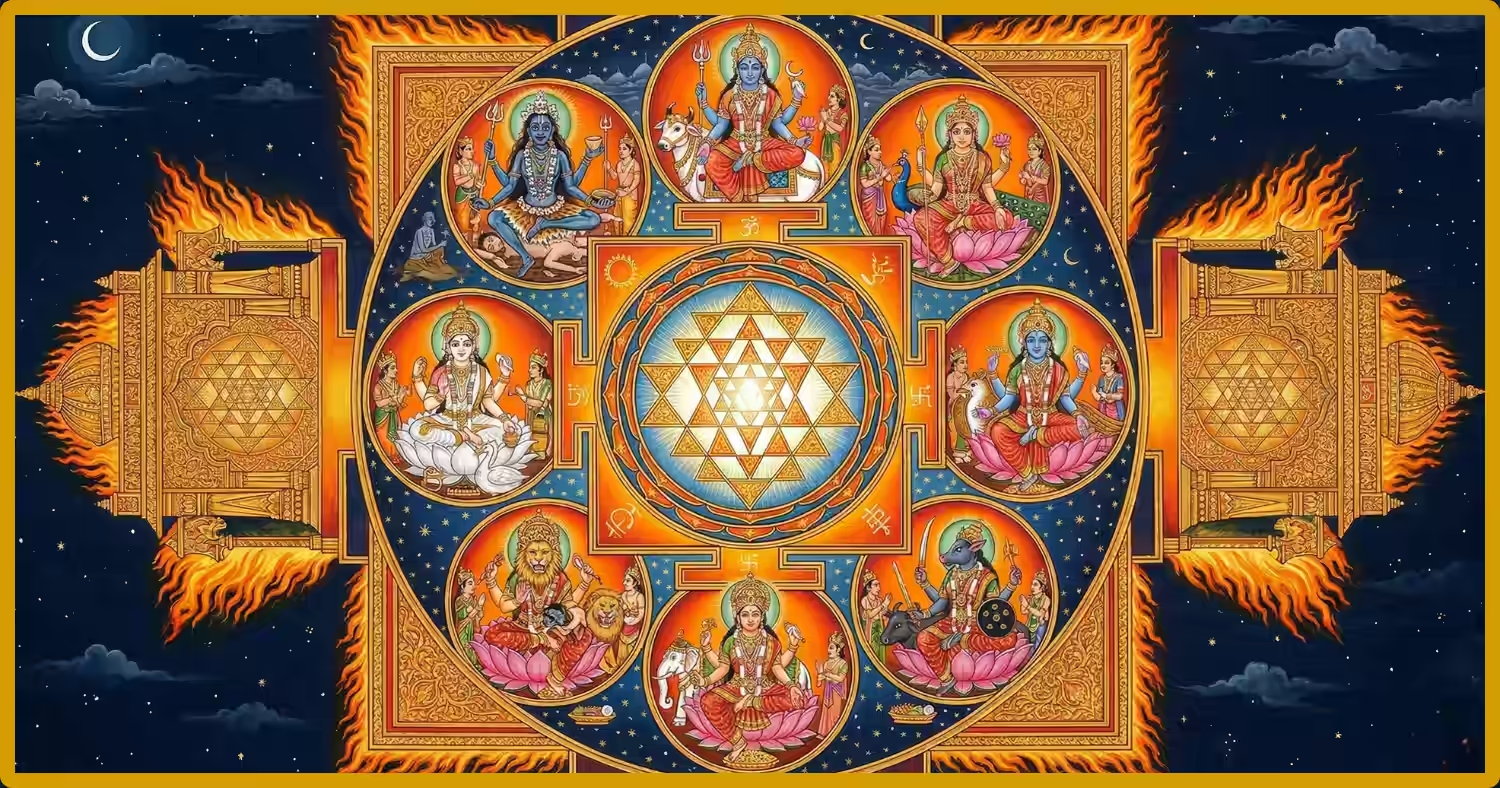
Ashtamatrika Yantra is a sacred geometric instrument from the Shakta-Tantric tradition, a hand-drawn mandala consecrated to the Eight Divine Mothers (Aṣṭamātṛkā), organized in eight directional positions within a protective Bhupura enclosure. Used in daily Sadhana, it dissolves deep-seated inner enemies such as fear, false ego, and tamasic heaviness, establishes all-round spiritual protection for the household, and deepens sound-based practices like mantra japa and nyasa. An authentic Ashtamatrika Yantra must be hand-drawn on Himalayan Bhojpatra and activated through Prana-Pratishtha consecration to function as a living spiritual device.
Do you feel spiritually exposed, as though unseen forces, recurring negative patterns, or a persistent inner heaviness keep pulling you back no matter how sincerely you try to move forward? When the protective cosmic matrix of the Divine Mother is absent from your daily Sadhana, even sincere spiritual effort can feel like walking uphill in the dark.
But the Shakta-Tantric tradition offers a profound technology to pierce through this obscurity. By aligning with a genuine, properly consecrated Ashtamatrika Yantra, you can invoke the Eight Mothers as a living shield, burning inner impurity, restoring rightful self-command, and surrounding your life with an unbreakable mandala of divine protection.
What Is the Ashtamatrika Yantra and Its Significance?
In Sanskrit, aṣṭa means eight and mātṛkā means mother. The Ashtamatrikas are among the most profound and mysterious forms of Shakti, not ornamental deities, but active cosmic forces whose origins are recorded in the Devi Mahatmya, one of the most authoritative Shakta scriptures, composed roughly in the 5th–6th century CE.
The Eight Divine Mothers
मातॄणां शक्तिरूपाणां नमस्तेऽस्तु नमो नमः | “Salutations again and again to the Mothers who are the very forms of Shakti.”
In the framework of the Shakta tradition, the Matrikas are revered not as secondary figures standing behind male deities but as those deities’ own active energy, their Shakti. Each Mother carries the same weapons, emblems, and vehicles as her corresponding deity. They are cosmic forces of creation, preservation, destruction, protection, and liberation, all unified in one mandala.
The Deep Philosophy and Symbolism of the Ashtamatrikas

Mercy in Bloom, Power in Flame: The Mother who nourishes the world with dawn’s grace and guards it with midnight’s fire.
The Matrikas embody the truth that the Divine Mother is not one-dimensional. A mother feeds and nurtures the child, but she also disciplines, protects, and turns ferociously uncompromising when danger must be destroyed. The Matrikas express this cosmic duality perfectly, they can appear both terrifying and supremely compassionate, because nature itself carries both of these qualities simultaneously.
“When honored and cared for, nature gives nourishment in the form of trees, fertile land, fruits, and grains. But when exploited, it becomes wild and unsparing, striking mankind as natural calamities. The Ashtamatrika Yantra is a complete mandala of spiritual motherhood, each Matrika representing a unique spiritual power.”
— From the Shakta Upasana Tradition
In Tantric understanding, the demons the Matrikas destroy are not merely external enemies on a battlefield. They live inside every human being, occupying the mind unrightfully as fear, ego, confusion, anger, vanity, desire, and tamasic heaviness. The Ashtamatrika Yantra is therefore a complete mandala of inner transformation, with each Mother addressing a precise dimension of spiritual obstruction.
Message ASHTAMATRIKA KIT to get the right Yantra + Mala suggestion.
Ashtamatrika Yantra: Spiritual Attributes & Significance
| Attribute | Vedic & Spiritual Significance |
| Presiding Deities | The Eight Divine Mothers (Active Shaktis of Brahma, Shiva, Vishnu, Skanda, Varaha, Indra, Durga & Narasimha) |
| Root Scripture | Devi Mahatmya (5th–6th century CE Shakta Canon) |
| Yantra Structure | Bhupura (Sacred Perimeter) enclosing eight directional Matrika positions |
| Associated Tradition | Kathmandu Valley Ashtamatrika Upasana (also revered across South Indian and pan-Shakta lineages) |
| Primary Blessings | All-Round Protection, Removal of Inner Enemies, Household Safety, Mantra-Shakti Deepening |
| Vedic Mantra | Om Aim Hreem Kleem Ashtamatrikabhyo Namaha (Safe, Non-Beeja invocation) |
YantraChants.com Trust Stack Advice
To experience the full potency of these attributes, ensure the Yantra is hand-drawn on Authentic Himalayan Bhojpatra rather than mass-produced alternatives. The organic nature of the Bhojpatra acts as a “high-capacity battery” for the Prana infused during consecration.
What Makes an Authentic Ashtamatrika Yantra Special?
The sacred geometry of the Ashtamatrika Yantra is built around a foundational structural principle. The outer square enclosure, called the Bhupura, with four directional openings acts as a fortress-wall that filters and protects the inner geometry, much like a sieve that blocks impurities from entering. Inside that enclosure, the Eight Mothers are organized in the eight directions like a spinning wheel of cosmic guardianship, an eightfold arrangement that shows the Divine Mother’s all-encompassing protection towards the practitioner.
The Authentic Ashtamatrika Yantra at YantraChants.com

However, a mere geometric print is utterly lifeless. For this mandala to become a Living Yantra capable of deeply shifting the energy of your space, it must adhere strictly to authentic creation protocols. A genuine spiritual device is not mass-produced; it is birthed through deep Sadhana, exact geometric proportions where even a 1mm error disrupts the energy flow, and the pure intention of the creator.
Spiritual and Symbolic Significance of the Eight Matrika Positions
In Vedic and Tantric cosmology, the number eight holds deep vibrational significance. Eight represents completeness in all directions, the four cardinal points and four diagonal points, forming a perfect field of awareness with no gap, no blind spot, and no unguarded threshold. This is why the Matrikas in Nepal are revered as guardians of city boundaries and directional thresholds; they are not merely figures inside a scripture but living presences stationed at every gate.
| Matrika | Corresponding Deity | Spiritual Domain |
| 1. Brahmi | Lord Brahma (Creator) | Knowledge, mantra-Shakti, creative intelligence, scripture, and the power of teaching |
| 2. Maheshvari | Lord Shiva | Austere Sadhana, dissolution of false identity, inner purification through tapas |
| 3. Kaumari | Lord Kartikeya (Skanda) | Courage, dharmic backbone, spiritual alertness, and victory over inertia |
| 4. Vaishnavi | Lord Vishnu | Sustaining virtue, nourishing what is worth preserving, protecting principles in daily life |
| 5. Varahi | Lord Varaha | Rescuing the soul from deep subconscious entanglement, occult protection, lifting from tamasic inertia |
| 6. Indrani | Lord Indra | Regal self-command, restoration of rightful authority, overcoming fear and compulsive habit |
| 7. Chamunda | Devi Durga (from Her forehead) | Destruction of hypocrisy, vanity, and poisonous inner tendencies, the fiercest purifier |
| 8. Narasimhi | Lord Narasimha | Fierce protection against destructive forces, evil eye (drishti), reversal of malefic attack and occult harm |
The efficacy of these effects relies entirely on the Prana-Pratishtha (Consecration). Without the specific lineage-based Beeja Mantra activation under the guidance of the Ramanandi Sampradaya, the mandala remains a geometric drawing rather than a Living Yantra.
-YantraChants.com Trust Stack Advice
4 Transformative Benefits
The Devi Mahatmya declares that the Matrikas appeared to restore the conditions in which truth, life, and dharma can continue unhindered. When consecrated properly, this spiritual device acts as a living spiritual matrix, eight-directional, all-encompassing, and deeply purifying.
For those whose inner battle is primarily against tamasic lethargy and the smothering of the inner fire, the Surya Yantra works as a powerful complementary practice alongside the Matrika mandala ( Surya Yantra Benefits: Confidence, Health & Authority ), the Mothers clear and protect the field, while Surya Deva ignites the inner sun.
Ashtamatrika Yantra: Impact Areas & Energetic Effects
| Transformative Benefit | Spiritual / Tantric Action | Real-World Application |
| 1. All-Round Protection | Activates the eight-directional Matrika shield, the Bhupura mandala | Relief from hostile influences, unseen pressure, atmospheres that chronically disturb mental peace |
| 2. Household & Family Safety | The Matrikas stand close to the raw realities of life: birth, disease, grief, fear, and childhood vulnerability | Protection of children, the home, and family members in periods of illness, grief, and instability |
| 3. Removal of Inner Enemies | Burns the demonic principles within, one fear multiplying into ten, one desire becoming a loop of addiction | Uncovers and dissolves limiting tendencies that block spiritual progress and daily functioning |
| 4. Deepening of Sound-Based Practices | Matrikas are linked with letters, mantra-Shakti, Mudra, and Nyasa (as per Mahanirvana Tantra) | Strengthens mantra japa, nyasa, swara sadhana, and the overall quality of devotional speech |
While these benefits are profound, they are only unlocked when the seeker approaches the Living Yantra with the correct mood of Sharanagati (surrender). This is not a “magic fix” but a tool for Sadhana that works in tandem with your Karma and the will of the Guru Parampara.
-YantraChants.com Trust Stack Warning
1) Establishes Strong Protection from Hostile Influences
“In the Kathmandu Valley, the Ashtamatrikas are revered as guardians of space, not merely figures inside a scripture but living presences stationed at city boundaries, shrines, and directional thresholds. They protect not only the temple’s heart but stand at its very gates.”
-Srimati Rohini Devi Dasi
If you consistently feel spiritually exposed, over-absorbing others’ negativity, disturbed by atmospheres, or vulnerable to influences you cannot name or explain, this points to an absence of the Matrika shield. The yantra supports those who are sensitive, easily influenced, or placed in environments of chronic conflict. People who carry this quality often describe feeling spiritually held from every direction once the Eight Mothers are properly invoked into their space.
However, before invoking the fierce protection of the Matrikas, it is often valuable to first clear the root energetic obstruction at the threshold level. Beginning with the Siddhi Vinayak Yantra ( Om Gam Ganapataye Benefits & Siddhi Vinayak Yantra ) prepares the path, so that when the Mothers arrive, they arrive into a cleared and receptive space.
2) Protects the Household and Family

Many seekers are comfortable with the gentle, nurturing aspect of the Divine Mother but unprepared for her protective ferocity. In the lived tradition, especially across the Kathmandu Valley and in Bhaktapur, the Ashtamatrikas are part of the lived geography of the region, not merely Pauranic or “inside the scripture” deities. They are outside, embodied around us, standing at the gates of temples and the boundaries of cities.
These goddesses have always stood close to the raw passages of human life: sickness, battle, death, childbirth, fertility, fear, and later with the protection of children and households. Real life is not only abundance and grace. It also carries grief, disease, and moments of deep vulnerability. Life gives, but life also takes. The Matrikas stand very close to that unvarnished reality, making their yantra particularly beneficial for household protection, especially for families with young children or those navigating illness and instability.
3) Removes Harmful Inner Tendencies

In the iconography of the Devi Mahatmya, the Matrikas charge into battle, drink blood, and assist the Mother Goddess in defeating demons like Andhaka, Shumbha, Nishumbha, and Raktabija. The demons they fought were not only outside in the battlefield, they are inside every human being, unrightfully occupying the mind and tormenting the individual as fear, ego, confusion, anger, vanity, desire, and tamasic heaviness.
The demon in Tantra is the principle of one vice multiplying into many at an uncontrollable rate: one fear becoming ten, one desire becoming a loop of addiction, and one thought pattern defining who you are. The Ashtamatrika Yantra uncovers those limiting tendencies, like exposing a maid who daily thieves household equipment without the owner’s notice. The Ashtamatrikas do not simply “bless” the seeker by cajoling the ego. Instead, they take charge, expose the loopholes, and devour what obstructs awakening. Worshipping the Ashtamatrika Yantra helps speed up that process.
For those who need additional fierce energetic defense against the most deeply entrenched inner and outer enemies, particularly where Tantric attack or severe negativity is involved, the Bhairava Sadhana framework provides the precise rules and protective invocations for such work ( Bhairava Sadhana: Rules and Yantras ), so that the seeker enters the battle equipped, not exposed.
4) Deepens Sound-Based Spiritual Practices
In Tantra, the Matrikas are associated with letters, sound, and mantra Shakti. Mudras and Nyasa are an integral part of Matrika Worship as per texts like the Mahanirvana Tantra. Hence, the yantra supports practices involving sound discipline like mantra japa, nyasa, swara sadhana, and the purification of speech.
Practitioners who work with mantra japa, nyasa, swara sadhana, or devotional chanting consistently report a deepening and steadying of these practices when the Matrika energy is properly invoked in their space. The supreme expression of this sound-based Shakta tradition is found in the Lalitha Sahasranamam, one thousand names of the Divine Mother whose recitation itself constitutes a complete act of Matrika worship. The Lalitha Sahasranamam and Sri Yantra together form the most complete sound-and-geometry offering in the Shakta canon ( Lalitha Sahasranamam & Sri Yantra ), a natural deepening for any sincere Ashtamatrika practitioner.
The Eight Mothers: An In-Depth Spiritual Portrait

Understanding each Matrika individually transforms your practice from mechanical invocation into genuine relationship. Each Mother is a specific frequency, a precision instrument for a specific dimension of inner work and outer protection.
Brahmi, The Intelligence Behind All Creation
Brahmi Devi is the Shakti of Lord Brahma, the creator, carrying emblems like the water pot, rosary, and book. She represents the power of creation, mantra, and knowledge. Before something appears outwardly, it must first arise as an idea or blueprint. That shaping intelligence is Brahmi. Her grace is needed for fulfillment in mantra, vidya, scripture, and teaching.
Maheshvari, The Purifying Fire of Serious Sadhana
Maheshvari is the power of Lord Shiva, shown with symbols such as the trident, crescent moon, serpent, and bull. Her presence is expansive, austere, and powerful. She is essential for serious Sadhana because spiritual life is not only about receiving blessings, it is equally about burning impurity. When someone is too attached to outer appearance or praise, she makes space for truth by dismantling falsehood. She liberates the individual by removing that which blocks union with truth. Her energy can be uncomfortable for those who fear silence and refrain from dissolving their false identity.
Kaumari, The Dharmic Warrior Energy
Kaumari is linked with Lord Kartikeya, the youthful war deity, shown with the spear and peacock symbolism. She gives courage to achieve one’s target, alertness, and the strength to fight the right battle. She shows that spiritual life also needs backbone, giving one the power to stop postponing dharma. Her grace is needed when a seeker knows what is right but lacks the strength to act on it consistently. She is the Mother who says: “Do what must be done.” She protects seekers from becoming inwardly weak, or defeated by recurring patterns.
Kaumari’s warrior energy is closely resonant with the fierce, loyal protection of Lord Hanuman. For seekers who need both courage and unshakable devotion as the foundation of their battle against inner weakness, the Hanuman Bhakti Yantra carries that same indomitable quality ( Hanuman Bhakti Yantra: Courage & Protection ), making it a powerful complement to Kaumari’s dharmic fire.
Vaishnavi, The Sustaining Intelligence
Vaishnavi is the power of Lord Vishnu, often depicted with Vaishnava emblems such as the conch, discus, mace, and lotus. Creation alone is not enough, what is created must be maintained and nourished. That sustaining intelligence is Vaishnavi. She helps seekers understand that not all spiritual greatness lies in miracles; much of it lies in quietly preserving your virtues and principles. Vaishnavi is the power that sustains what is worth sustaining.
Varahi, The Rescuer from Deep Entanglement
Varahi is one of the most striking Matrikas, recognizable by her boar or sow-like head. Connected with the Lord Varaha, she is fierce and deeply Tantric. Just as Lord Varaha dives into mud and lifts the Earth itself, Varahi Devi enters the dense and buried subconscious layers of our mind, dragging one out of inertia, occult influence, and toxicity. This is why serious practitioners often experience Varahi Devi as a rescuing force that is both maternal and ferocious. Varahi Devi can recover the soul from deep entanglement. The Buddhist Deity Vajravarahi later evolved from Devi Varahi, showing her far-reaching influence.
To go deeper into the specific Mantra and Yantra of the deity from whom Varahi herself draws her power, the Varaha Yantra and its associated mantra practice offer an essential guide to invoking that same rescuing, earth-lifting force in its most direct form ( Varaha Mantra Protection & Varaha Yantra ), for those who feel called to go to the root of Varahi’s lineage.
Indrani, The Restoration of Regal Self-Command
Indrani Devi is linked with Lord Indra, the king of the gods, and hence carries a regal and dignified presence, depicted with the elephant, thunderbolt, and royal emblems. She represents the ability to occupy one’s rightful space without apology. Indrani Devi’s grace is important where the soul has become timid and compromised, unable to take one’s stand. She helps restore self-command in a mind ruled by fear and compulsive habits.
Chamunda, The Most Ferocious Purifier

Chamunda Devi is the most openly fearsome of the Mothers. She burst from Durga Devi’s forehead as an embodiment of battle rage; her very name is tied to the slaying of the demons Chanda and Munda. She is skeletal, emaciated, cremation-ground-like and terrifying in appearance. These are not signs of evil, they signify her freedom from illusion and her closeness to ultimate truths that the ordinary mind fears and avoids.
She is terrifying because she is uncompromising. She cuts through hypocrisy, vanity, and lower impulses. Without Devi Chamunda, spiritual life loses its gravity and depth. She is the Mother who will not allow one to worship sweetness while secretly harbouring poisonous tendencies. Chamunda is the power that destroys what must not remain. She represents the truth that the Divine Mother also protects by devouring danger, and that this devouring is itself an act of the deepest maternal love.
Narasimhi, The Fierce Termination of All Attack
The eighth Matrika is Narasimhi, corresponding to Lord Narasimha. Some traditions associate her with Pratyangira (Atharvana Bhadrakali), the consort of Sharabheshwara. She is lion-faced, terrible in majesty, holding the trident, serpent, drum, skull, and sitting atop a lion vehicle. Her imagery is deliberately fierce, shown with reddened eyes and wild hair, a form meant to frighten negativity itself into retreat. She protects not by smiling at trouble, but by ending its right to continue. Her energy carries the unambiguous message: “This is enough. The attack stops here.”
Narasimhi Devi awakens the soul’s power to say: “I will not allow falsehood to rule my life. I reject what is degrading my consciousness.” In South Indian and Shakta tradition, she is invoked for protection against destructive forces, evil eye (drishti), bad omens, and malefic rituals. Traditions devoted to her approach her with seriousness and caution, because she is an Ugra (fierce) Devi and not to be worshiped casually. Her invocation is always paired with absolute inner sincerity, a half-hearted approach to Narasimhi’s energy is not recommended by any lineage.
Does The Ashtamatrika Yantra Suit You?
Loading…
—
—
Safe Vedic Mantras to Enhance Your Practice (The YantraChants.com Trust Stack)
To deepen your connection with the Eight Mothers, you can chant this safe, universal invocation while seated before your Yantra:
ॐ ऐं ह्रीं क्लीं अष्टमातृकाभ्यो नमः, Om Aim Hreem Kleem Ashtamatrikabhyo Namaha.
A vital note on spiritual safety: We strongly advise against chanting complex Tantric Beeja (seed) mantras, particularly those associated with Ugra Devis such as Chamunda or Narasimhi, without formal initiation from a Guru. Uninitiated chanting can force open spiritual granthis, leading to severe energetic and physical misalignment. The mantra provided above is entirely safe, addressing the Eight Mothers in their collective devotional form, and can be chanted by any sincere seeker.
Maintaining spiritual cleanliness and strong inner boundaries is especially crucial during Matrika Sadhana. Approach the practice daily, keep the altar space physically clean, and avoid beginning the Sadhana in a distracted or emotionally turbulent state. The Mothers respond to sincerity, and sincerity begins with preparation.
Comparison: Ordinary Market Yantras vs. YantraChants Trust Stack
| Feature | Ordinary Market Yantras | YantraChants Trust Stack Methodology |
| The Medium | Paper, generic materials, or plastic prints | Authentic Himalayan Bhojpatra (Acts as a living “battery” for Prana) |
| Creation Method | Factory printed or machine-stamped | Hand-drawn using a precise Pomegranate (Anar) twig stylus |
| Sacred Inks | Synthetic or chemical dyes | Natural Vedic Elements: Ashtagandha, Kesar, Kumkum, Chandan |
| Activation Process | Sold completely dormant | Lineage-Based Prana Pratishtha: Activated via 108×3+ Japa under Sri Ramanandi Sampradaya guidance |
| Core Intention | Commercial decoration | Seva Bhava: Created for dedicated Sadhana; proceeds support Vrindavan Dham Seva |
Watch: Shri Damodar Dasji Creating a Yantra
The distinction in the Medium is not merely aesthetic; it is functional. While many seekers are used to mass-produced items, the Trust Stack mandates Bhojpatra because its organic nature is uniquely capable of permanently holding the Prana (life force) infused during the 108×3+ Japa activation.
– YantraChants.com Trust Stack Advice
Frequently Asked Questions (FAQs)
Q1. What is the Ashtamatrika Yantra and its main benefits?
A. The Ashtamatrika Yantra is a sacred geometric mandala dedicated to the Eight Divine Mothers that provides all-round spiritual protection, dissolves inner enemies such as fear and false ego, protects the household and family, and deepens mantra-based spiritual practices. By invoking the eight Matrikas in their directional positions within the Bhupura enclosure, the yantra surrounds the practitioner with a complete, gap-free protective field, addressing both visible outer challenges and hidden inner obstructions simultaneously.
Q2. Who should keep the Ashtamatrika Yantra?
A. The Ashtamatrika Yantra is particularly beneficial for individuals who feel spiritually exposed, repeatedly influenced by negative environments, or burdened by recurring inner patterns they cannot overcome through willpower alone. It is also strongly recommended for households with young children, those navigating illness or grief, seekers engaged in mantra and sound-based practices, and anyone working with Shakta or Tantric deities who requires a stable, protected foundation for their Sadhana.
Q3. How does the Bhupura structure of the Yantra work?
A. The Bhupura is the outer square enclosure of the Ashtamatrika Yantra with four directional openings. It functions as a sacred perimeter, a spiritual fortress-wall that filters what enters the inner geometric space, blocking impurities while allowing pure intent to pass through. Inside this perimeter, the Eight Mothers are positioned in all eight directions, creating a complete, gap-free mandala of protection that addresses every angle of the practitioner’s energetic environment.
Q4. Why is Bhojpatra used instead of other materials?
A. Authentic Himalayan Bhojpatra is used instead of mass-produced materials because its organic nature acts as a high-capacity spiritual battery capable of permanently holding the Prana instilled during consecration. Lifeless materials like paper, plastic, or synthetic prints cannot retain the energetic charge generated by disciplined ritual activation. The Matrikas are fierce and powerful forces, they require a living medium capable of genuinely holding their presence.
Q5. What is the ideal daily practice and placement?
A. The ideal placement for the Ashtamatrika Yantra is on an East-facing or North-East-facing wall, or within a dedicated, clean altar space. A steady daily practice involves keeping the area physically clean, lighting a ghee diya, and sitting with a straight spine to chant the Matrika invocation with focused, sincere intent. Consistency matters more than duration, fifteen minutes of daily sincere practice will produce deeper results than irregular long sessions.
Q6. Which mantra should I chant?
A. The safest and most universal mantra to chant with the Ashtamatrika Yantra is “Om Aim Hreem Kleem Ashtamatrikabhyo Namaha” (ॐ ऐं ह्रीं क्लीं अष्टमातृकाभ्यो नमः). Practitioners should avoid the specific Tantric Beeja mantras of individual fierce Matrikas, especially Chamunda and Narasimhi, without proper Guru initiation and lineage-based Diksha, making this collective invocation highly effective and spiritually safe for daily home practice.
How to Practice with an Ashtamatrika Yantra and Rudraksha Mala (10-Step Method)

Ashtamatrika Yantra Practice
Step 1: Prepare the Space, 1 minute
- Place the device on a clean altar, ideally on an East-facing or North-East facing wall or in your dedicated worship space.
- Sit on a clean āsana or cloth so the body and mind enter a sacred, disciplined state.
- Light a small ghee diya and, if available, offer a mild incense.
Step 2: Face the Altar and Set Your Posture, 1 minute
- Sit with your spine straight and body relaxed.
- Keep your attention inward and avoid distractions like your phone or unnecessary movement.
- Let your eyes rest gently on the sacred geometry for a few breaths before beginning.
Step 3: Center Yourself with Inner Resolve, 30 seconds
- Wash your hands, or wipe them clean if needed.
- Lightly touch the center of your chest and inwardly pray: “May the Eight Mothers remove whatever within me is false, fearful, and obstructing the light of truth.”
- Let this become a moment of sincerity, not hurry.
Step 4: Hold the Mala Correctly, 1 minute
- Hold your Rudraksha Mala in your right hand, or the hand you normally use for japa.
- Let the mala rest naturally without strain.
- Keep it at heart level or slightly below, and do not let it touch the floor.
Step 5: Begin with a Safe Matrika Opening, 2 minutes
- Gaze softly ahead and begin chanting the safe Matrika mantra: “Om Aim Hreem Kleem Ashtamatrikabhyo Namaha.”
- Move one bead per chant.
You may chant 27 times, 54 times, or 108 times depending on your time and steadiness.
Step 6: Offer What Requires Protection, 30 seconds
- After a few rounds of chanting, look at the center of the Yantra with calm attention.
- Inwardly offer to the Eight Mothers whatever in your life requires their protection: the household, the children, the inner battle, the recurring pattern.
- You may pray simply:
“Divine Mothers, stand guard over all that is vulnerable in my life and within me.”
Step 7: Continue Japa with Steadiness, 5 to 15 minutes
- Continue chanting “Om Aim Hreem Kleem Ashtamatrikabhyo Namaha” in a calm and regular rhythm.
- Let the sound become steady and dignified, not forceful.
- If the mind wanders, bring the eyes back and resume with patience.
Step 8: Use the Mala as a Discipline Anchor, during chanting
- Move one bead for each mantra.
- When you reach the Meru bead, do not cross over it; reverse the mala direction instead.
- Do not use the index finger while counting.
- Let the mala help build inner order, focus, and steady devotional rhythm.
Step 9: Closing Gratitude and Alignment Prayer, 1 to 2 minutes
- After the japa is complete, sit quietly.
- Offer a simple prayer such as: “O Eight Mothers, may this worship bring clarity, protection, household safety, and alignment with Dharma.”
- Sit for a few moments and allow the practice to settle inwardly.
Step 10: Complete with Reverence, 1 minute
- Do a respectful namaskāra.
- Touch the mala lightly to your forehead as a gesture of gratitude.
- Carry one inner resolve into the day:
“Today, I will not allow fear, falsehood, or inner weakness to go unchallenged.”
Mindfulness Awareness Plan
Choose your cycle length (7 / 21 / 41 days), pick disciplines, lock them for the full cycle, and journal daily to see exactly where you slip - and what strengthens you.
The YantraChants Difference: Why We Only Use Authentic Bhojpatra
At YantraChants.com, we operate strictly on a foundational philosophy that prioritizes spiritual efficacy over mass commerce. We do not sell decorative pieces; we provide authentic Upakaranas (spiritual tools) meant for dedicated usage, protection, and Sadhana.
We absolutely mandate the use of authentic Himalayan Bhojpatra (Birch Bark) for our flagship Yantras. Why? Bhojpatra is a living, organic substance revered in the Yajur Veda and Tantric texts. It acts as a high-capacity spiritual “battery.” When drawn on Bhojpatra, the organic fibers permanently absorb and hold the Prana (life force) instilled during the consecration process. Lifeless, mass-produced materials completely fail to hold this energy.
Shri Damodar Dasji Serving At YantraChants.com
“A geometric grid drawn on lifeless, mass-market material is merely art. But when inscribed on sacred Himalayan Bhojpatra and awakened through an unbroken lineage’s Prana Pratishtha, it ceases to be an object, it becomes a breathing, living spiritual device.”
-The YantraChants.com Trust Stack Experience
- Hand-Drawn Precision: Every piece is meticulously hand-drawn by dedicated Sevaks using a Pomegranate (Anar) twig and traditional Vedic inks like Ashtagandha, Kesar, and Kumkum.
- Lineage-Based Prana Pratishtha: A drawing is just a drawing until activated. Our devices undergo rigorous consecration protocols, including 108×3+ Japa of specific Beeja Mantras, under the strict guidance of the Sri Ramanandi Sampradaya (specifically by Sri Damodar Dasji Maharaj and Srimati Rohini Devi Dasi).
- Seva Bhava (Purity of Intent): Our work is an extension of our devotion. We maintain an inner mood of Satsanga, Sadhana, and Sharanagati. When you receive a tool from us, you receive an item crafted in a deeply Sattvic state, and the proceeds support Dham Seva in Vrindavan, caring for the needy and vulnerable.
Placement and Worship Guidelines

To respect the sanctity of this spiritual device, place your Bhojpatra on an East-facing or North-East facing wall, or within your dedicated altar. It is designed for focused spiritual work, not casual display.
Each morning, light a small ghee diya and offer incense. Sit before your energized space and chant the provided mantra with reverence. Approach the Eight Mothers not as distant deities to be appeased, but as presences who are actively engaged with your life, watching, guarding, and purifying.
To amplify the auspiciousness of your mornings and align your daily actions with righteous awareness, the Karagre Vasate Laxmi mantra sets a perfect dharmic foundation before the Matrika invocation begins ( Karagre Vasate Laxmi Mantra Meaning & Benefits ), a simple but powerful way to consecrate the hands and the day before approaching the Eight Mothers.
“Treat the Yantra not as a product, but as a revered, living presence in your home. The sincerity and reverence you pour into your daily Sadhana is the exact measure of the protection and Tejas (brilliance) it will radiate back into your life.”
-Shri Damodar Dasji Maharaj
Stop being governed by what you cannot see. Invoke the Eight Mothers, establish your protection, and step forward with the full force of the divine feminine standing guard.
Author: Viraja Devi Dasi
Reviewed for Paramparic Accuracy by: Srimati Rohini Devi Dasi
For personalized spiritual guidance, WhatsApp us at: +917417238880

Vani Devi Dasi

Rohini Devi Dasi