Table of Contents
Sri Ram and The Ramayana
The famous Indian epic Ramayana is one of the most revered Vedic scriptures of the Hindu faith. Description of Sri Rama forms the first 32 short verses of the Valmiki Ramayana, the spoken words of sage Narada, the initial of the 24,000 verses of the great scripture. The Ramayana is such that 24,000 verses can be heard for a month, a year, for many years.
A single verse is of so much depth that even one verse can be heard for a day, a year, or for many years. No one can measure the glory of the verses of the Ramayana. The Ramayana is Ithihasa, as it is a well-documented, poetic representation of the life of Sri Rama. It narrates the story of Sri Rama and the History of Raghukul (Clan of King Raghu and prestigious kings like Ikshavaku, Aja, and Dasharatha).
The Versions of Ramayana
Ramayana was originally written by Sage Valmiki, in Bithoor, on the banks of River Tamasa in Uttar Pradesh. Due to his exquisite ability to render the Life of Bhagawan in a poetic form, Sage Valmiki received the title – Adi-Kavi, which means the first poet.
Although Sage Valmiki wrote the original Ramayana in Sanskrit, other sages and scholars represented this scripture in their regional languages. Thus, 300 regional versions of Ramayana, both in India as well as abroad.
The 3 most popular editions of Ramayana are:
1) Ramavataram (Kamba Ramayana written by Kambar)
2) Ramacharitmanasa (written by Tulsidas Goswami ji)
3) The Ranganatha Ramayana, written in Telugu by Gona Budda Reddy
There are 7 Kandas or Cantos that are divided systematically on the basis of major life events of Sri Rama.
Sri Rama had 16 Exceptional Qualities, unequalled, unparalled.
This is the conclusion of all the 7 Cantos of the Scripture.
For readers worldwide, it is inspiring to know that there are translations available which explain the 7 kandas of ramayana in English with devotion and clarity. This helps devotees who may not know Sanskrit or regional languages to still experience the divine narrative of Sri Rama in a language close to their heart.
1) Bala Kanda

Bala kanda commences with the auspicious birth of the 4 princes of Ayodhya.
It describes in detail the palatial Yajna sacrifice carried out by King Dasharatha and His queens for begetting the scions of the dynasty. They performed the Putra-Kameshti Yajna under the supervision of the Royal priest Sage Vashistha. As a result, Lord Sri Ramachandra took birth in the month of Chaitra (April-May), with all auspicious planetary positions.
Lord Rama was born to the chief-queen Kaushalya, while Lord Bharatha was born to Queen Kailkeyi. The two twin lords, Shatrughna and Lakshmana were born to Queen Sumithra. The Bala Kanda gives the beautiful childhood stories of the 4 brothers great emphasis.
The 7 kanda Ramayana begins here with Bala Kanda, showing us the Lord’s divine beginnings. Every Kanda has a distinct purpose, Bala Kanda being about Rama’s sacred birth and childhood, laying the foundation for His divine mission.
Gurukul Life and Ahilya’s Deliverance
Their Gurukul-Life begins and they are sent to sage Vashistha’s ashram.
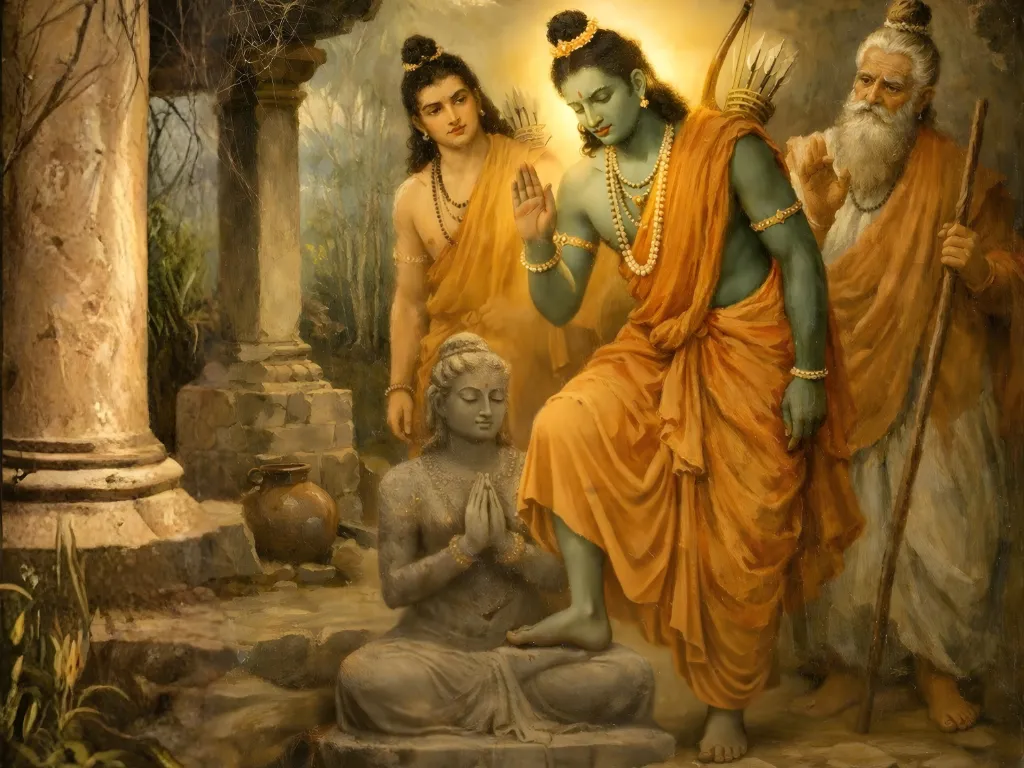
They complete their military, arts, science, and commerce, political, and social studies in the gurukul and return back to Ayodhya. After returning, Sage Vishwamitra takes the 2 princes, Rama and Lakshmana along with him to kill demoness Taraka. The deliverance of Devi Ahilya, the wife of Gauthama is also discussed.
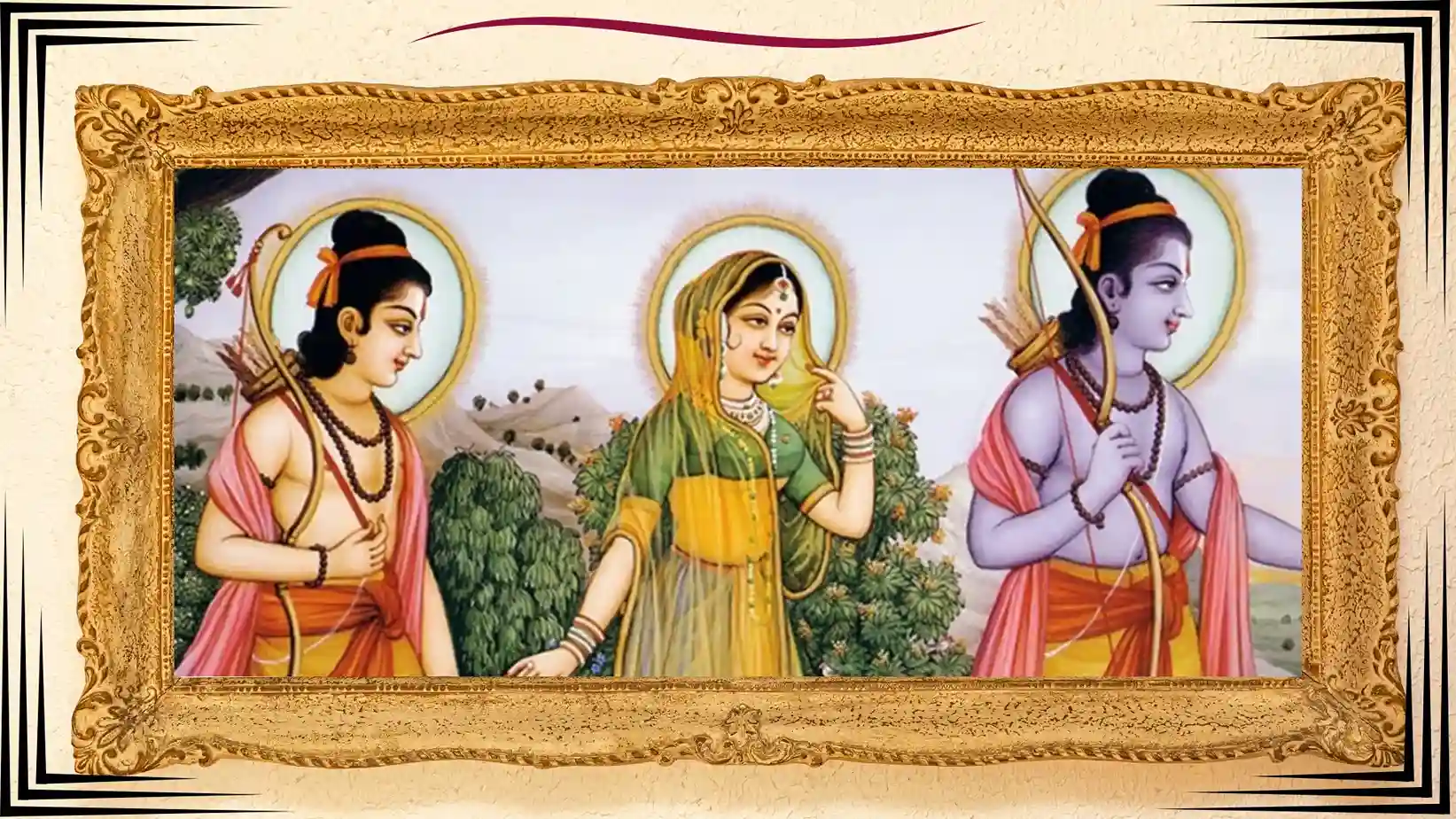
Later, Sage Vishwamitra and the two princes head over to the Kingdom of Mithila to attend the Sita Swayamvar. The popular Pushpavatika episode does not find a reference in Valmiki Ramayana.
It is a part of Ramacharitmanasa.
The Swayamvara of the Mother Sita
Sri Rama Breaks the Mighty Shiva Dhanush and King Janaka weds off Sita Devi to Him. The Balakanda covers in detail the auspicious marriage even of all the four princes of Ayodhya with the princesses of Mithila. However, their return to Ayodhya after the marriage ceremony marks the end of Bala Kanda.
2) Ayodhya Kanda

This is the most popular segment of Ramayana and sets the very foundation of the entire epic. Now, Sita and Rama return to Ayodhya and devote the majority of their time serving King Dasharatha and the Queens. All 4 princes serve the subjects of Ayodhya and receive their love in abundance.
The 7 Kanda of Ramayana are best understood when seen as stages of a human soul’s journey. The Ayodhya Kanda reflects duty, love, and sacrifice. qualities that devotees meditate upon in their daily life.
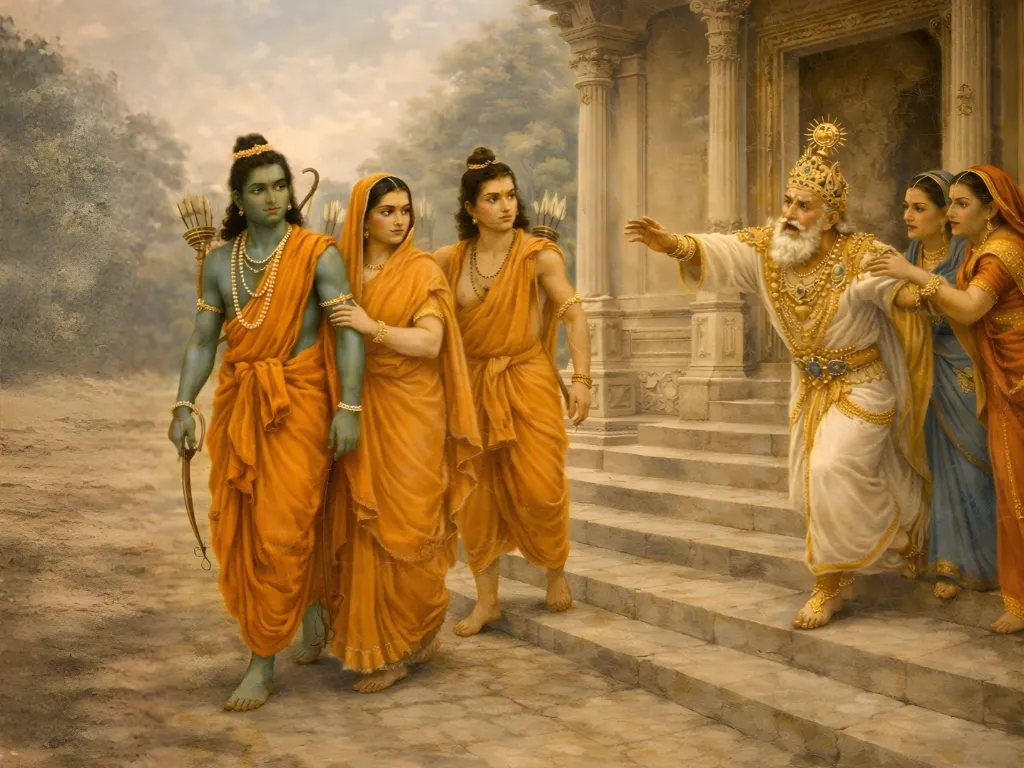
Therefore, King Dashratha summoned the assembly of ministers and decided to crown Sri Rama as the new King of Ayodhya. But, the wicked maid-servant brainwashed the queen by injecting insecurity in her and asked her two exercise her 2 boons.
Thus, she asked for Lord Bharatha’s coronation as the King of Ayodhya as her first boon, while 14 years of exile for Sri Rama.
Bharatha Revolts
Lord Bharatha along with Shatrughna was oblivious of this scheming as they were in their maternal home, the kingdom of Kaikeya. On returning, Bharatha revolts and immediately walked towards the forest to receive Lord Rama out of his immense love for the Lord.
In the forest, Sri Bharath meets Lord Rama, Sita, and Laxmana.
Bharatha – like a renunciant in Ayodhya
The Lord does not accept Sri Bharath’s request to return to Ayodhya. Hence Sri Bharath returns to Ayodhya with the Paduka (wooden slippers) of Lord Rama.
He accepts the dress of renunciation and leaves for the nearby location of Nandigram. After installing the Lord’s Paduka on the throne, he vows to rule Ayodhya Puri on behalf of Lord Rama for 14 years. He leads the life of a man who has renounced all pleasures for the Love of the Lord and performs his duty only for the pleasure of the Lord.
3) Aranya Kand

This is the point of turn of events in the Lord of Sri Rama. This Kanda forms the foundation for the fulfillment of the Lord’s Nara Leela (Human-like pastimes).
Many seekers also love to read the 7 kandas of Ramayana in Sanskrit, for the original verses carry a deep vibration. Even chanting a few verses from Aranya Kanda is said to purify the mind and give courage in the face of trials.
Shoorpanakha is Punished
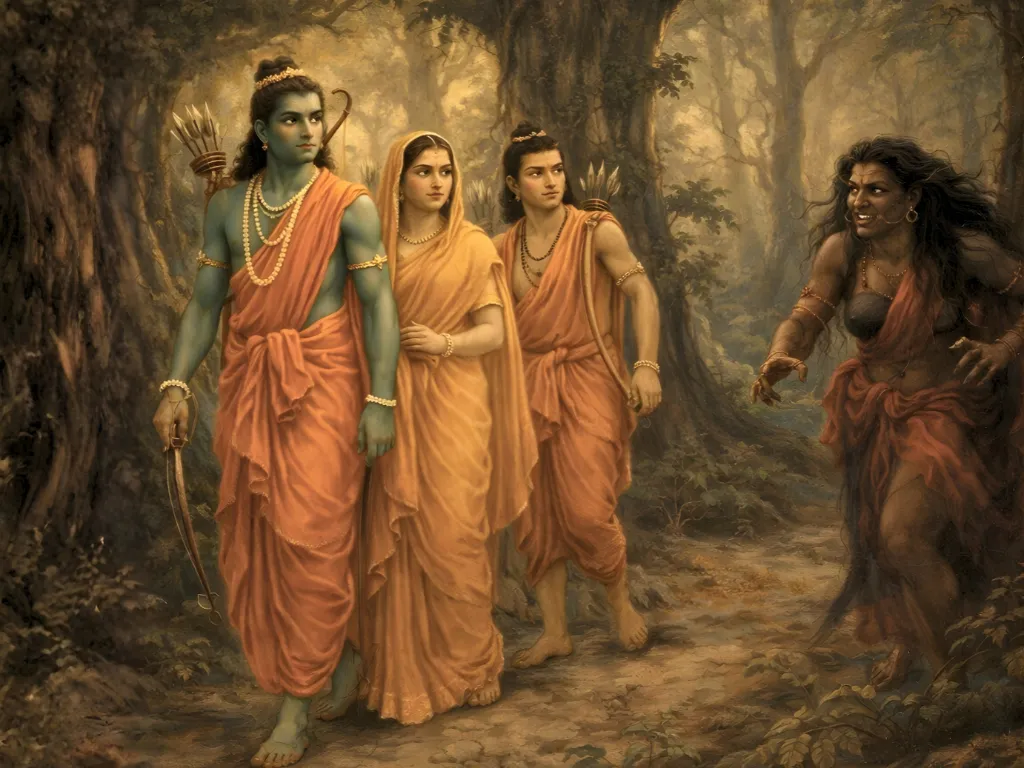
One must remember that one of the most important reasons for the Lord’s incarnation was the destruction of Ravana. Here Shoorpanakha meets the Lord and Laxmana and falls for their beauty. Following the cutting of her nose by Sri Laxmana, the Kanda covers the event of abduction of Srimati Seeta Devi by Ravana in great detail. Before we proceed to the Kishkindha Kand, let us briefly study the Life-Changing Sri Ramachandra Yantram
Śrī Rāmacandra Yantram (Sri Ramachandra Yantram): A Devotional and Philosophical Exposition
What is the Sri Ramachandra Yantram?
The Śrī Rāmacandra Yantram is the sacred geometric embodiment of the Sri Rāma mantra, a visual form that unites mantra (sound) and yantra (form) into one living field of divine presence. In the Chāndogya Upaniṣad (6.3.2) we read:
“सेयं देवताऽऐक्षताहं नामरूपे व्याकरवाणीति।”
“That Divine Being thought: I shall differentiate into name and form.”
This passage affirms that the entire cosmos is woven of nāma (sound/name) and rūpa (form/shape). The yantra is therefore the form-body of the mantra.
The Māṇḍūkya Upaniṣad (1.8) extends this principle:
“सोऽयं आत्माऽध्यक्षरं ओम्… चत्वारि पादा चत्वारि मात्राः।”
“That very Self is Oṃ; the four quarters of the Self correspond to the four measures of Oṃ.”
Here, Oṃ is called the Self in sound. By extension, yantra is the Self in form. The Śrī Rāmacandra Yantram follows this principle, becoming the geometric crystallisation of the eternal Sri Rāma mantra.
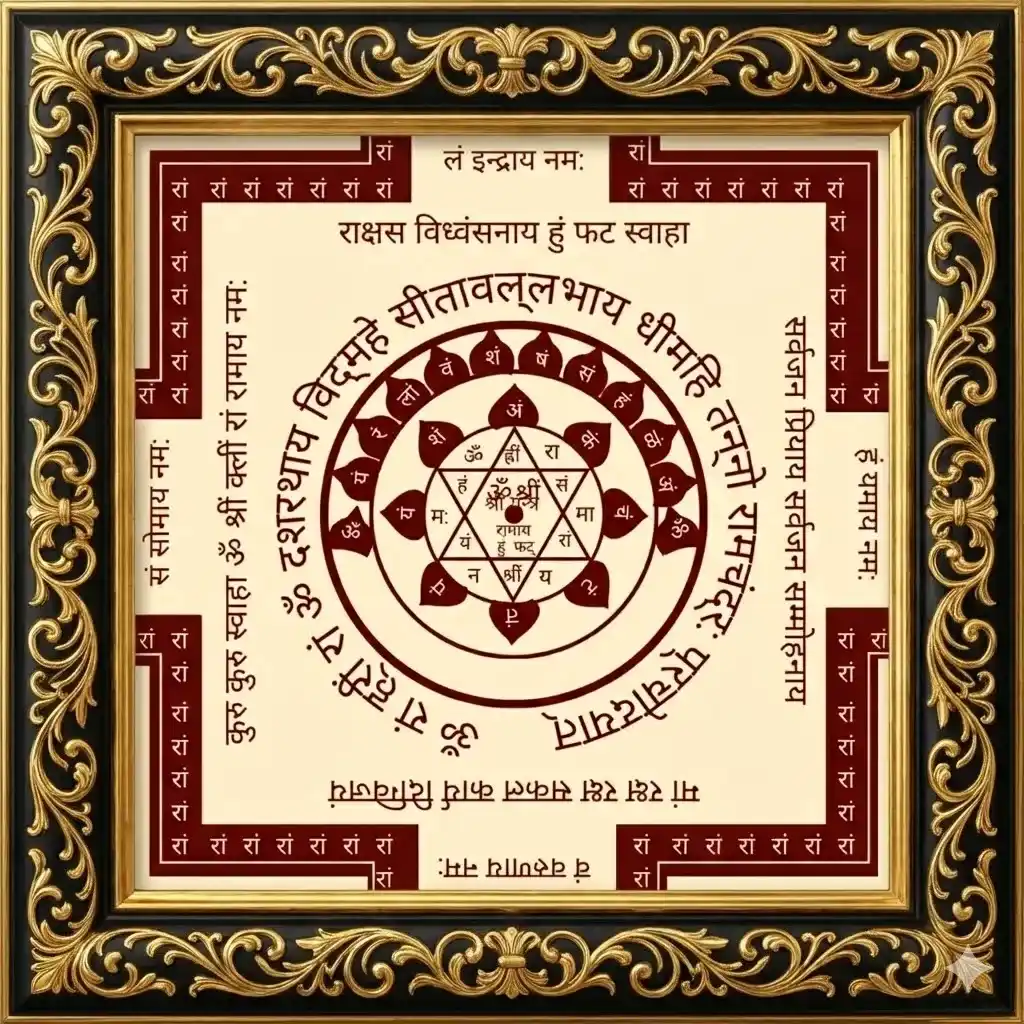
In the yantra image, the outer bhūpura (protective square) is filled with repetitions of “रां” and protective mantras like “शं ईशानाय नमः”. This creates a spiritual perimeter, sealing the yantra against discordant energies. The petals and triangles inside contain bīja mantras such as ह्रीं (hrīṃ) for devotion, श्रीं (śrīṃ) for prosperity, ऐं (aiṃ) for wisdom, and राम itself for the supreme vibration of dharma. At the bindu, the innermost point, sits the living presence of Śrī Rāma, the axis of the yantra.

Thus, just as chanting “Śrī Rām, Jaya Rām, Jaya Jaya Rām” purifies the heart, meditating on this yantra anchors those vibrations into the environment. The mantra is the sound-body; the yantra is the form-body. Together, they make devotion whole.
Benefits of the Sri Ramachandra Yantram
The Śrī Rāmacandra Yantram brings profound spiritual and practical benefits when approached with faith and steadiness. Its blessings flow in nine broad streams, echoing the nine qualities that Lord Rāma personifies: protection, dharma, compassion, strength, prosperity, wisdom, peace, harmony, and liberation.
Protection from negativity is one of its foremost blessings. The yantra is inscribed with protective bījas like hūṃ and phaṭ, traditionally used in Tantric literature for warding off hostile energies. When placed on a clean altar, it radiates a subtle field that shields the home or workplace from disturbances, both external and internal.
Support for righteous living (dharma) arises naturally from this yantra. Sri Rāma is described in the Rāmāyaṇa as “maryādā puruṣottama”, the ideal being who upheld boundaries and righteousness. By meditating on the yantra, one’s mind becomes steady and aligned with dharma, helping devotees make ethical decisions even in difficult circumstances.

Emotional stability and compassion are also nurtured. Chanting before the yantra calms inner agitation, and the heart gradually becomes softer, reflecting Sri Rāma’s own compassion for all beings, from sages to monkeys, from his enemies to his devotees.
Courage and strength flow from its fiery syllables like रां (rāṃ), which are associated with solar force and vitality. Just as Sri Rāma conquered Rāvaṇa not merely with might but with unwavering resolve, the yantra empowers devotees to overcome challenges with steadiness and courage.
Prosperity and auspiciousness are invoked through the presence of śrīṃ, a seed sound tied to Lakṣmī. Since Sri Rāma’s consort is Sri Sītā Devi, the yantra embodies their union, ensuring that the blessings of prosperity, household harmony, and fertility are also granted.

Wisdom and clarity come through the syllable aiṃ, linked to Sarasvatī. The yantra supports students, seekers, and professionals who need intellectual sharpness and focus. It is especially powerful when installed in places of study or teaching.
Peace of mind and atmosphere is perhaps its most immediate effect. Families who have kept the yantra at home often report an intangible calm, as though arguments and restlessness gradually dissolve. This serenity deepens when combined with daily japa of the Sri Rāma nāma.
Harmony in relationships also arises because Sri Rāma is the very embodiment of loyalty, love, and duty. Couples, families, and communities that venerate the yantra often find their conflicts softening, as devotion naturally breeds understanding.
Finally, spiritual growth and liberation (mokṣa) are the highest gifts. The yantra silently reminds the devotee that worldly gains are temporary, but the eternal joy of remembering Sri Rāma transcends birth and death. In the Adhyātma Rāmāyaṇa, it is said: “राम नाम बन्धन विमोचनम्”, “The name of Sri Rāma is the liberator from bondage.” The yantra is that name in visual form, guiding the soul to freedom.
Thus, whether one seeks material well-being or spiritual awakening, the Śrī Rāmacandra Yantram fulfils both, always leading the devotee back to the lap of dharma and bhakti.
Structure of the Sri Ramachandra Yantram
The Śrī Rāmacandra Yantram is carefully structured, each layer carrying its own vibration.
The bhūpura (outermost square) acts as the sacred boundary. It is inscribed with multiple “रां” sounds, forming a protective shield. The corners contain mantras such as “शं ईशानाय नमः” and “रं अग्नये नमः”, invoking the guardians of the directions. The bhūpura is the fortress wall, ensuring that only sattvic energies move inward.
Next comes the circle of protection, often filled with phrases like “राक्षस विध्वंसनाय हूं फट् स्वाहा”. This explicitly ties the yantra to Lord Rāma’s role as destroyer of evil, recalling his slaying of Rāvaṇa and other demons.
Within this lies the lotus of petals. Each petal bears a bīja syllable such as ह्रीं, श्रीं, ऐं, representing devotion, prosperity, and wisdom respectively. These petals are not ornamental but serve as energy channels, radiating specific shaktis into the devotee’s subtle body.
The intersecting triangles symbolize the union of śakti and śiva, form and consciousness. In a Vaishnava yantra, these also signify the union of Sri Rāma and Sri Sītā Devi, compassion and abundance.
Finally, the bindu (dot) at the center is the heart of the yantra. Here the syllable “ॐ रा” is placed, embodying the essence of Sri Rāma. This is where meditation should culminate: the devotee visualises all outer shapes collapsing into this one luminous point, the very soul of the yantra.
Each part of the structure, from bhūpura to bindu, corresponds to a stage of inner movement: protection, purification, awakening, union, and realization.
Geometrical Significance of the Sri Ramachandra Yantram
Geometry in yantras is not decorative but functional. Straight lines, circles, petals, and bindu are channels through which mantra-energy flows.
The square (bhūpura) represents stability, grounding the energy in the material plane. Its four gateways correspond to the four directions and also the four aims of life (dharma, artha, kāma, mokṣa).
The circle represents wholeness and the unbroken cycle of consciousness. In meditation, it harmonizes the aura, making the mind expansive.
The lotus petals signify unfolding consciousness. Just as a lotus opens petal by petal, so too the mind opens to devotion when meditating on this yantra. Each bīja on the petals stimulates a corresponding chakra: hṛīṃ resonates with the heart, śrīṃ with the sacral chakra, aiṃ with the throat, collectively refining speech, devotion, and harmony.

The intersecting triangles transmit dynamic energy. The upward triangle symbolizes puruṣa (consciousness, masculine), and the downward symbolizes prakṛti (energy, feminine). Their union produces balance and vitality, stabilizing both inner and outer life.
The bindu is the most potent point. It is both the source and the dissolution. Gazing at the bindu during japa allows the devotee to concentrate energy, much like focusing a ray of sunlight through a lens. This centralizes spiritual force and awakens the higher centers in the subtle body.
Thus, the geometrical significance of the Śrī Rāmacandra Yantram lies in its power to transmit mantra-energy through the visual path, harmonizing body, mind, and soul.
Mantras to Activate the Sri Ramachandra Yantram
For any yantra to be active, it must be awakened by mantra. The Śrī Rāmacandra Yantram is energized through specific bīja mantras and gāyatrī mantras.
Two principal bījas:
- “ॐ रां नमः” (Om Rām Namaḥ) – This invokes the fiery, protective energy of Lord Rāma, burning away negativity.
- “ह्रीं श्रीं रामाय नमः” (Hrīṃ Śrīṃ Rāmāya Namaḥ) – This combines devotion (hrīṃ), prosperity (śrīṃ), and the name of Sri Rāma, creating a holistic vibration of protection and abundance.
Two Gāyatrī Mantras:
- “ॐ दशरथाय विद्महे सीतावल्लभाय धीमहि तन्नो रामः प्रचोदयात्।”
“We meditate upon the son of Daśaratha, beloved of Sri Sītā Devi. May that Sri Rāma inspire our intellect.” - “ॐ रामचन्द्राय विद्महे रघुनाथाय धीमहि तन्नो रामः प्रचोदयात्।”
“We meditate upon Sri Rāmacandra, Lord of the Raghus. May that Sri Rāma illumine our understanding.”

Guru Dīkṣā:
While anyone may respectfully chant, the fullest effect comes through initiation by a self-realized Guru. The Guru transfers śakti into the mantra, ensuring the yantra resonates correctly. Without dīkṣā, the yantra still blesses, but with it, the yantra truly awakens as a living presence.
How the Sri Ramachandra Yantram is Prepared at YantraChants.com
At yantrachants.com, each yantra is prepared according to traditional paramparā. The process begins with choosing the right medium, often Bhojpatra, a sacred bark praised in scriptures for its capacity to hold mantra vibrations. Metals such as copper or silver may also be used.
The yantra is hand-drawn with natural ink prepared from herbal essences. Each line is traced while chanting the bījas of Sri Rāma, ensuring that sound-energy is embedded in form. The lotus petals are inscribed with hrīṃ, śrīṃ, aiṃ, and the central bindu receives “ॐ रां.”
Before delivery, the yantra undergoes prāṇa-pratiṣṭhā, the ritual infusion of life-energy. This includes offerings of flowers, incense, and ghee lamps, accompanied by the chanting of the Sri Rāma Gayatrī 108 times. The Guru in paramparā blesses the yantra, transferring lineage power into it.

At YantraChants, care is also taken to align the yantra with the devotee’s sankalpa (intention), whether for protection, prosperity, education, or spiritual growth. This customization ensures that each yantra is not a generic symbol but a living tool tailored for the seeker.
Importance of a Self-Realized Guru
A yantra is more than lines and letters, it is a living circuit of energy. But for it to come alive, the presence of a Guru is crucial. The Guru embodies the living tradition and transmits the subtle force of mantra into the yantra.
Scriptures declare: “गुरुर्ब्रह्मा गुरुर्विष्णुः गुरुर्देवो महेश्वरः।” “The Guru is Brahmā, Viṣṇu, and Maheśvara.” This verse highlights that the Guru is the channel through which divine force flows.
Without guidance, the devotee may approach the yantra mechanically. With a self-realized Guru, the yantra becomes luminous. The Guru teaches not just pronunciation of mantras but also bhāva, the inner feeling that makes the yantra’s power descend.
Thus, a Guru is not optional; he or she is the key that unlocks the yantra.
Rare Observations in Using the Sri Sri Rāmachandra Yantram
Devotees have reported subtle signs while using this yantra: a sudden fragrance of sandalwood without incense, a dream of Lord Rāma offering reassurance, or the spontaneous urge to chant His name with joy.
During Sri Rāma Navamī or Ekādaśī, the yantra often feels more vibrant, as if the atmosphere itself carries the presence of Rāma. Some report the yantra warming slightly during meditation, symbolizing its fiery protective energy.
Rarely, the yantra acts as a remedy for long-standing obstacles, legal disputes, relationship challenges, or chronic indecision. It does so not by magic but by aligning the devotee’s mind with dharma, thereby clearing confusion.
Devotional Significance of Sri Ramachandra Bhagawan
Beyond geometry and ritual, the yantra is a gateway to bhakti. Sri Rāma is remembered as the maryādā puruṣottama, the embodiment of virtue and devotion. To meditate on this yantra is to sit before Lord Rāma Himself.
The yantra is not occult; it is devotional. Its purpose is to inspire remembrance, to make the devotee’s home a small Ayodhyā, where dharma and compassion reign.

In chanting and gazing upon the yantra, one feels Sri Sītā Devi’s presence as well, the energy of love, abundance, and forgiveness. Thus, the yantra becomes not only a tool of protection and prosperity but a mirror of the eternal bond between Sri Rāma and His devotees.
The Ramachandra Yantra Does Not Contain a Numeric Pattern
Unlike some tantric yantras that use intricate numerical grids (such as the Kubera Koṣṭaka or Navagraha yantras), the Śrī Rāmacandra Yantram is not based on number patterns. Instead, it is purely mantra–śakti in geometric form. Every element of the yantra, its squares, lotus petals, triangles, and bindu, is energized by seed syllables (bīja mantras) and by the very name of Sri Rāma.
This distinction is important. A numeric yantra channels mathematical harmonics, while the Rāmacandra Yantram channels nāma–śakti, the vibratory force of Lord Rāma’s name and presence. Its simplicity is its strength: it requires no calculation, only devotion. The energy does not arise from arithmetic combinations but from direct resonance with Sri Rāma-nāma, which saints like Tulsidās Goswami and Kabīr Dasji declared as greater than any calculation or ritual.
The Actual Energized Yantra and Its Value
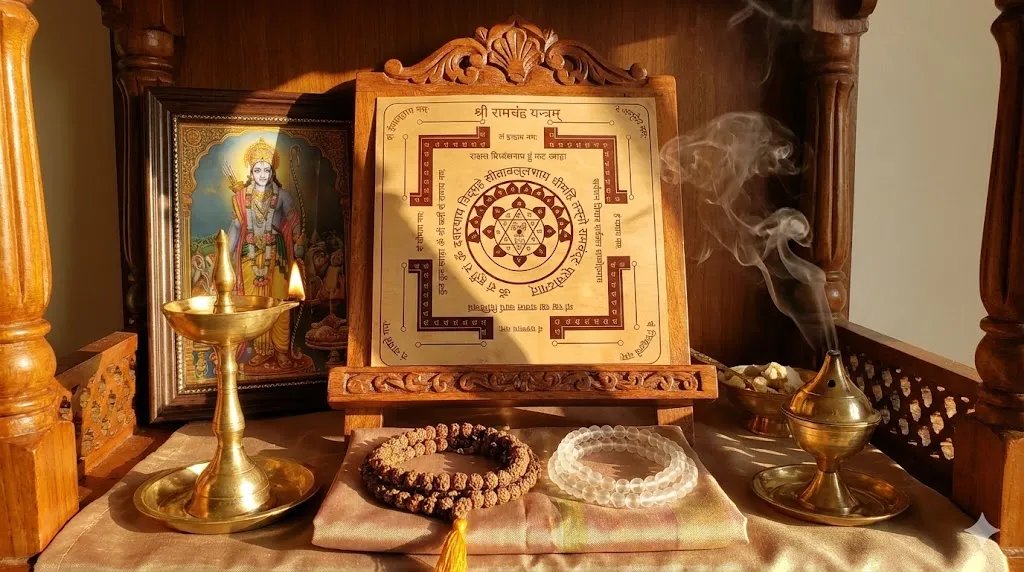
The image above is the Śrī Rāmacandra Yantram. This yantra embodies the full devotional and energetic current of Lord Rāma.
- Bhūpura (outer square): Written with “रां” repeatedly, forming a fortress of mantra vibrations. Corner invocations like “शं ईशानाय नमः” and “रं अग्नये नमः” call the guardians of directions to protect the devotee.
- Protective circle: With inscriptions such as “राक्षस विध्वंसनाय हूं फट् स्वाहा”, it recalls Lord Rāma’s divine power to destroy negativity and protect devotees.
- Lotus petals: Containing bījas like ह्रीं, श्रीं, ऐं, these petals radiate qualities of devotion, prosperity, and wisdom, harmonizing the devotee’s inner field.
- Triangles: Depict the union of śakti and śiva, Sri Sītā Devi and Sri Rāma, dynamic energy and steady consciousness.
- Bindu (center point): Marked by “ॐ रा”, the very heart of the yantra, where the devotee focuses and feels Sri Rāma’s living presence.
By meditating on this yantra, the devotee connects directly with Sri Rāma’s qualities: dharma, courage, protection, and compassion. The image is not ornamental; it is an energetic map of Sri Rāma’s blessings, meant to be installed on an altar, worshiped with a lamp and incense, and honored daily through mantra.
Frequently Asked Questions (FAQs)
Below are practical questions most often asked online and in devotional circles about the Śrī Rāmacandra Yantram and Sri Rāma-nāma.
Q1. What is the Sri Ramachandra Yantram and how does it work with the Sri Ramachandra Mantra?
A: The yantra is the geometric form of the Sri Rāma mantra. Chanting the mantra while focusing on the yantra creates a synergy of sound and form, deepening meditation and devotion.
Q2. How do I place the Sri Ramachandra Yantram at home for best results?
A: Install it on a clean altar facing east or northeast. Light a lamp and incense, keep the area uncluttered, and sit facing east during practice.
Q3. Which day is best to begin, and what is the minimum daily practice?
A: Thursdays, Fridays, and Ekādaśī are most auspicious. Begin with a small pūjā and chant 11–108 repetitions of Sri Rāma bīja mantras daily.
Q4. Do I need Guru Deeksha for the Sri Ramachandra Yantram?
A: Dīkṣā ensures the yantra is fully alive through lineage power. Still, sincere devotion with purity brings blessings even without formal initiation.
Q5. Who can keep the Sri Ramachandra Yantram?
A: Anyone with faith, respect, and cleanliness may keep it. Follow your family traditions; when unsure, approach simply and with reverence.
Q6. How long does it take to see results?
A: With steady practice, devotees often notice peace and protection within 40–90 days. Timings vary according to karma and faith.
Q7. Can I keep multiple yantras together with the Sri Ramachandra Yantram?
A: Yes, as long as the intentions harmonize. Avoid conflicting yantras on the same altar.
Q8. How do I cleanse and re-energize the Sri Ramachandra Yantram regularly?
A: Wipe it clean, offer a lamp and incense, and chant 11–108 repetitions of Sri Rāma bīja mantras, especially on Ekādaśī or Sri Rāma Navamī.
Q9. Where should I place it in an office or shop, or can I carry a kavach?
A: Place it near the work desk or cash box respectfully. A kavach version may be carried close to the heart.
Q10. What should I do if the yantra fades, cracks, or is disrespected?
A: Wrap it in a clean cloth and immerse or bury it respectfully, then replace with a new, sanctified yantra.
Q11. Can I offer Tulsi leaves and observe Ekādaśī with this yantra?
A: Absolutely. Tulsi is dear to Lord Viṣṇu and enhances the potency of Sri Rāma worship. Ekādaśī vrata magnifies devotion and steadiness.
Q12. How do I set sankalpa without anxiety?
A: State your intention softly, then surrender it to Sri Rāma. Consistency, humility, and gratitude ensure that the sankalpa matures naturally.
4) Kishkindha Kand

The Lord and Laxmana are on the lookout for Sita Devi. Now, there is also the story of the Lord meeting His greatest devotee, Sri Hanumanji Maharaj, for the first time. The Kanda then goes on to describe the Lord’s meeting with Sugreeva, the monkey-king in exile.
Here the 7 Kanda format shows its beauty. Kishkindha Kanda highlights the power of friendship, loyalty, and divine service. It is this section where the destiny of Rama and Hanumanji beautifully aligns.
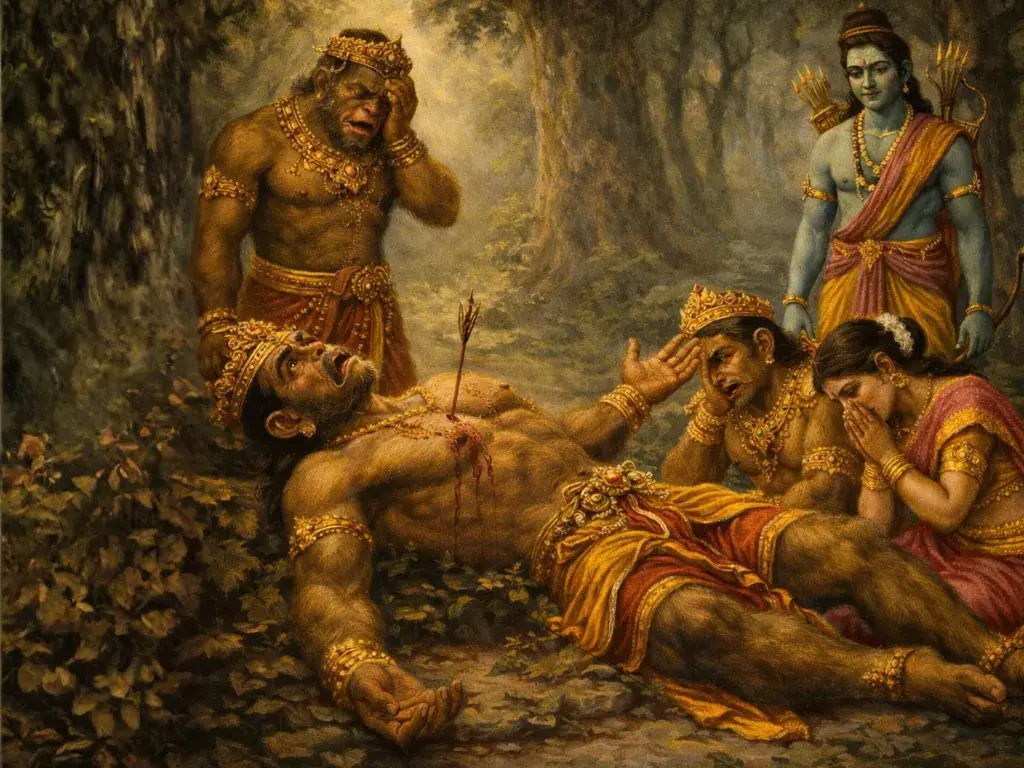
The Lord slays Vali (brother of Sugreeva), and coronates Sugreeva as the King of Kishkindha. It is in this Kanda, that there is a search party of monkeys that go in search of Mother Seeta.
5) Sundara Kand

One can consider this Kanda as the most auspicious compared to all other sections. Hence, it got its name. “Sundar”, means beautiful, auspicious.
For devotees in South India, reading the 7 kandas of Ramayana in Telugu carries a special sweetness. Telugu poets like Ranganatha garu enriched this Kanda with local devotion, making Sundara Kanda a household recitation for blessings and protection.
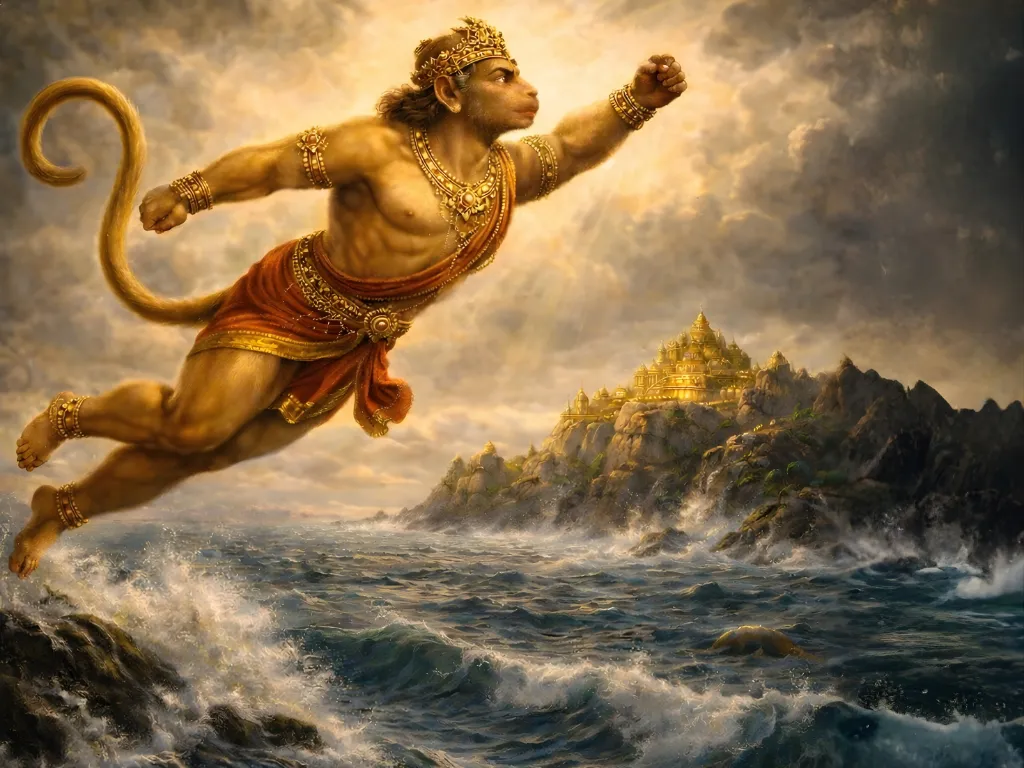
This is because it describes the strength and beautiful pastimes of Sri Hanumanji Maharaj, in the quest to find Mother Sita. There is a description of how Hanumanji Maharaj flew over the ocean and entered Lanka, is given here. So, this Kanda describes Hanumanji’s subsequent meeting with the Mother, the slaying of demons in the Ashoka Vatika, his meeting with the demon king Ravana, etc, in great detail.
One can consider this Kanda as the spiritual purport of a living entity’s life on the material planet. Hence it is a very auspicious practice to just read the Sundarakand as often as possible.
6) Yuddha Kanda (Lanka Kand)

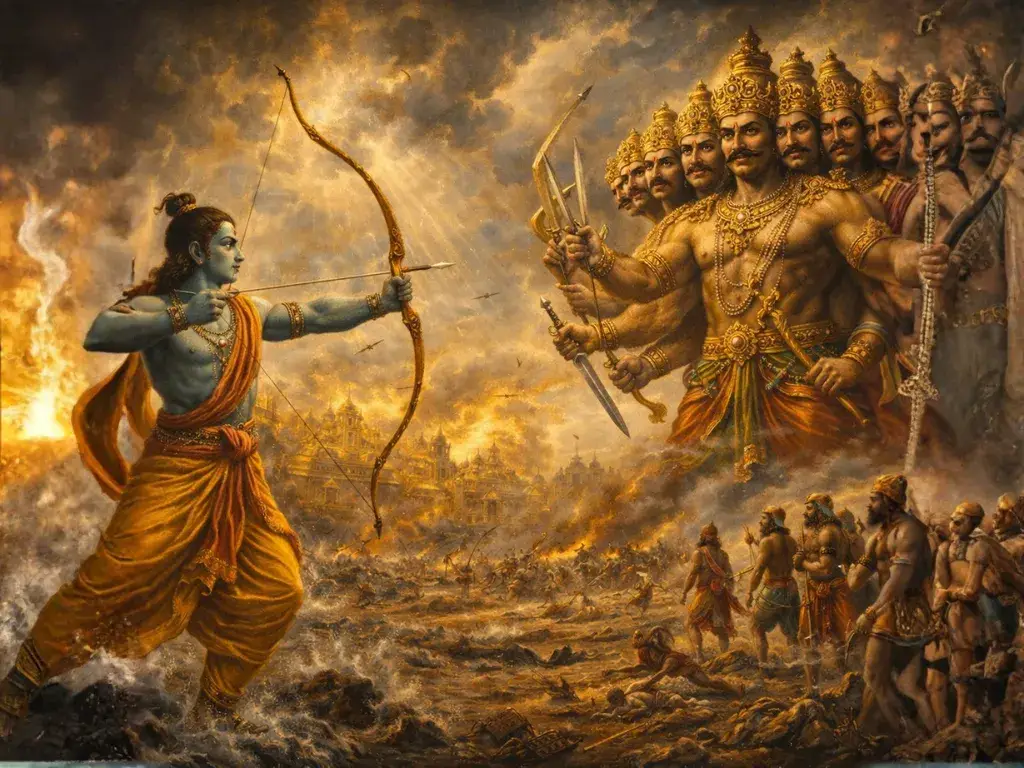
This Section of the Ramayana describes the war between the Lord and Ravana. In the grand scheme of the 7 Kandas, Yuddha Kanda shines as the victory of Dharma over Adharma. It reminds us that even the darkest battles of life can be overcome with faith, courage, and the Lord’s grace.
Also, the monkeys fight the Rakshasa Army in this Kanda. There is a detailed description of the killing of Meghanada, Kumbhakarana, and Ravana. After devastating the demon race, Vibheeshana is installed as the new king of Lanka.
Sri Rama, the monkeys (Vanaras) including Sugreeva, Sri Hanumanji Maharaj, Angada along with the new king of Lanka Vibheeshana ascend the Pushpaka Vimana (celestial airplane).
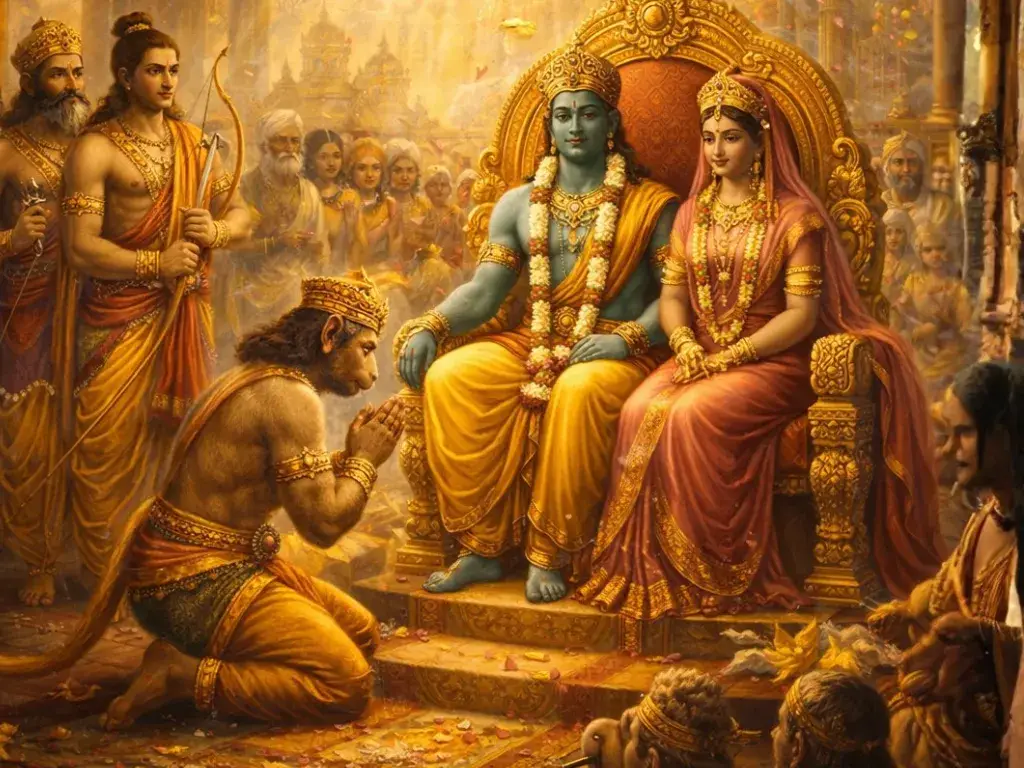
They travel to Ayodhya. Meanwhile, People of Ayodhya light lamps to receive the Lord with joy and gaiety. The whole city of Ayodhya celebrates this event of the return of Sri Rama to Ayodhya Puri after 14 long years.
Therefore, Bharatha Varsha celebrates this event even today, as the festival of lights, Deepawali.
7) Uttara Kanda

Here the whole victorious party of Sri Rama arrives at Ayodhya Puri. Sri Rama meets every member of the family as well as the entire population of Ayodhya Puri personally. Later on, Sage Vasishtha coronates Sri Rama as the king of Ayodhya Puri. Thus concludes the 7 Kandas of Ramayana, a timeless scripture that continues to inspire millions across centuries. Each Kanda is like a stepping stone, guiding the soul from innocence to struggle, devotion to victory, and finally, to peace and responsibility.
Every yantra is not just drawn; it is invoked. The Sri Ramachandra Yantra carries the blessings of courage, dharma, and divine love. If you wish to experience its presence personally and understand how it may serve your life, you may message us on WhatsApp (+91-7417238880) for guidance. Alternately, click the WhatsApp button below and write to us.