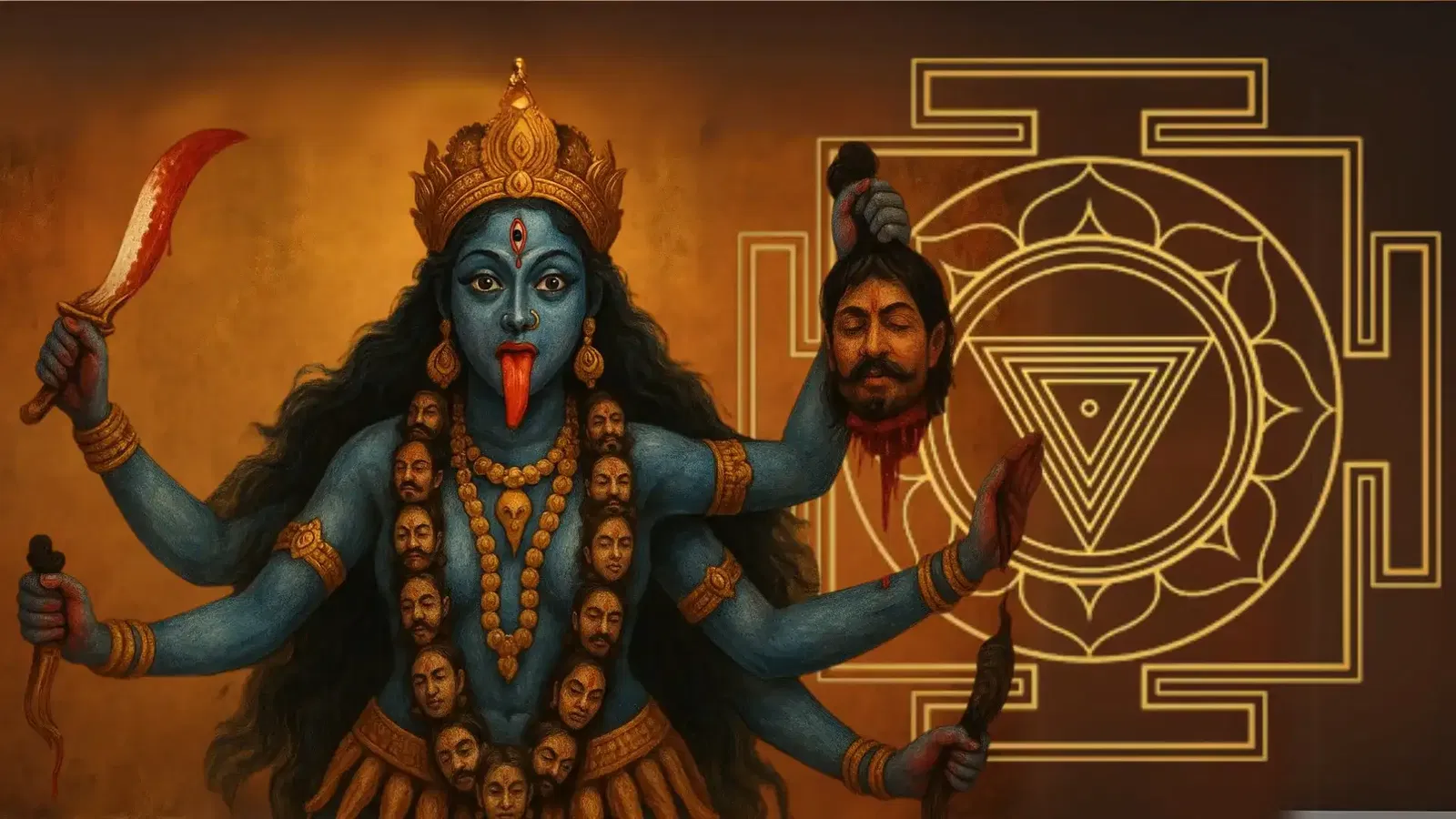
Who is Goddess Kali?
Goddess Kali is the fierce and compassionate Mother who destroys inner fears, removes negative influences, and cuts away the limitations that hold a person back from their true spiritual power. She represents time (Kāla), transformation, protection, and liberation. In the yogic and tantric path, Kali is the energy that dissolves ego, burns impurities, and gives a devotee the courage to face life with truth, strength, and fearlessness.
While Kali is often depicted as fierce, devotees know her as the most protective and loving form of Devi, who removes obstacles instantly and guards spiritual progress.
| Benefit Area | Subtle Energy Action | Result for Sadhaka |
| Protection | Dissolves evil eye and jealousy. | Unshakable inner security. |
| Karmic Healing | Burns deep-seated traumas. | Emotional weight lifted. |
| Willpower | Ignites the “Inner Sun.” | Decisiveness in career/life. |
Significance of the Kali Yantra
The Kali Yantra is one of the strongest spiritual protections against jealousy, black magic, ancestral energy blocks, and constant fear — all governed by Kali Devi, the 1st Dashamahavidya.
The Kali Yantra is dedicated to Kali Devi, the 1st Dashamahavidya and manifestation of transformation. The word transformation is often used in reference to Kali Devi. What does this actually mean, and how does the Kali Yantra help achieve this?
Kali is the female personification of Kala, or Time. Representations of Kala have always been fierce to nature, which includes Yama, Bhairava, and Dhumavati. Kala can never be tender or relenting. It teaches us to change and adapt- people change, so do places and events. In this ever-changing material world, nothing is permanent. Thus Kali Devi is “transformation” both within and without.
She is always seen laughing menacingly. Her blissful laughter reminds us of life’s perishable nature, to remain unentagled by its illusory glamour, and see the truth that lies hidden.

Nature of Kali Sadhana
The path of Kali Sadhana is not an easy one. Her iconography suggests she attracts individuals who feel a sudden, irresistible pull towards her. They are not here to live superficial lives. Instead, they want to dig deep into the workings of the human psyche and unravel dark, unexplored truths that others may not dare to face.
Contrary to the English saying “See beauty in everything,” one shall see the ugliness that lies behind the mask of beauty. This refers to seeing through false intentions as clear as a mirror, seeing the unpleasantness that lies beneath the skin of lust—the flesh, the bones, and the skeleton—and to withstand the reality of life without a trace of morose.

Significance and Nature of Kali Ma
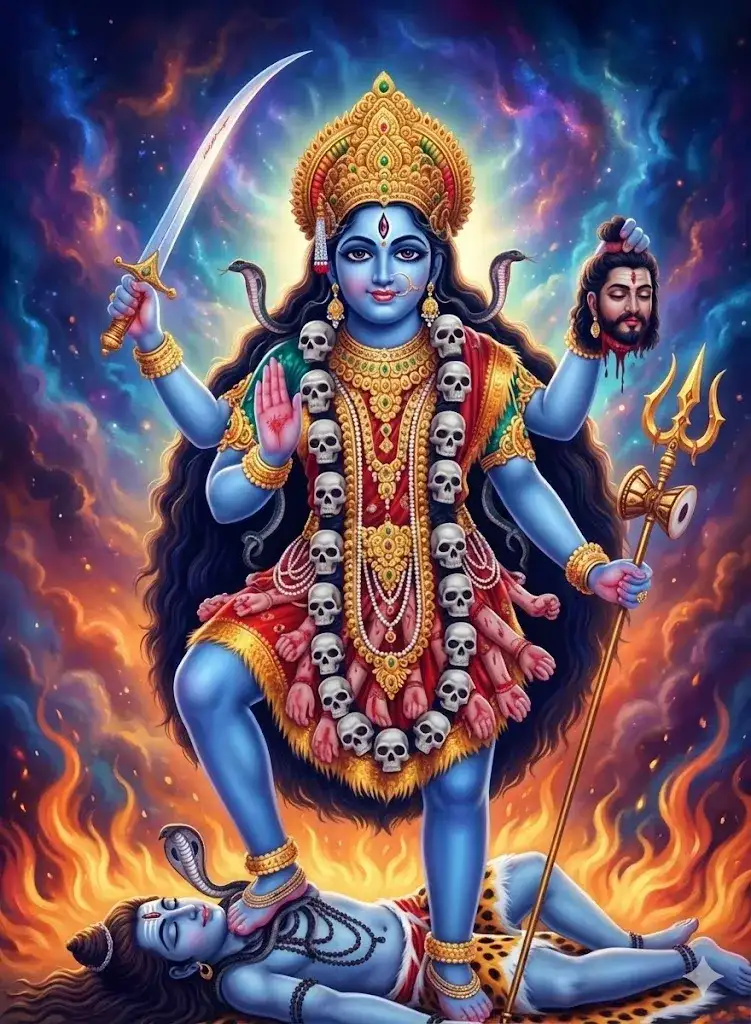
Kali Devi stands unclothed or bereft of garments, suggesting that all the darkness within shall ultimately stand exposed and naked to the world and to oneself. She teaches us to confront our negativity (past life vasanas such as jealousy, anger, greed, lust etc.) with fearlessness and acceptance. Unlike Parvati, Lakshmi, and Saraswati Devi who have a nurturing (Saumya) approach towards their devotees, Kali devi is profoundly mature and strict. She presents one with challenges so that one grows into a resilient being, capable of deciphering life’s truth by the grit of his own wisdom. Her intense energy is not suitable for weak-minded individuals who feel overwhelmed by life and its problems.

For Kali Sadhana, one must be willing to sacrifice the ego, which she holds in her hand. The head in her hand doesn’t belong to any far fetched demon. It represents our egoic selves. Her sadhana mandates a high degree of veera bhava, or inner courage. One either has it or doesn’t. It can’t be cultivated.
What does the Kali Yantra represent?
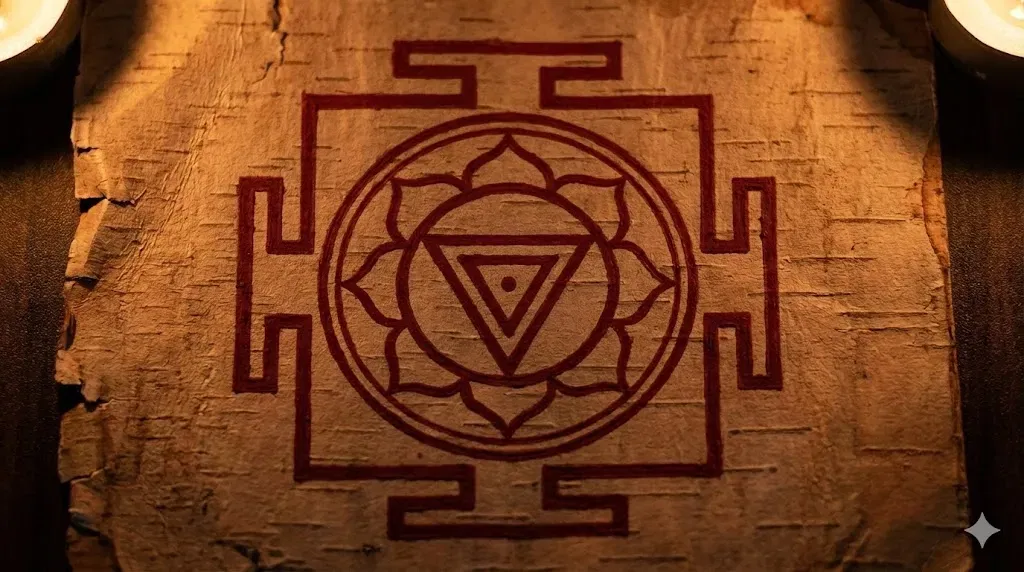
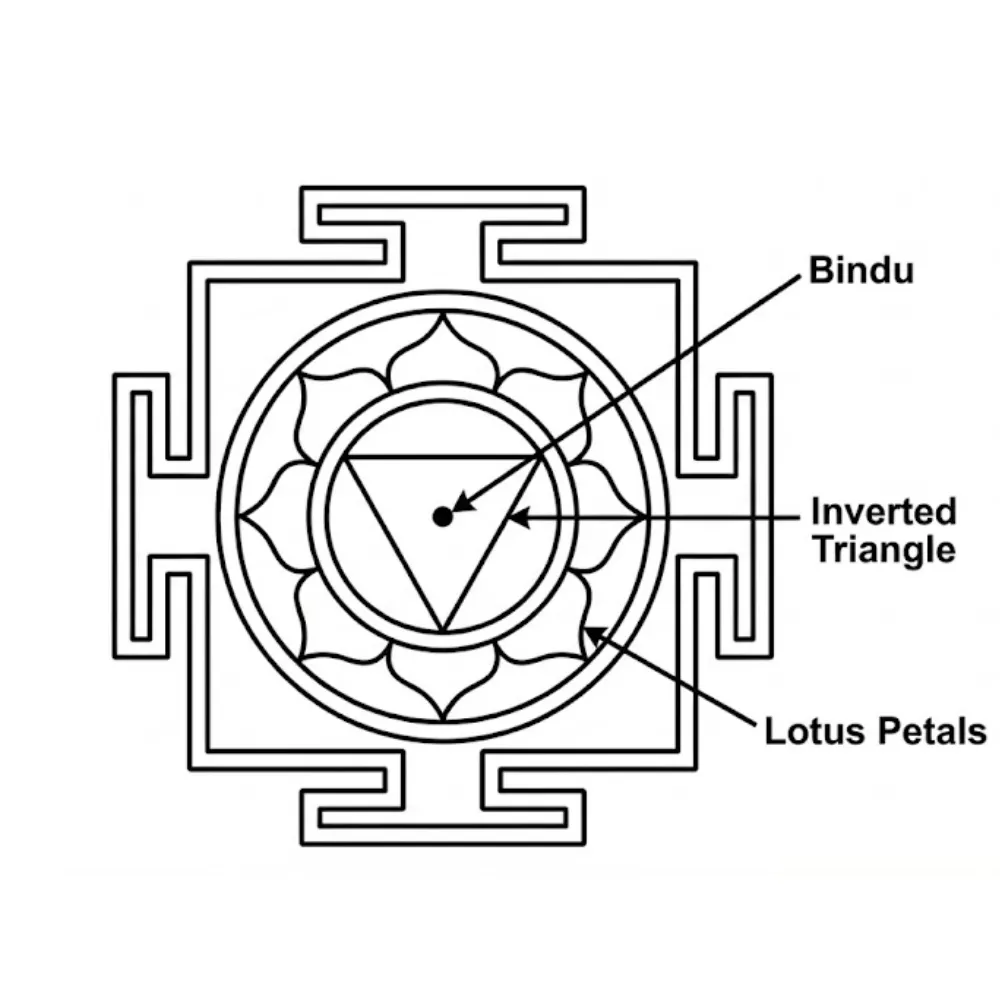
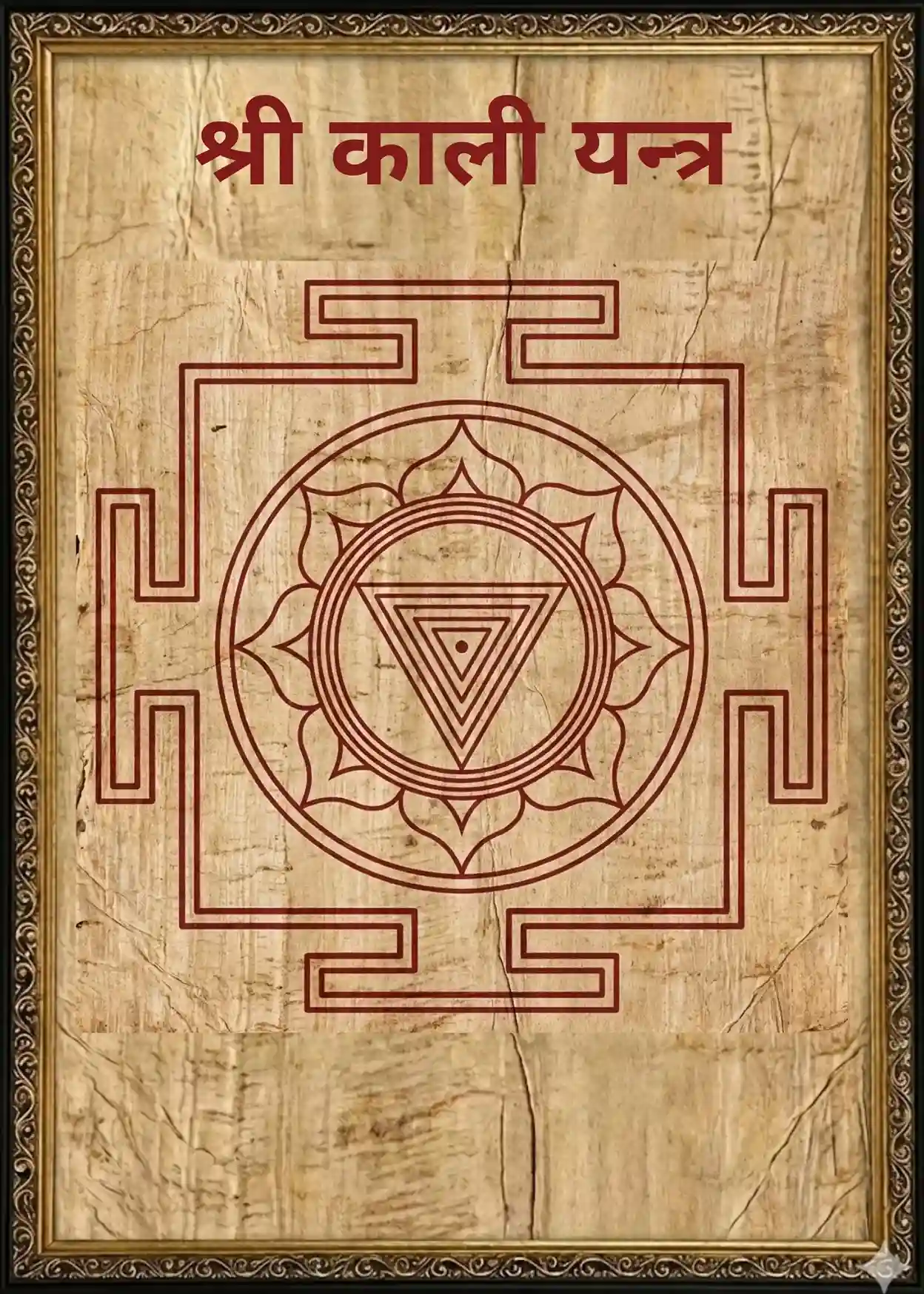
The entire energetic blueprint of Kali Devi is encapsulated in her Yantra; it is her temple. The Yantra is like the Morse code, containing all her secret knowledge, powers and universal truths in the form of geometric shapes and symbols. The lotus petals, circles, especially the downward triangles and their placement, all have a deep impact on our psyche, the bindu being the center of pure consciousness where all Her energies lie.

Meditating on the Yantra with devotion initiates sudden realizations, energy shifts and periods of trance when done under the guidance of a siddha guru. The Kali Yantra is thus a very powerful conduit of divine grace, helping one transcend the shackles of material existence and our time-bound identities.
Worshipping the Kali yantra is akin to worshipping the goddess in person.
Traditionally, women are depicted as feminine, with their hair tied in a bun, in modest drapery, and as an epitome of shyness. But here the mother goddess is in a wild and dominating avatar; her hair is unkept and loose, her expressions fierce while she is unclothed, defying the conventional norms of society. She steps over her consort and stands with firmness. Hence, she is widely worshipped through Vamachara (left-handed path of Tantra), which involves embracing unconventional elements disapproved by society.

We observe a waistbelt of severed hands around her waist. This waistbelt of hands signifies Karmendriyas, or organs of action. The Srimad Bhagavatam classifies hands as a major karmendriya in the list of Achita Tattvas. The waistbelt of severed hands suggests her intolerance towards sinful actions. She expects her sadhakas to walk on the sharp-edged sword of moral and righteous conduct; else they shall be punished for their misdoings.
What are the Benefits of the Kali Yantra?

The benefits of the Kali Yantra are as follows:
The FIRST benefits people feel are better sleep, mental calmness & protection from unknown negativity.
- Protection from all kinds of dark forces, negativity, evil eyes, black magic, deep unnamable fears and enemies. Its benefits go beyond surface rituals Those exhausted by negative energies, betrayed, or eternally worried feel better and stable in its presence.
- For sadhakas, it accelerates mantra sadhana, especially when done with the Kali bija mantras (kindly do not attempt without guru’s guidance).
- The Yantra helps activate the lower chakras, particularly the Swadhisthana and Muladhara which govern survival and creativity. All problems pertaining to the lower chakras are solved by the Yantra.
- One develops courage and fearlessness to face life’s challenges head on without retreating.
- Individuals worshipping the Kali Yantra can sense energies due to intuitive abilities developed during the course of Yantra meditation.
The Symbolism Behind the Geometry of the Kali Yantra
Each line, shape, and pattern in the Kali Yantra is an outcome of deep realizations and visions experienced by adept tanriks. Their metaphysical symbolism helps attain transcendence and cultivate the power to face life challenges.
The Downward-Pointing Triangle: Feminine Creative Force
The downward-inverted triangles are the distinguishing factors that form the heart of the Yantra. Downward triangles represent Shakti, while upward triangles represent Shiva. Unlike intersecting triangles found in other yantras, in the Kali Yantra three downward-facing triangles form a tight central cluster. They represent three aspects of Shakti: creation, preservation, and destruction.
As the concentric triangles reduce in size, grace descends from the gross (outer triangles) to the subtle (inner triangle). Inside the subtlest triangle that is in the core resides Devi Kali, the Supreme Truth, hidden by the grossness of this material world. Thus the downward triangles show how grace penetrates from the gross to subtle sheaths of the seeker’s being.
Circles Surrounding the Triangle
Concentric circles encircle the triangle. These symbolize the cyclical nature of time, karma and rebirth — which Kali Devi governs and ultimately dissolves. For the sadhaka, these circles represent the layers of the self that must be pierced through devotion and meditation.
The Lotus with Eight Petals (Ashtadal Padma)
Surrounding the triangle is an eight-petaled lotus, which symbolizes purity amid chaos as well as eight directions of energy. Each petal is a spiritual gateway, often representing ashta siddhis (spiritual powers) or ashta shaktis (forms of Devi). It serves as a spiritual filter — allowing only purified, awakened energy to move inward or outward.
| Geometric Element | Spiritual Representation | Benefit for the Practitioner |
| Central Bindu | Pure Consciousness / Shiva | Mental focus and center of stillness. |
| Downward Triangle | Shakti / Creative Force | Manifestation and feminine power. |
| 8-Petaled Lotus | Ashta Siddhis / Directions | Protection from all 8 directions. |
| Bhupura (Square) | The Material World | Grounding spiritual energy into daily life. |
The Square (Bhupura) With T-Shaped Entrances
The outermost layer is the square enclosure with four T-shaped gates, facing the four cardinal directions. The Bhupura represents the material world (bhuloka), which must be consciously entered through awareness and ritual. The gates symbolize crossing over from the mundane into the spiritual, which shall eventually initiate a shift in perception and consciousness.
The Central Bindu
At the very center of the yantra is the bindu, often hidden within the innermost triangle. This bindu is Kali Herself, the still point in the center of the storm — the Absolute, beyond duality, time, or form. It’s where the practitioner focuses one’s gaze during meditation, merging the mind with pure awareness.
When to Install the Kali Yantra?

Before installing the Yantra, one should look for days that align with Kali Devi’s energy, such as Amavasya (New Moon), Ashtami Tithi, Navratri days, or Kali-specific planetary hours (especially during Rahu Kaal or midnight rituals, if you are initiated). If you are unsure, you may choose a quiet Saturday or Tuesday morning for the Yantra installation.
External purity is very important in activating the Yantra’s energy. One should bathe and wear fresh, clean clothes, preferably of red or white color. If the Yantra is made traditionally on Bhojpatra, one should sprinkle Ganga Jal or gomutra around the area, not on the Yantra.
How Should One Use the Kali Yantra at Home?
The Kali Yantra is not to be passively hung on the wall but revered from the bottom of one’s heart as the breathing symbol of divine grace. This Yantra is capable of granting transcendence, being the living personification of Kali Devi.

To install the Yantra, select a peaceful and undisturbed area. The location must be clean, preferably set aside for prayer or dhyana. Kindly do not install it in the bedroom unless instructed by a spiritual guide.
Where Should I Place the Kali Yantra for Best Results?
The yantra must face the west direction, while you should sit facing the east during meditation. West is the direction of the setting sun, suiting Kali Devi’s nature of dissolution. For the sadhaka, east (the direction of the rising sun) is ideal for receiving spiritual blessings and wisdom. Thus, the placement suggested aligns with Vastu rules and the nature of the goddess.

On a wooden plank, keep the yantra on a red or black cotton cloth. These colours sync with Shakti’s raw energy, where Red represents Rajas (or the mode of passion) and Black denotes Tamas (the mode of ignorance).
| Feature | Recommended Practice | Reason |
| Direction | Face West | Aligns with Kali’s energy of dissolution. |
| Seating | Practitioner faces East | Optimizes reception of spiritual light. |
| Surface | Wooden Plank / Red Cloth | Natural materials hold “Prana” better. |
| Height | Above waist level | Shows respect to the Deity. |
For yantras like the Kali Yantra, where rituals matter, it is best to avoid plastic-based yantras. Bhojpatras Yantras are highly suitable.

Ensure that your altar is free of dust, since Devi resides only where there is cleanliness and respect for her.
Advanced Kali Sadhana & Guru Deeksha
For very intense forms of Kali sadhana (long retreats, high mantra counts, midnight rituals etc.), it is always safer to receive Guru Deeksha first. Initiation gives protection, structure, and the right way to handle such a powerful Shakti. For household-level worship with a properly energized yantra, guided by a guru, simple daily practice with devotion is usually sufficient and safe.
Meditation and Mantra Chanting with the Kali Yantra
Daily sit before the yantra at dawn or dusk and light a ghee lamp or diya in front of it. Offer a red flower or even simple water with devotion. Only initiated sadhakas are advised to shut their eyes and chant the Kali Mantra “Om Krim Kalikayai Namah” or the mantra given to you during the time of initiation. Again note: Guru Deeksha is mandatory of any form of Kali sadhana. Even 11 or 21 repetitions with full focus can initiaite energy alignment. Over time, one can increase the chanting to 108 times (or as guided by your guru) depending on one’s life events and body response.

Focus your attention on the bindu (dot) at the center of the yantra. This is where the power of the Yantra is concentrated. Allow your mind to settle there.
The geometric shapes heavily affect one’s mental patterns, inducing tranquility and insight and even bringing up negative thought patterns that need to be dissolved with sadhana.
Keep in mind, the strength of the Kali Yantra isn’t in elaborate rituals. It is in consistency, devotion, and faith. The more you commit to it, the more it reflects back to you.
Ideally, the Kali Yantra should face the west, with the practitioner facing east while meditating. It can be kept in a sacred space, on a clean cloth or wooden pedestal. Avoid placing it near the bedroom unless under proper guidance. The western direction resonates with Kali’s dissolving energy and enhances spiritual work.
Apply a bindu (dot) on the yantra with kumkum, sindoor, or chandan using the ring finger of your right hand. Offer red flowers to the Yantra, particularly hibiscus, which is dear to Kali. Depending on the availability, you may also offer raw rice, cloves, or fruits.
Which Mantra Should Be Chanted With the Kali Yantra?
The most famous and powerful Kali mantra is:
ॐ क्रीं कालिकायै नमः
Om Krim Kalikayai Namah
It is short and extremely effective in invoking the presence of Kali Devi.

Chanting this 108 times daily while gazing at the yantra builds the momentum for grace to flow. Advanced sadhakas may use longer mantras like the Kali Mahavidya Mantra or guided beej sound practices depending on their lineage.
Inwardly speak your intention—not as a desire, but as a prayer. This will bring transparency, allowing Goddess Kali to mould your path in favour of your material and spiritual. As described earlier in the significance part, the first sacrifice that must be made is the ego. Hence, offer your ego, your attachments, and your doubts at the feet of Kali Devi, and let her manage the reins of your life.
Kali Devi’s Link to Lord Shiva in the Yantra

At first glance, Kali Devi appears as a fierce and independent force — wild, untamed, and dancing on the chest of Lord Shiva. But beneath this dynamic symbolism lies the eternal interplay between Consciousness (Shiva) and Energy (Shakti). The Kali Yantra, though dedicated to the Goddess, vibrates with this silent presence of Lord Shiva — particularly through its center: the bindu, representing Shiva’s third eye, or Trinetra.
In tantric philosophy, Kali is not separate from Shiva. She is his awakened energy — the pulsating Shakti without which even the most potent consciousness remains static. While Kali moves, rages, destroys, and births, Shiva remains motionless, expansive, and aware. The Kali Yantra holds both these aspects: movement through its sharp triangles and lotus petals and stillness in its central dot — the bindu.
This bindu when meditated upon, becomes the Trinetra — Shiva’s third eye — the point of higher perception, where duality is burnt away. It is the inner vision to see beyond form, fear, and illusion. In many tantric commentaries, this bindu is described as the meeting point of action and inaction— exactly the realm where Kali operates, and Shiva watches. Shiva is essential to ground Kali; Kali is needed for Shiva to manifest.
Importance of Bhojpatra in Yantra-Making

According to Skanda Purana and Shaktisamgama Tantra, Bhojpatra is one of the ideal writing mediums for mantras, yantras, and kavachas. The Bhojpatra breathes — retaining prana. Sages believed that the pranic field of the Bhojpatra tree could hold subtle vibrations for extended periods — unlike paper, or synthetic substitutes.
Its natural origin and association with Himalayan sattva (purity) make it ideal for absorbing high-frequency energies like that of Maa Kali.
Unlike industrial paper, which is processed and energetically flat, Bhojpatra has a living memory. Its fibrous layers absorb the mantra-infused ink like skin absorbs sacred ash.
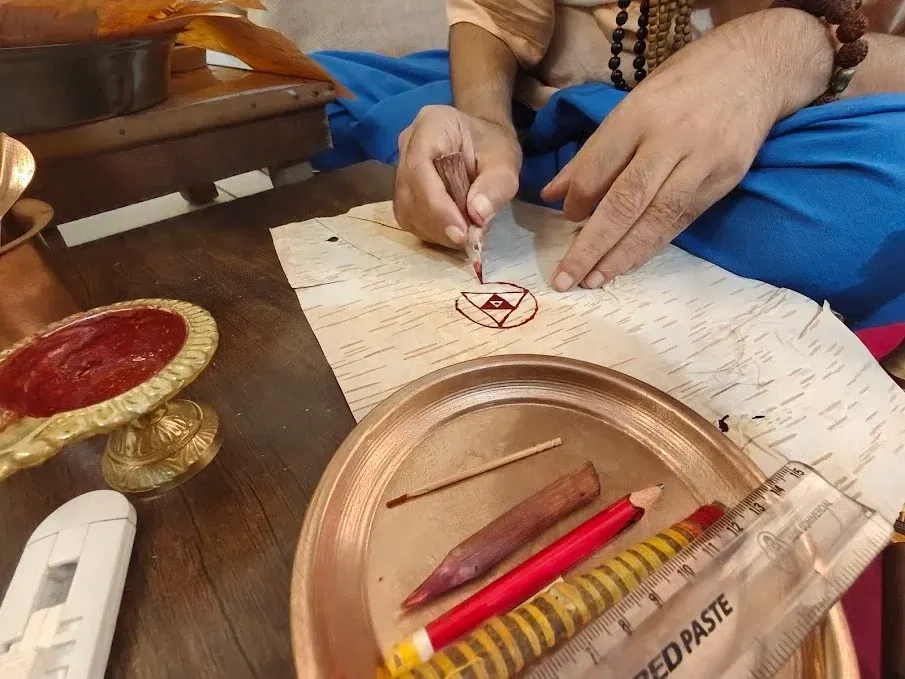
The Bhojpatra acts as a safe and grounding vessel to anchor the fierce and fast-acting Shakti of Kali Devi.
A Kali Yantra handmade on Bhojpatra using natural inks (made from ingredients like haldi, kumkum, or chandan) becomes ritually alive, which otherwise cannot be replicated by print or synthetic duplication.
Once energized on an auspicious tithi (like Amavasya), the Bhojpatra yantra becomes a spiritual vessel storing divine frequencies like a talisman. Many tantrics even use it as a base for siddhi kriyas.
What Makes Our Kali Yantra Different from Printed or Mass-Produced Ones?
| Feature | YantraChants Authentic Yantra | Mass-Produced / Printed |
| Material | Natural Himalayan Bhojpatra | Glossy Paper or Metal Foil |
| Creation | Hand-drawn by initiated Sadhakas | Industrial Printing Machine |
| Ink | Ashtagandha / Natural Pastes | Chemical Synthetic Ink |
| Energy | Prana-Pratishtha Ritualized | Inert / Decorative Only |
| Lifespan | Vibrant Pranic Field | Energetically Flat |

- Our yantra is drawn by hand and not printed by machines. The sadhaka who prepares the Yantra does sadhana before starting the Yantra creation. This process creates a yantra that is spiritually “alive.” Printed yantras, on the other hand, may visually resemble the original form but, being inert, may not carry subtle energy.
- Our yantras are created on natural Bhojpatra bark, as prescribed in ancient texts. Bhojpatra holds vibration, unlike glossy paper or metallic foils used in commercial yantras.
- To prepare our Yantras, use natural pastes of kumkum, chandan, kesar, and haldi. This natural ink preserves the sattvic quality of the yantra, enhancing its spiritual potency. Chemical prints, in contrast, may be visually vibrant but lack pranic purity. A yantra meant for worship must never be made with lifeless materials.
- Our Kali Yantras are not dispatched immediately after creation. They are ritually energized (prana-pratishtha) by our Guru Parampara system, inviting the Devi to dwell in the Yantra.
- We do not modify the original form of the Yantra to make it “market-friendly” or decorative. The yantra’s geometry remains true to Tantric scriptures and oral lineage teachings.
Is Kali Yantra Suitable for Householders or Only Tantrics?
This is a common question — and an important one. Because of its fierce reputation and energy, many believe the Kali Yantra is only for advanced tantrics or renunciates. But in truth, Goddess Kali does not belong to any exclusive group. She belongs to those who are sincere, open, and ready to transform — whether they live in forests, temples, or homes.

The Kali Yantra is absolutely suitable for householders, provided one is initiated by a guru and is ready to devote at least 5 minutes daily as spiritual discipline.
It shields the home from negative vibrations and attacks. Many initiated householders keep the yantra to protect their family from unknown fears and subtle interferences. The Kali Yantra helps to burn inner impurities and unresolved ancestral karma that manifests as life problems. However, it is always advised to maintain both external and internal purity. Do not place it casually in bedrooms or let others touch it out of curiosity.
In the eyes of Kali Devi, a householder with a pure heart is as exalted as a sannyasi. She does not discriminate by roles — she transforms anyone willing to face truth.
In fact, many of her dear devotees are householders. For example, Ramprasad Sen and Sri Ramakrishna Paramahamsa engaged in deep Kali sadhana while being Grihasthas (householders).
Kali Yantra of Transformation: From Fear to Fierce Freedom
Unlike yantras that address life on the surface, this one shakes our very foundation, challenging notions about ourselves and the world. To sit before the Kali Yantra is to be stripped of pretense, ego, and inherited fear. It is a mirror that reveals our true face, without sugar-coating.

Most of us live with hidden fears — of loss, judgment, failure, death, or simply of being truly seen. We cope with these fears by building layers of personality, roles, beliefs, and even spiritual identities. The Kali Yantra goes deep within those unseen layers by dissolving our falsehood. Its energy doesn’t coddle the mind; rather, it targets the root.
What Does the Transformation Look Like?
At first, the yantra may stir discomfort. Long-buried emotions may rise, intesifying old patterns. This is the process of tantric unraveling, where Kali is not trying to break you — she is breaking what is not you. She reveals what must go before truth can remain.

Over time, as your attachment and devotion towards the Yantra deepen, you shall see how your fears transform into a profound sense of clarity that is hard to explain. All confusions shall change their shape into convictions and resolve. Slowly, the mind’s clinginess shall turn into fierce independence. This journey is not about progress but about undoing what you have built—mental notions and conditioning. This is what ancient sages called Kali’s grace — fierce but compassionate beyond comprehension.
The freedom Kali Devi offers through her yantra is not freedom to indulge, it’s freedom from illusion—the kind of liberation that no outer success can ever match.
Does the Kali Yantra Really Work, or Is It Belief-Based?
This is perhaps the most honest question a sincere seeker can ask — “Does the Kali Yantra actually work?
The Kali Yantra is not powered by belief — it is powered by geometry, mantra, and intention. It is a tantric technology, corresponding to the frequency of Goddess Kali herself. Just as sound waves affect matter (as seen in cymatics), Yantras interact with subtle layers of our mind and energy body.
The triangles, lotus petals, bindu- all have energetic significance. Even without knowing their significance, just meditating on the Yantra influences the subconscious mind, dissolving fear and inertia. That’s not belief — that’s subtle physics, deeply understood by ancient rishis.

The Kali Yantra responds to devotion and sincerity of intention. It is not about blind belief, but it about being transparent with one’s intention. The Sadhaka must be mentally prepared to face fear, surrender ego and one’s lower identity to the deity.
This alignment brings the change. When you are receptive and tuned to the will of the deity, the yantra becomes a magnifying mirror, amplifying what you bring to it.
Across centuries, householders, saints, tantrics, and even skeptics have reported powerful shifts through yantra sadhana. Stories abound of protection from negative forces, sudden inner direction, or accelerated spiritual growth after regular practice with the Kali Yantra. These are not just placebo experiences —they’re lived testimonies from diverse walks of life.
And when the yantra is made traditionally on Bhojpatra, with mantra-infused ink and guru parampara energization, it becomes a living. channel of Shakti.
How To Worship the Kali Yantra Daily (The Simple Protection Ritual)

Step 1: Prepare the Space — Shuddhi & Sthana Shakti – 2 minutes
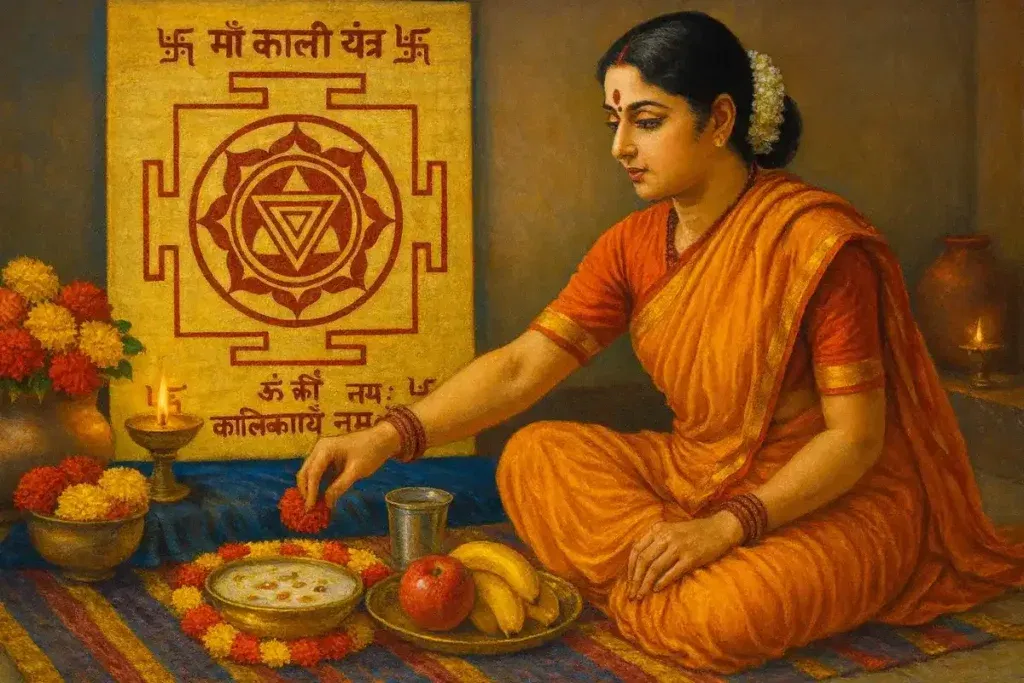
- Choose a clean, quiet spot facing East while the Yantra faces West.
- Light a diya (sesame oil if possible).
- Take one deep slow breath, and say silently:
- “Maa, please protect my home and heart today.”
- This is not a complex act — just a sincere welcome to Mother Kali.
Step 2: Invoke Presence — Pranapratishtha Bhava – 2 minutes
- Gently look at the center (Bindu) of the Yantra and focus your mind.
- Offer one flower, or simply place your right hand over the Yantra with devotion:
- “O Mother, stand guard over me and my family.”
- When attention meets Yantra, energy begins to flow.
Step 3: Chant the Mantra — Kali Raksha Mantra – 3 minutes
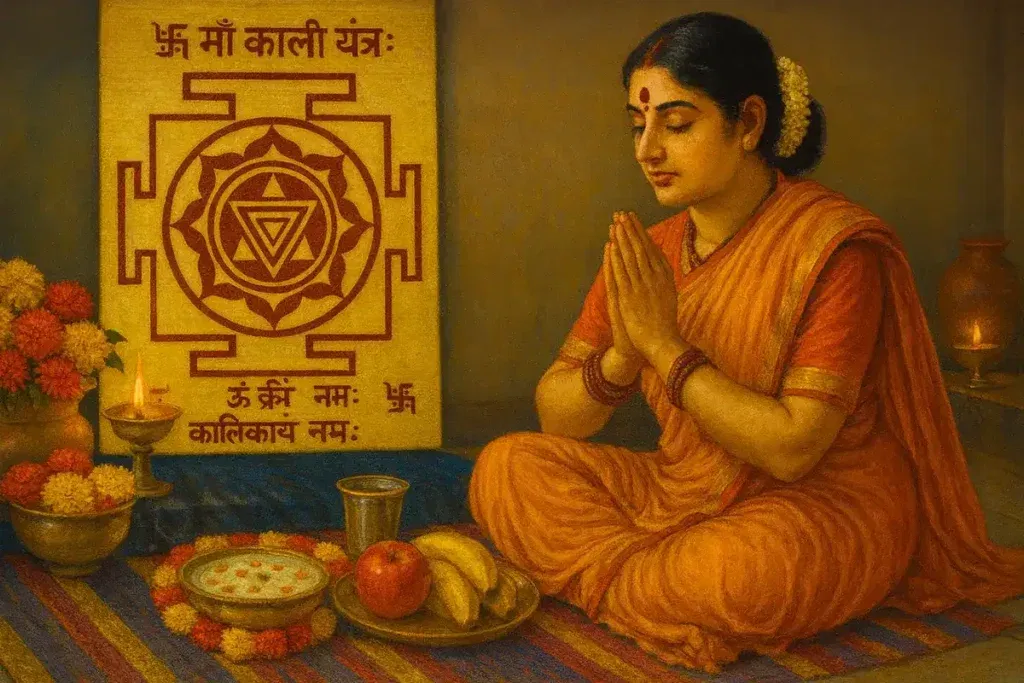
- Chant with a steady, calm rhythm:
- “ॐ क्रीं कालिकायै नमः”
- “Om Krim Kalikayai Namah”
- (11 or 21 times)
- If fear rises → chant a little more.
- If mind wanders → come back to Her eyes.
- Here, Bhakti is more important than count.
Step 4: Surrender Worry — Manah Shanti – 1–2 minutes
- Close your eyes.
- Imagine Maa Kali cutting your fears at the root.
- Say within: Whatever negativity surrounds me,
- Mother, burn it in Your fire.
- Let breath become soft.
- Allow calmness to grow.
Step 5: Close with Gratitude — Kruta-Gnyata – 30 seconds
- Fold your hands to the Yantra and whisper:
- “Thank you Maa. Stay with me always.”
- Leave the diya to complete its burn.
- Kali Yantra will continue protecting your home through the night and day.
🌺 Weekly/Monthly Enhancements (Optional)
- Tuesday nights: Extra chanting for faster results
- Amavasya: Powerful cleansing & protection upgrade
- Sprinkle saffron water once a week while praying
- Add a red cloth beneath the Yantra if possible
These deepen energy without making the practice difficult.
Placement Reminders (very important)
- Raised level — never on the floor
- Not near feet, dustbins, or noisy electronics
- A small, clean altar is ideal
- Bedroom placement is okay if above waist height
Safety & Support | Soft Encouragement Block
This daily puja is completely safe for all household devotees.
If someone wants to go deeper into advanced tantric practices,
Guru guidance can be taken in the future, naturally and peacefully.
Frequently Asked Questions (FAQs) on Kali Yantra
Q1. What problems does the Kali Yantra help with?
A. The Kali Yantra is especially helpful for those facing unexplained fear, black magic, evil eye, jealousy, sudden losses, or a feeling of being energetically attacked. It also supports inner courage, emotional stability, and continuous spiritual protection for the entire family.
Q2. Can a complete beginner or householder keep the Kali Yantra at home?
A. Yes. A sincere householder can safely keep an energized Kali Yantra at home, provided basic purity, respect, and simple daily reverence are maintained. Advanced tantric sadhanas are different and may require Guru Deeksha, but the yantra itself can be a compassionate protection for ordinary devotees when guided properly.
Q3. Where should I place the Kali Yantra for best results?
A. Keep it in a clean and sacred place, ideally facing west, while you sit facing east during prayer. Avoid placing it casually in bedrooms or near feet. Treat it like a small temple of Devi within your home.
Q4. What simple daily practice can I do with the Kali Yantra?
A. Light a diya, offer a flower if possible, sit quietly, and chant “ॐ क्रीं कालिकायै नमः (Om Krim Kalikayai Namah)” 11 or 21 times daily. Even a few minutes of sincere connection are powerful.
Q5. How long does it usually take to feel a difference?
A. Many devotees notice better sleep, reduced fear, and emotional stability within 7–21 days of consistent worship and proper placement. Kali Devi responds to sincerity.
Q6. What is the benefit of an energized Bhojpatra Kali Yantra versus a printed one?
A. A handmade Bhojpatra yantra energized through Guru Parampara holds a much deeper spiritual charge and works like a living channel of Kali Shakti. Printed yantras are visually similar but usually lack activation.
Q7. Is it necessary to follow strict rules like no onion/garlic or non-veg?
A. For household worship, cleanliness, devotion, and sincerity matter the most. Stricter disciplines are needed only for advanced sadhakas under Guru guidance.
Q8. What if I feel emotionally overwhelmed after starting Kali Yantra worship?
A. Sometimes Kali Devi brings old fears and suppressed emotions up for healing. If it feels intense, reduce chanting temporarily, ground with simple prayers, or seek Guru guidance. Her intention is always protection and liberation.
Q9. Can I worship other Deities along with the Kali Yantra?
A. Yes. Kali Devi can be worshipped harmoniously alongside Sri Lakshmi, Lord Ganesha, Lord Shiva, or Vishnu. Divine energies complement each other when worshipped respectfully.
Q10. How can I receive personal guidance on whether the Kali Yantra is right for me?
A. You can reach out for through WhatsApp for ordering and get things cleared.
YantraChants.com: A Sacred Refuge for Protection and Inner Courage
In a time when unseen pressures, subtle negativity, and emotional burdens silently weigh upon the mind, the worship of Mahākālī offers a fearless anchor. At YantraChants.com, the Kali Yantra is not treated as a decorative symbol, but as a living presence of Shakti, a disciplined guardian of one’s inner space, energized through the methods preserved in Shākta lineage memory. Each yantra is approached with the same seriousness with which a doorway into the Divine should be approached: with mantra, purity, responsibility, and trust.
The household devotee who seeks emotional steadiness, spiritual protection, and freedom from unseen disturbances is not expected to become a tantrika overnight. The Bhojpatra Kali Yantra offered here is crafted to support simple and sincere worship, allowing grace to flow strongly, while the devotee remains grounded in family dharma and daily life. It stands not as a promise of miraculous results, but as a shield of devotion, energizing the home with courage and clarity.
YantraChants.com exists to honour the sacredness of this relationship. We offer what has been sanctified, not merely made, but awakened. A Kali Yantra is a companion to the sādhaka’s heart: silent, watchful, and uncompromising in its protection. Serving seekers with humility and lineage responsibility, we aspire to remain a quiet ally for those who walk the spiritual path with sincerity, strength, and deep trust in the Mother who destroys every fear.

Vani Devi Dasi

Damodar Das Ji Maharaj