
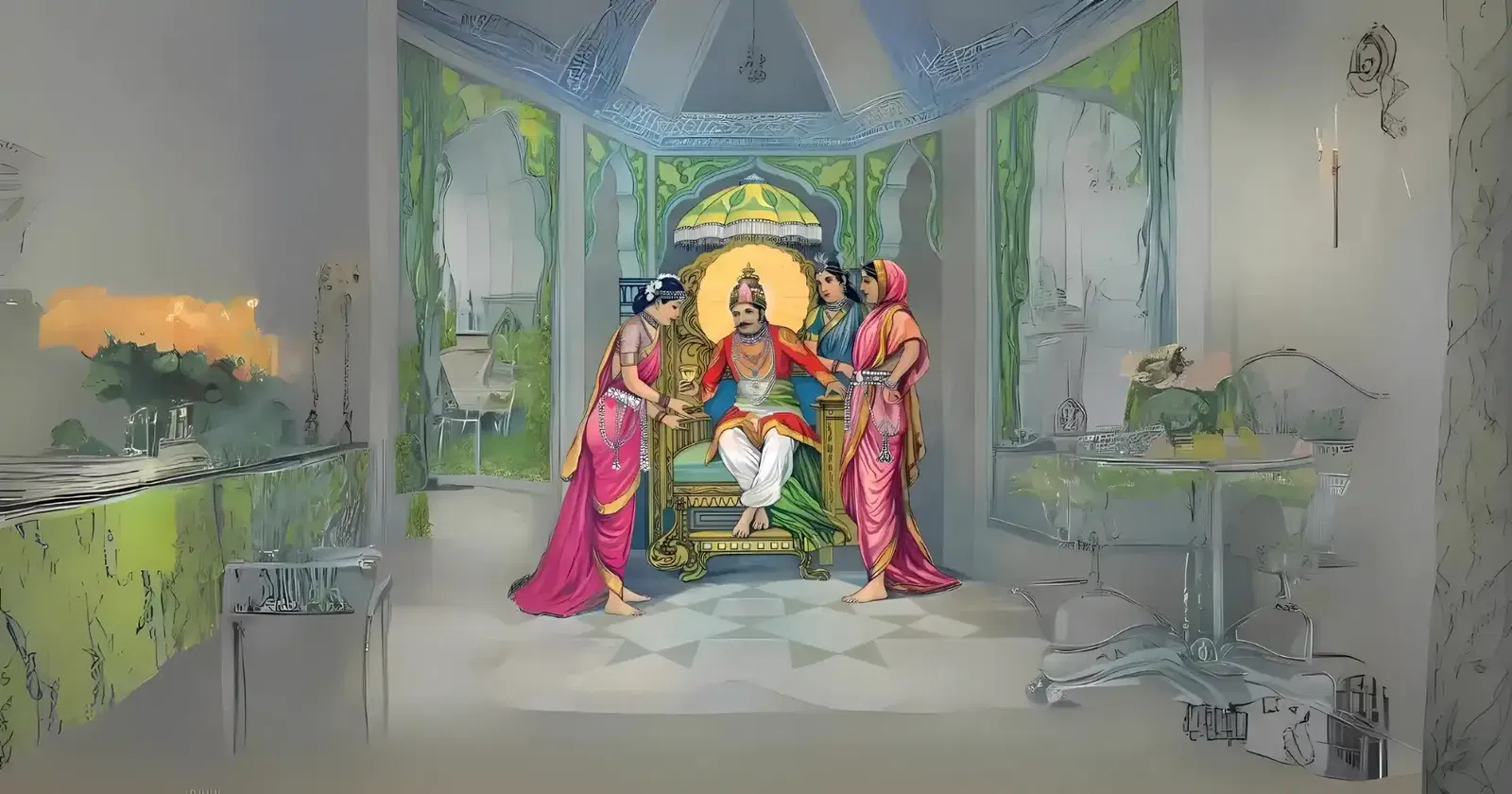
Did you know a seemingly harmless prank in youth can later ripen into a grave trigger that affects reputation, relationships, and destiny?
In the Ananda Ramayana, Devi Kaikeyi’s story reveals that karma is not always a form of punishment. Sometimes, it is life’s precise way of showing us where we must grow in maturity. Karma, in this sense, acts like a perfect lesson that points out the exact inner weakness or trait that needs refinement.
When life begins to feel like a chariot wheel slowly coming loose, with focus fading, relationships growing unsteady, reputation feeling fragile, and inner peace cracking under pressure, the episode of Devi Kaikeyi offers a steady and grounded lesson.
The Episode from Ananda Ramayana
Ravana Tries to Kill Devi Kaushalya
On learning from the creator Sri Brahma about His own death, Ravana made Kaushalya Devi a captive and ensued a war with King Dasharatha, to cut destiny at its root. He believed that by doing so, he would turn the course of events, hindering the advent of Sri Rama.
But the story turns out to be strange. The queen was enclosed in a box and dispatched to an isolated island. When Ravana boasted that he had conquered his death, in the presence of Sri Brahma, the box was opened. The captive queen was not alone. From the box arose 3 beings
- Sri Dasharatha
- Sumantra
- Devi Kaushalya
Ravana was stunned. His violence could not reduce reality but instead expanded his resistance and fear of the future. Sri Brahma warns him in essence:
- You tried to capture one and destroy the other, but now three collectively appear in front of you.
- What you resist can multiply into stronger opposition.
- Sri Rama will manifest, and your attempt to escape fate shall become your trap.
“The more we fight what must unfold, the more tightly we bind ourselves to it.”
Thus advised by Sri Brahma, Ravana was advised to adopt decency and return the couple to Ayodhya.
This episode teaches us that when fear drives action, karma intensifies the exact pattern we are trying to suppress.
Sri Dasharatha Marries Devi Sumitra and Devi Kaikeyi
Later, Sri Dasharatha marries Devi Sumitra (Magadha) and Devi Kaikeyi (Kekeya), and also many princesses as part of diplomatic alliances which was seen common in that era’s statecraft. Yet the story points out something painfully human:
Even with power, wealth, and alliances, Sri Dasharatha feels inner emptiness as he had no progeny. This reflects the truth that although outer success may exist, the heart feels incomplete.
The Wheel Moment: Devi Kaikeyi’s Silent Sacrifice

A massive war erupts between Devatas and Danavas. It was a belief that whoever gains the support of Sri Dasharatha shall surely emerge victorious. So, the Devatas approached him to join the war, to which he unhesitatingly agreed.
Devi Kaikeyi accompanies him and proves herself skilled, composed, and brave.
Then the wheel moment happens: During battle, the chariot wheel spindle broke. Sri Dasharatha remained focused on the battle, not realizing that his chariot was about to collapse.
Devi Kaikeyi observed that the chariot cracking under stress could be fatal.
So she does something startling:
She placed her index finger into the wheel hub, using it as the spindle. She singlehandedly held the wheel together while war continued.
She absorbed the pain silently to keep the king steady.
Why Did Devi Kaikeyi Suffer That Pain?
The Curse of the Yogi (The “Black Mark” Theme)
This pain stemmed from a previous karma. As a teenager, Devi Kaikeyi played a prank on a resting yogi. She smeared his face with black ink and unapologetically bursted out in laughter.
Seeing her insensitivity, the yogi cursed her. The curse is described as a symbolic mark:
- An “invisible black mark” will be smeared across her face. This implied infamy, social scorn and humiliation.
- He further asserted that her own son will detest looking upon her face.
- Time will strike like a thunderbolt and this will inevitably occur.
So, when Queen Kaikeyi placed her finger in place of the spindle, two powerful themes came into focus.
- Her chastity and devotion to her husband: This moved the king to grant her two boons.
- Her earlier insult to a yogi: It turned those very boons into the means through which his curse manifested.
Blessings and Boons can surface older karmas so that it may finally end.
The Three Queens of the Solar Dynasty
Each queen represents a different dharmic pillar in the Solar dynasty.

| Queen | Key Contribution | Spiritual Significance |
| Devi Kaushalya | Mother of Sri Rama | Embodiment of patience, wisdom, and dharmic stability |
| Devi Sumitra | Mother of Lakshmana & Shatrughna | Symbol of selfless service and quiet strength. |
| Devi Kaikeyi | Mother of Sri Bharatha, Savior of Sri Dasharatha in war | Symbol of self-sacrifice, enduring pain and suffering for Bhagawan’s pastimes to manifest |
The Devotional Core
Through the story of Queen Kaikeyi we must learn the necessity of aligning our mind and conduct with dharmic principles. This ensures a fulfilling material and spiritual life. When there is a misalignment it can invite misfortune. So, the question is what is the shield or protection armor that can save us from such calamities? This episode contains the answer to this question. Real protection is not just an outer shield, it is inner alignment. When your conduct matches dharma (clean speech, steady mind, service towards the God Realized, disciplined habits, truthfulness, etc) life slowly stops feeling hostile and starts becoming more supportive.
So the safest devotional path is:
- Steadiness over intensity (small daily practice, not occasional extremes)
- Choose a small, consistent practice that you can do every day, instead of doing big, dramatic effort once in a while.
- Do not spread, rather go deeper into one practice. Rather than chanting multiple mantras/stotras take one, focus while chanting/reciting and maintain it as a lifelong practice.
- Steady practice changes your mind and habits slowly but permanently.
- Intense bursts feel powerful, but they usually don’t last.
- Daily japa over emotional chanting: Don’t chant only when emotions are high (fear, panic, anger, desperation) and then stop when you feel better. That kind of chanting is reaction-based.
Instead, chant a little every day, even on normal days. That kind of chanting is discipline-based. Why? Because daily repetition trains the mind and character, like daily exercise trains the body.
Pure intent over fear-driven remedies (devotion, not panic): You chant or pray with thoughts like
- “May I become steady.”
- “May my thoughts, words and deeds become clean.”
- “May I act dharmically.”
- “May I remember Sri Rama with devotion.”
This kind of intent purifies you and builds real inner protection.
Avoid these kinds of Fear-driven remedies
- “Something bad will happen unless I do this.”
- “I must fix this immediately.”
- “I’m cursed / someone is harming me.”
- “Remove this problem right now.”
- “I will chant this mantra because I will get this benefit or else I shall stop chanting the mantra.”
Such approaches turn spiritual practice into a source of anxiety and defeat the very purpose of sādhanā. The true spirit of practice rests in devotion and surrender. When mantras or the Lord are approached merely for personal gain, the practice loses its purity and slips into subtle selfishness.
Mapping the Episode from Ananda Ramayana to Daily Life along with Remedies
| If your issue feels like… | Use this devotional anchor | Why it matches this story | What to consider from YantraChants + To do Remedies |
| Fear, instability, dejection, collapse in crucial life events. | Sri Rama japa + grounding (Muladhara Balancing) | The Wheel collapses on the battlefield. Likewise, our life seems to crumble under pressure and problems. | Shri Ram Jay Ram Jay Jay Ram Mantra 108 times on energized Neem Mala/ Tulsi Mala + Muladhara Kavach for alignment or daily walking barefoot early in the morning on soil/grass. |
| Mental noise, wrong thoughts/ actions, Anger, Pride, etc. | Sri Rama Raksha Yantra + Sphatika Mala japa | Ravana was overtaken by pride and he tried to control his destiny that amplified his fears, anger, etc. | Sri Ram Raksha Yantra provides protection from (helps overcome) vices + Sphatika Mala soothes the mind. |
| impulsive speech, unintentionally misaligned actions, reputation damage | Rudraksha Mala + restraint vow | Curse theme of Devi Kaikeyi | Rudraksha Mala for steadiness + consciously undertake self-control |
| “I do so much, no recognition”, inner emptiness, voidity, sadness, etc. | Daily arghya/namaskara + mantra | Although materially fulfilled, Sri Dasharatha’s sorrow over absence of progeny. | Energized Sri Rama Yantra + Worship + Mantra |
Kindly Note: These are spiritual disciplines that do not substitute for medical/legal advice. Their value is steadiness, devotion, and inner correction.
Developing 6 Sublime Spiritual Qualities: (YantraChants.com Vidya-Siddhi Framework)
You can choose to follow one or more of these practices to develop any of these spiritual qualities that develop in an individual through sustained will and sincerity towards practice.
1. Truthfulness

This is the prime quality in a sadhaka. Sri Rama throughout His pastimes emphasised on the necessity of truth and upholding one’s promise. Truth or Satya is nondifferent from Sri Rama.
Spiritual Tools and practice
The Shri Ramachandra Yantra is the most aligned spiritual anchor for developing Truthfulness. It enables one to maintain the brilliance of Truth (Sri Rama) with the softness of the moon (Chandra).
- Sit facing east (if possible).
- Place your Energized Sri Ramachandra Yantra in your home temple altar.
- Regularly worship it with incense and ghee lamps.
- You may chant associated Rama Mantras and conclude your daily prayers/worship with the Aarti.
2. Obedience
Obedience is a priceless quality. It can only grow when the innermost tendency of rebellion or defiance is conquered. This Dharmik Quality is essential for the bond of a Guru and Shishya to blossom.
Spiritual Tools and practice
The Shri Hanuman Bhakti Yantra enables one to become obedient and pay heed to good advice.
- Start the practice on a Tuesday or Saturday as these days align with Sri Hanumanji Maharaj’s energy.
- You can place your Energized Sri Hanuman Bhakti Yantra in the North East corner, East or at your home temple.
- To invoke the Grace of Lord Hanuman chant the following at least 3 times.
मनोजवं मारुततुल्यवेगं
जितेन्द्रियं बुद्धिमतां वरिष्ठ ।
वातात्मजं वानरयूथमुख्यं
श्रीरामदूतं शरणं प्रपद्ये ।
Mano-Javam Maaruta-Tulya-Vegam
Jite[a-I]ndriyam Buddhi-Mataam Varissttha |
Vaata-Atmajam Vaanara-Yuutha-Mukhyam
Shriiraama-Duutam Sharannam Prapadye | - With folded palms and closed eyes, Pray to Lord Hanuman for developing Obedience, to perform only the right actions and one’s duties. If you are initiated, remember your Guruji along with Hanuman ji Maharaj and seek their blessings to always abide by Dharma.
3. Helpfulness
Helpfulness refers to Seva in the spiritual context. Seva is one of the most exalted moods of Bhakti. To reach its peak, one must earnestly work towards cutting asunder selfishness and the tendency to expect reward for every action.
Spiritual Tools and practice
The Shri Sankatmochan Hanuman Yantra is a spiritual tool with a twofold purpose: it helps cut through obstacles, problems, distress, and persistent troubles in the sādhaka’s life, and it also supports the good the worshipper resolves to do for others. It strengthens their efforts to protect, uplift, and serve others.
- On a Tuesday or Saturday, Place the Energized Shri Sankat Mochan Hanuman Yantra in your home temple altar
- Keep an orange (sindoori colored) cloth as the base.
- Light a Chameli (Jasmin) oil Lamp.
- Recite the Sankatmochan Hanuman Ashtak 2 times daily infront of the yantra, to receive the Grace of the deity.
- Continue the worship as a daily practice.
- On the first day of installing the Yantra at home, offer Kesari sweet.
4. Silence
Silence is a very rare quality to find these days. The chaotic cities, towns and other places reflect the inner noise of people around, which is full of conflicting ideas and viewpoints. Therefore, it is important to practice and develop silence to remain grounded.
Spiritual Tools and practice
The Shri Ram Jay Ram Jay Jay Ram mantra increases awareness. When paired with the Sphatik Mala this mantra brings calmness and the ability to remain quiet. It enables one to speak only when necessary and not out of habit, impulse, anger or frustration.

- Once you receive the energized Sphatik Mala, kindly place it overnight in your home temple altar, in front of the Image of the Ram darbar/ Shri Sita Ram Hanuman.
- Next morning after a bath you can sit on your woolen asan and chant 1 round of the mala with the above mentioned Mantra.
- Pray to the divinities- Srimati Sita Devi and Sri Ramachandra, while always keeping and revering Hanuman ji Maharaj to bless you with calmness and to develop silence.
- You can start once daily with 1 round and gradually increase the number of rounds and also chant it in the morning and evening
- Consistency is the key to harnessing the virtue of silence.
5. Humility
It is said that without Humility, all spiritual practices are rendered ineffective. Pride and haughtiness are like the great lids that close the vessel of the heart. Only humility can shatter this lid and allow the ambrosia of Bhakti to flow in our hearts and make us more spiritually uplifted.
Spiritual Tools and practice
The Shri Seeta Ram Yantra is a powerful spiritual tool that can be worshipped by anyone. It carries the nurturing, protective energies of Srimati Seeta Devi and Sri Rama, supporting the sādhaka’s overall growth, inner steadiness, clarity, and dharmic strength.

When the Seeta Ram Hanuman mantra is recited before it, the humility and seva-bhāva of Sri Hanumanji Maharaj is naturally awakened. In this way, devotion becomes complete: you receive grace, and you learn to hold that grace with service and surrender. Over time, it keeps a person grounded, gentle, and emotionally steady, even while life is moving.
The Tulsi Mala is ideal for developing this sublime quality, however with restrictions. It is advisable to use only those who avoid non-veg, intoxicants (alcohol, smoking, etc) onion, garlic and mushrooms. This is because Tulsi is highly Sattvik and its energy is disturbed or offended when impurities in food habits persist. Alternatively, Neem Mala can be safely used by anyone.
- On a Thursday or Tuesday install the Energized Shri Seeta Ram Yantra in your home temple.
- Alternatively you may install it on the East or North East.
- Light a ghee lamp and some incense in front of the Yantra.
- You may offer some flowers and a sweet dish on the first day of installation.
- Place the Japa mala in front of the yantra for sometime before you chant.
- Pray to the deities to make you humbler than the blade of a grass so that all spiritual gifts are bestowed upon you.
- Now, place an Asan, such that you face the yantra.
- Sit on it and begin chanting Sita Ram Hanuman in an audible manner such that you can hear your own voice. This improves concentration.
- Conclude the chanting by prostrating in front of the yantra.
Another Powerful Yantra You must be Interested is the Sri Ramachandra Yantra:
6. Celibacy

Celibacy means Brahmacharya or retraining the mind, body and speech from all kinds of sensual activities and matter. The first step one should take is a conscious abstinence from material or content that triggers agitation in the mind that leads to failure in Brahmacharya.
Spiritual Tools and practice
The Panchamukhi Hanuman Yantra is a fiery spiritual tool to invoke the Grace of Lord Hanuman who bestows Brahmacharya on his ardent devotees. Without Brahmacharya, one cannot commit to the spiritual path. Lust is the shackle that keeps one bound to the Mayic World.
- On a Tuesday/Saturday install the Energized Shri Panchamukhi Hanuman Yantra in your home temple.
- You may offer some fresh red or orange flowers to invoke the fiery and protective energies of Shri Panchamukhi Hanuman ji Maharaj on the first day or keep it as a regular feature of worship to increase the vibration of your home space with His energies.
- Light a ghee lamp and some incense in front of the Yantra.
- Alternatively, place the Yantra in the East or North of your home.
- Place the Rudraksha Japa mala in front of the yantra for sometime before you chant.
- Pray to Lord Hanuman for burning away the seeds of Lust and allowing the flower of Bhakti to blossom.
- Now, place a woolen red/orange colored Asan, such that you face the yantra.
- Sit on it and begin chanting Shri Hanumate Namah
- First focus on the geometry of the Yantra.
- After attaining mastery in that you may close your eyes and contemplate on the geometry of this Yantra.
- This keeps you connected with the Energy of Shri Panchamukhi Hanuman Ji Maharaj.
- Conclude the chanting by prostrating in front of the yantra.
Mass Print vs YantraChants.com Trust Stack Handmade Bhojpatra Yantra

| Feature | Mass-Printed Yantra | Bhojpatra Yantra (lineage-style) |
| Material | Paper/metal print | Bhojpatra (traditional medium) |
| Drawn quality | Mechanical repetition | Hand-crafted geometry discipline |
| Use-case | Decorative / generic | Sadhana-oriented “focus symbol” for individual purposes. |
| Best for | Casual placement | Daily practice, worship, mantra chanting and consistency |
| Trust factor | Unknown source | Clear Instruction PDF for Guidance |
“What it Does NOT do” (YantraChants.com Trust Stack Section)
This practice:
- Does not guarantee instant life changes. The changes experienced are gradual, subjective and personal.
- Does not replace medical, legal, or professional support
- Does not justify fear-based superstition. It is faith based.
It does help you build steadiness, restraint, and devotional continuity, so that the “wheel of life” stops slipping.
Frequently Asked Questions (FAQs) on Sri Rama Mantra Japa / Yantra
Q1. Is this Kaikeyi curse story literally true or symbolic?
A. Many readers approach it both ways. It is a sacred narration, literally true for it is accounted in our scriptures, which is even symbolically true. It teaches how disrespect ripens into consequence and the necessity of dharmic alignment.
Q2. Which mala is best for Sri Rama japa?
A. Tulsi Mala is traditionally favored for Sri Vishnu/Sri Rama devotion but must be used only after purification in food and lifestyle is observed. Sphatika supports calm repetition; Rudraksha supports restraint and steadiness.
Q3. Do I need a yantra to practice this?
A. No, yantras are not mandatory to practice self awareness. But a yantra can act as a visual anchor that trains consistency. If your mind scatters easily, an energized Bhojpatra Yantra can support focus and daily discipline.
Q4. How long should I practice before expecting inner results?
A. Give it 41 days as a sincerity window. The first “result” is steadiness, cleaner speech, calmer reactions, stronger discipline. Then life slowly reorganizes around that.
Transform Your Steadiness with YantraChants.com
If your life-wheel keeps slipping (focus, reputation, relationships, inner peace) do not look for shortcuts. Build protection through alignment.
An energized Bhojpatra Sri Rama Yantra can serve as a daily darshan anchor, and a consistent mala practice (Tulsi/Sphatika/Rudraksha) can stabilize japa.
For guidance on choosing the right spiritual anchor for your current life-state:
WhatsApp: +917417238880
Explore: YantraChants.com

Rohini Devi Dasi
Damodar Das Ji Maharaj