
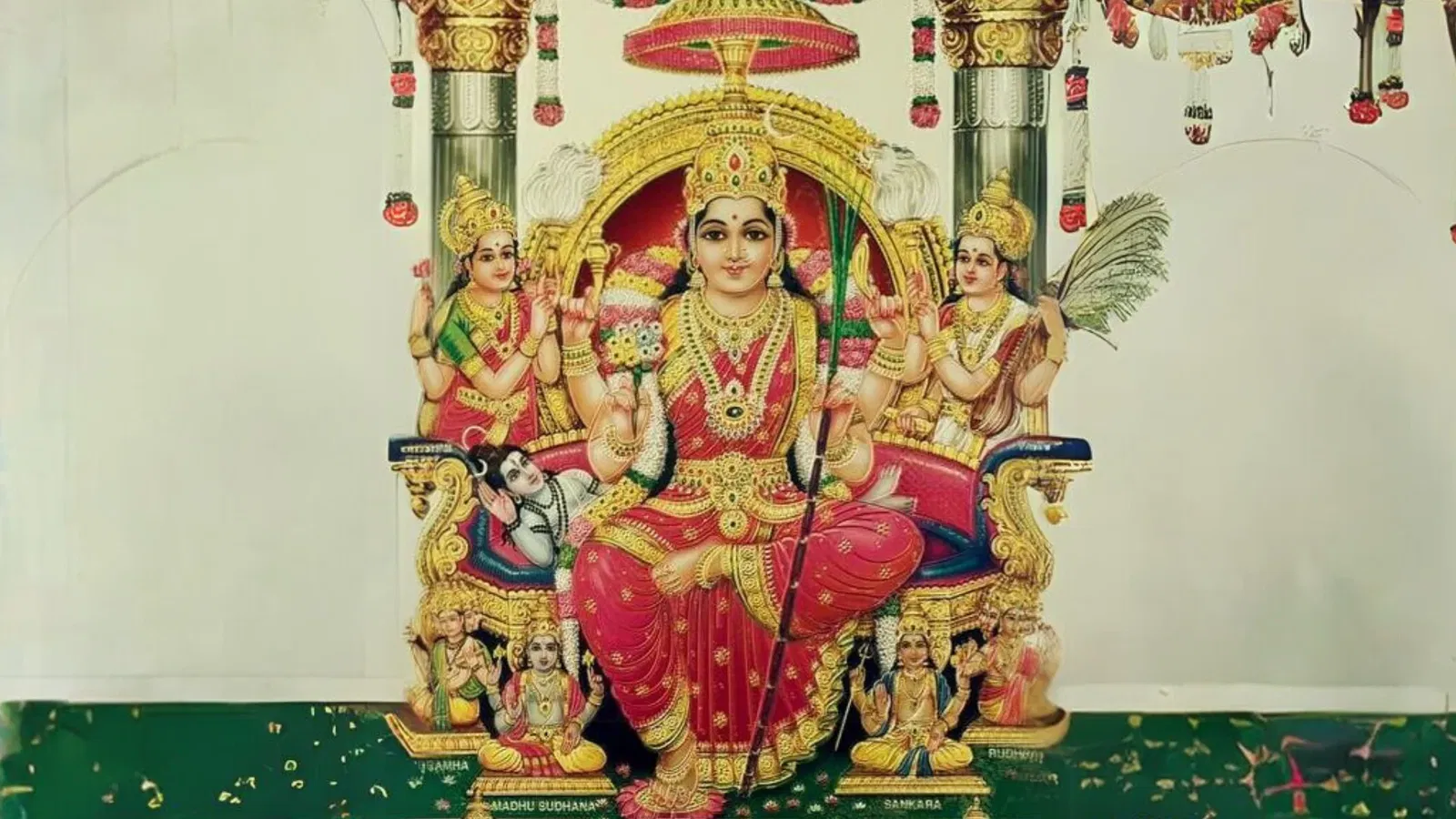
Introduction
Most people chant Lalitha Sahasranamam with devotion… yet feel the effect fade within minutes.
The reason is not lack of faith.
It is lack of energetic anchoring.
In Sri Vidya, sound (mantra) is never used without form (yantra).
This article shows you the safe, authentic, and powerful way to chant using Sri Yantra and Sri Lalitha Tripura Sundari Yantra so the effects stay, settle, and transform your inner world.

Instant recognition
| What devotee does | What actually happens | Missing link | What fixes it |
| Lights diya, chants daily | Mind calms briefly | Attention scatters after | Visual geometric anchor |
| Sincere devotion | Emotional upliftment | No containment of vibration | Energized Bhojpatra Yantra |
| Knows 1000 names | Intellectual reverence | No inner absorption | Bindu focus during chanting |
| Listens passively | Soothing effect | No transformation | Yantra-based sadhana |
From the Brahmanda Purana, Lord Hayagriva teaches Sage Agastya the Lalitha Sahasranama.
“Sri Chakra Raja Nilaya” — She resides in the Sri Chakra.
The Sahasranama is the verbal form.
The Sri Yantra is the geometric form.
Sri Yantra vs Shodashi Yantra

| Aspect | Sri Yantra | Sri Lalitha Tripura Sundari (Shodashi) Yantra |
| Geometry | 43 triangles, intense | Heart-lotus softness |
| Effect | Chakra alignment, prana flow | Emotional healing, devotion |
| Best for | Life structure, clarity, growth | Relationships, heart opening |
| Experience | Powerful, elevating | Gentle, nurturing |
| Ideal user | Distracted mind, scattered life | Emotional healing, family harmony |
Message SRI YANTRA KIT to get the right Yantra + Mala suggestion.
Additionally, if you are drawn to the profound protective geometries of the Mother, you will deeply resonate with our guide on the Khadgamala Stotram (Khadgamala Stotram: Meaning & Sri Chakra Protection.)
Are You Ready for Sri Yantra Sadhana?
Loading…
—
—
The Vidya Siddhi Precision (reference)
“A Yantra is not a symbol; it is a living altar of Shakti. If the geometry is off by even 1mm, the energy short-circuits.”
— Sri Damodar Dasji Maharaj
This is why Bhojpatra, natural inks, and hand-drawing are not tradition, but necessity.
The Sri Yantra At YantraChants.com

How to Practice
10-Minute Lalitha Sahasranama Yantra Practice (safe for all)
- Sit facing East. Place Yantra at eye level.
- Light ghee diya and incense.
- Gaze at the Bindu for 30 seconds.
- Begin chanting.
- Whenever mind wanders, return eyes to Bindu.
- Sit silently 2 minutes after.
- Offer gratitude.
“Bindu Tarpana Santushta” — She is pleased by offering to the Bindu.
A Note on Beeja Mantras
owerful beeja mantras require Guru initiation.
Sri Lalitha Sahasranama along with the Yantra is the safest complete path for householders.
Real Observed Benefits
- Emotional stability through the day
- Reduced overthinking
- Clearer decisions
- Harmonious home atmosphere
- Natural devotion without force
- Better sleep, calm nervous system
- Feeling Devi’s presence, not just chanting
To truly stabilize these subtle benefits, consistency is your greatest asset. Track your daily chanting, cultivate emotional stability, and lock in your discipline using our Mindfulness Awareness Plan below. Commit to a 7, 21, or 41-day cycle to firmly anchor the Devi’s presence in your daily routine and log your progress.
Mindfulness Awareness Plan
Choose your cycle length (7 / 21 / 41 days), pick disciplines, lock them for the full cycle, and journal daily to see exactly where you slip - and what strengthens you.
Why BhojaPatra is mandatory (YantraChants.com Trust Stack )
| Element | Why it matters |
| Bhojpatra | Natural high-capacity energy “battery” |
| Ashtagandha ink | Organic conductor of mantra vibration |
| Anar twig | Traditional precision stylus |
| Ramanandi guidance | Vidya-Siddhi correctness |
Suitable Tools for the Sri Yantra and Lalitha Sahasranama Chanting
| Mala | Why ideal here |
| Sphatika | Cools mind, enhances Devi mantra |
| Red Chandan | Aligns with Lalitha’s Shakti |
| Lotus Bead | Heart chakra activation |
| Tulsi | Devotional purity |
Selecting the right mala is just as crucial as the Yantra. If you are preparing your space and mind before Devi sadhana, invoking the remover of obstacles with the Om Gam Ganapataye Mantra (Om Gam Ganapataye: 11 Benefits and the Siddhi Vinayak Yantra)
or cultivating morning grace with the Karagre Vasate Lakshmi Mantra (Karagre Vasate Laxmi Mantra: Meaning & 7 Benefits) , provides an excellent energetic foundation.
How to Chant Sri Lalitha Sahasranamam with a Crystal Mala in front of Sri Yantra (10-Step Method)

Step 1: Prepare the Space — 1 minute
- Place the Sri Yantra / Sri Lalitha Tripura Sundari (Shodashi) Yantra on a clean altar at eye level.
- Sit on an āsana (mat/cloth) so the body and mind “enter worship mode.”
- Light a diya (ghee/sesame oil lamp) and, if available, a gentle incense.
Step 2: Face the Yantra and Set Your Posture — 1 minute
- Sit facing the Yantra with a straight spine (comfortable, not forced).
- Keep your water bottle/phone away—this is your “inner containment” time.
- Let the eyes rest on the Yantra for a few breaths, without rushing.
Step 3: Wash the Hands, Touch the Heart — 30 seconds
- Wash hands (or wipe) and lightly touch the center of the chest.
- Inwardly affirm: “May my chanting become sincere, steady, and pure.”
Step 4: Hold the Crystal Mala Correctly — 1 minute
- Hold the crystal mala in your right hand (or the hand you normally use for japa).
- Let it rest lightly—do not pull or stretch it.
- Keep the mala at heart level or slightly below, and avoid letting it touch the floor.
Step 5: Do a Gentle Devi Opening (Safe) — 2 minutes
- With the mala, chant a simple nama-mantra that is safe and devotional (no bīja).
- Move one bead per chant (108 times, or 27 if short on time):
- “Sri Lalitha Devyai Namah”
- Let the sound become calm and intimate—this “warms” the space for Sahasranamam.
Step 6: Offer to the Bindu — 30 seconds
- Look softly at the Bindu (center point) of the Sri Yantra.
- Offer your mind’s restlessness and your life’s burdens inwardly: “Mother, receive this.”
Step 7: Begin Sri Lalitha Sahasranamam — 10 to 20 minutes
- Start chanting the Sri Lalitha Sahasranamam steadily and clearly.
- Keep the eyes returning to the Yantra whenever the mind wanders.
- If you cannot chant aloud, chant softly or mentally—but stay fully present.
Step 8: Use the Crystal Mala as a Stability Anchor — during chanting
- After the one chant of Sri Lalitha Devyai Namah, start the Lalitha Sahsranama Chant.
- Once the Initial Dhyanam is completed, Chant one “Sri Lalitha Devyai Namah” and chant two lines of the Sahasranamam.
- After completing two lines move one bead to mark a couplet.
- Once you reach themeru bead, reverse the direction of the mala, but do not count over the Meru bead.
- Do not use the index finger.
Step 9: Closing Gratitude and Protection Seal — 1 to 2 minutes
- Sit quietly facing the Yantra.
- Speak one simple line (no force, no bargaining):
- “Sri Lalitha Devi, please let this worship settle into my home and my heart.”
- Feel the practice “stay” in the space, instead of immediately rushing back to routine.
Step 10: Respectful Completion — 1 minute
- Do namaskāram to the Yantra (with humility, not urgency).
- Touch the mala to the forehead once as a sign of reverence.
- Carry a calm vow into the day: “Today, I will protect the purity of this inner mood.”
Frequently Asked Questions on Sri Lalitha Sahasranamam and the Sri Yantra
Q1. What is Sri Lalitha Sahasranamam?
A. Sri Lalitha Sahasranamam is a sacred hymn of 1000 names of Sri Lalitha Devi, revered across Shakta and Sri Vidya traditions as a living doorway into Devi’s presence, wisdom, and inner transformation.
Q2. Where is Sri Lalitha Sahasranamam found in scripture?
A. It is found in the Brahmanda Purana, where Sri Hayagriva Lord recites the thousand names to Sage Agastya, revealing deep layers of Vedantic, Tantric, and Yogic truth held inside each name.
Q3. Why are the 1000 names called “gateways” and not just chanting?
A. Because each name functions like a spiritual key, unlocking a precise layer of Devi’s nature, so recitation becomes a map of inner awakening, not merely a verbal prayer.
Q4. What does “Sri Chakra Raja Nilaya” mean in practice?
A. It points to Sri Lalitha Devi as the one who resides in the Sri Chakra (Sri Yantra), meaning sacred geometry is not “symbolic only”, it is a living seat where Devi’s presence is invoked and stabilized.
Q5. What does “Anahathabja Nilaya” indicate for a sadhaka?
A. It indicates Devi’s presence in the Anahata Chakra (heart center), suggesting that regular Sahasranamam practice naturally supports heart-softening, emotional healing, and devotional sweetness.
Q6. What is the meaning of “Chidagni Kunda Sambhuta”?
A. It reveals Devi as emerging from the “fire of consciousness,” teaching that real transformation comes from awakened awareness, not from outer display or mechanical routine.
To further empower your personal altar and overall Sadhana, explore our other lineage-based resources: harness spiritual magnetism with the Kleem Mantra(Kleem Mantra: Meaning, Benefits & Attraction Secrets) , invoke divine protection through the Authentic Kali Yantra (Authentic Kali Yantra: 5 Benefits for Divine Protection) or the Varaha Mantra and Yantra (Varaha Yantra & Mantra: The Divine Anchor for Protection) , awaken focused martial discipline with the Murugan Mantra (Murugan Mantra & Yantra: Secrets, Benefits & Vidhi), cultivate radiant life-force via Surya Arghya (Surya Arghya Vidhi: 41-Day Solar Success Guide), or immerse yourself in devotion with the Om Kleem Krishnaya Namah Mantra (Om Kleem Krishnaya Namah: Power, Yantra & Grace).
Conclusion
When sound meets form, chanting becomes communion.
Your home becomes Sri Pura.
Your heart becomes the throne of Devi.
For authentic Bhojpatra Sri Yantra, Sri Lalitha Tripura Sundari Yantra, and malas prepared with sattvik rituals — WhatsApp YantraChants.com.

Vani Devi Dasi

Rohini Devi Dasi